

‘Making India “Self-Reliant” Is the only way to ensure that the 21st Century belongs to India.’
– PM Modi
The recent deliberations of the Army’s senior leadership and the emphasis on self-reliance mark a major concern for India’s future defence trajectory. What was once framed as an economic aspiration has now become a strategic necessity. Self-reliance in defence is no longer a matter of policy preference. It has become an operational imperative shaped by the hard realities of contemporary conflict.
The global security environment is undergoing a structural shift. Ongoing conflicts in Europe and West Asia have shown that wars today are not confined to geography. They disrupt energy flows, fracture supply chains, and weaponise interdependence. Nations that rely on external suppliers for critical military capabilities find themselves exposed not only to adversaries but also to the unpredictability of partners.
In this context, India’s military leadership has emphasised the need to strengthen indigenous capabilities across the defence spectrum. The focus is not limited to acquiring platforms but extends to building a resilient ecosystem capable of sustaining military operations amid prolonged uncertainty.
A key lesson from recent conflicts is the fragility of global supply chains. Even technologically advanced nations have faced shortages of ammunition, spares, and critical components when supply lines were disrupted. For India, which faces persistent security challenges on multiple fronts, such vulnerabilities pose a significant risk. Military preparedness cannot be contingent on external stability.
The emphasis on self-reliance is therefore grounded in the fundamental principle of strategic autonomy. A nation must retain the ability to equip, sustain, and adapt its armed forces without being constrained by external dependencies. This does not imply disengaging from global partnerships. Rather, it calls for a recalibration in which external collaboration supplements rather than replaces domestic capability.
The evolving character of warfare reinforces this imperative. Technology, data, and the speed of decision-making increasingly shape modern conflicts. The battlefield is no longer defined solely by conventional platforms but by the integration of unmanned systems, cyber capabilities, artificial intelligence, and electronic warfare.
Recent operational experiences have underscored the growing centrality of unmanned aerial systems and the need for effective countermeasures. Drones are no longer auxiliary tools. They are central to surveillance, targeting, and precision engagement. Equally, the ability to detect and neutralise hostile drones has become a critical component of force protection.
These capabilities require rapid innovation cycles and close alignment among doctrine, technology, and operational use. Such integration cannot be achieved solely through imports. It requires a domestic ecosystem capable of continuous adaptation and innovation. Legacy procurement must give way to smart, time-sensitive procurement that creates a separate fast-track path with assured financial support for fast-moving, disruptive technology systems. Further, the delegation of power to the service Vice Chiefs needs to be enhanced, moving from emergency procurement to technology induction.
The call for sovereign technological capabilities, particularly in artificial intelligence and data-centric warfare, reflects a deeper concern. In an era when algorithms shape operational outcomes, reliance on external technologies creates strategic vulnerabilities that are difficult to mitigate. Control over data, software, and decision-support systems is emerging as a core element of national power. The need is to balance kinetic with non-kinetic capabilities commensurate with the multidomain warfare doctrine.
Despite significant progress in recent years, India’s defence industrial base continues to face structural challenges. Defence production has expanded, and exports have grown in both scale and geographic reach. However, the gap between potential and performance remains evident. India’s import dependencies remain a concern.
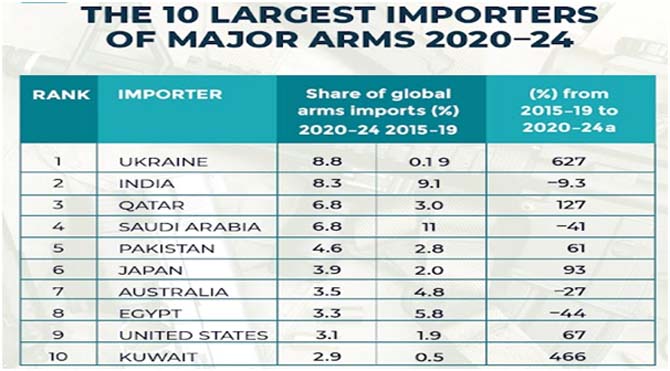
One key constraint is the limited depth of indigenous capability. While domestic manufacturing has increased, critical technologies and components are still often sourced externally. This creates a layered dependency that can be exposed during crises. In particular, the identification of indigenous content and the mapping of technology remain grey areas.
The institutional structure of the defence industry also warrants attention. Public sector enterprises retain a dominant position, while private industry, particularly smaller firms and startups, faces barriers to funding, access to technology, and market predictability. Innovation thrives in competitive, flexible environments, and the current system has yet to enable it to mature.
Addressing these challenges requires a comprehensive and sustained effort. Policy reforms must be paired with consistent implementation. Industry needs long-term visibility into demand to justify investments in capacity and research. Risk-sharing mechanisms between the government and industry can encourage participation in high-technology programmes that entail significant uncertainty. The intermediary approach or layered bureaucracy for fast-moving technologies must be abandoned in favour of direct military-civil fusion.
Investment in research and development remains a critical area. India’s expenditure in this domain, particularly in defence, is modest compared with that of leading military powers. Increasing this investment is not merely a question of budget allocation. It is essential for building technological depth and reducing dependence on external sources.
Equally important is strengthening the linkages among the armed forces, industry, and research institutions. Defence innovation cannot be pursued in isolation. It requires continuous interaction among users, developers, and policymakers to ensure that technological solutions align with operational requirements.
Supply chain resilience must also be treated as a strategic mission. This involves not only expanding domestic manufacturing capacity but also identifying critical dependencies and developing alternatives. In areas where imports remain necessary, diversifying sources and strategic stockpiling can mitigate risks.
The broader objective is to transition from a model of dependence to one of credible deterrence. A self-reliant defence ecosystem enhances not only military capability but also strategic signalling. It signals the capacity to sustain operations independently and reduces the leverage that external actors may seek to exert.
At the same time, self-reliance must be understood pragmatically. It does not imply complete autarky, nor is such a goal feasible in a globalised technological environment. The emphasis should be on achieving control over critical technologies and on ensuring that external dependencies do not compromise operational readiness.
The responsibility for achieving this transformation extends beyond the military establishment. It requires a whole-of-nation approach, with coordinated action by government, industry, academia, and the financial sector. Defence preparedness is intrinsically linked to industrial capability, technological innovation, and economic resilience.
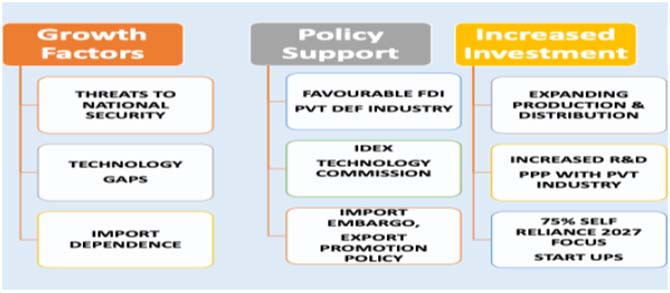
India has several advantages in this regard. Its large domestic market, growing technological base, and expanding industrial capacity provide a strong foundation. The challenge is to harness these strengths in a coherent and sustained manner.
Several areas require a practical reassessment to ensure effective progress in the defence sector. Budgetary support should gradually rise to around 2–2.5% of GDP, while efficient utilisation must remain a priority. Establishing a non-lapsable capital fund and strengthening domestic procurement provisions can improve funding continuity. At the same time, a balanced risk- and gain-sharing model between the government and industry is essential to encourage private investment, especially in large-scale projects and R&D.
Indigenous research and development should be the cornerstone, with increased allocation and emphasis on critical technologies such as electronics, metallurgy, semiconductor chips and systems design. Indigenisation must go beyond assembly and ensure high domestic value, supported by a transparent mechanism for measuring local content. Import substitution policies should also include a clear roadmap to reduce dependence over time.
A collaborative ecosystem comprising MSMEs, startups, and private players is crucial and supported by technology transfer and policy stability. Business models must ensure predictable orders and long-term viability. Institutionalising technology mapping, pricing indexing, and transparent selection processes will enhance clarity.
Self-reliance in defence is no longer a distant objective. It is a strategic national mission that will shape India’s ability to secure its interests in an increasingly uncertain world. The decisions taken today will determine not only the effectiveness of the armed forces but also the degree of autonomy India can exercise on the global stage. In matters of national security, there is little room for delay. The pursuit of defence self-reliance must therefore proceed with urgency, clarity, an innovative approach, and sustained commitment. Much is being done at the policy level, but it must yield outcomes at the warfighter end, with the desired technologies, within a defined timeframe. It is here that India needs to walk the talk.
ABOUT THE AUTHOR
 Lieutenant General A B Shivane, is the former Strike Corps Commander and Director General of Mechanised Forces. As a scholar warrior, he has authored over 200 publications on national security and matters defence, besides four books and is an internationally renowned keynote speaker. The General was a Consultant to the Ministry of Defence (Ordnance Factory Board) post-superannuation. He was the Distinguished Fellow and held COAS Chair of Excellence at the Centre for Land Warfare Studies 2021 2022. He is also the Senior Advisor Board Member to several organisations and Think Tanks.