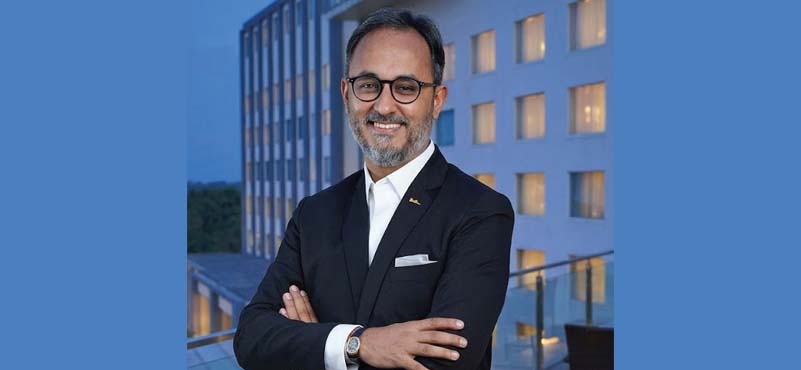
With Radisson Hotels, growth is not being measured only in numbers. Even then, the group is looking at 500 properties in the next few years. How does the challenge stack up, we check out in a conversation with Nikhil Sharma, Managing Director and Area Senior VP and COO for South Asia. Following are some highlights.
How is the present phase of development at Radisson Hotels? Like the speed, the execution, and the results, the journey?
Nikhil Sharma: As an organization we are on a treadmill without a stop button.
That’s a good one. So, how has been the business this year, so far?
Nikhil Sharma: This year, if we look at quarter on quarter, let me just talk about West Asia first and the impact of West Asia. Our portfolio is evenly split between metros and tier 2, tier 3. So tier 2, tier 3, tier 4 haven’t seen any impact per se of West Asia. But we saw slowdown in Bangalore, in Hyderabad. Delhi and Mumbai last month continued at the same pace and continued to grow. The rest part of the country has grown, same quarter, which is a good number. But yes, I mean, let’s see what happens in the next few days given geopolitics that’s happening globally.
Can Bangalore be more affected from West Asia or could be some other factors?
Nikhil Sharma: Personally, I would have thought Delhi, Bombay will get more affected, given the number of Emirates and Qatar flights coming into both these cities. But they didn’t see any slowdown. So, the downslide in Bangalore could be IT and US, driven? Both cities are IT cities, Hyderabad, like that. Right.
Understood. That makes good sense. But how much of your business is affected internationally?
Nikhil Sharma: Internationally?
No, like the component of your Delhi-Bombay business or Delhi business, how much of it comes from overseas?
 Nikhil Sharma: Not that much. I mean, impact would be less than 5% for Delhi-Bombay. But we saw 20% plus impact in Hyderabad and Bangalore.
Coming back to the larger picture, where are you seeing Radisson today as a chain? I mean you were the first foreign company to come to India, the first foreign brand that I, if I am right about it that is. So today where do you see Radisson as a group across the country?
Nikhil Sharma: Two things. Firstly, Intercon and Hilton have been here far longer than Radisson. Mr. Kachru actually got Radisson the same year as Marriott opened in India. So, while it feels like we have been here forever, we’ve only been here for 28 years now. And Hilton and Intercon internationally have been here for… You’d remember Taj as Inter-Con and The Oberoi.
Right. Sure.
Nikhil Sharma: So, they’ve been here for a long time.
Yes, yes. I stand corrected.
Nikhil Sharma: I think kudos to Mr. Kachru for building the brand and building some iconic hotels to start with. See the Mahipalpur Hotel, for example. That’s where it all started. Or MBD Noida or the GRT Hotel in Chennai. And the foundation was strong. Today, we have 223 hotels, 114 locations. On course to become a 500 hotel company. And we are very proud of that. What does it mean for RHG? We will be the second largest country brands that sell the most for us. And in upscale and upper upscale, if you were to look at just the brands, for the last two years, actually we have been the highest selling brand from that perspective.
So, these 500, are planned by when?
Nikhil Sharma: 2030. Not too far from now.
You touched this very interesting aspect. This increasing dissemination across hotel companies to have various brands. So, you would have a brand strategy evolving like you have a Radisson Collection, you have a so many other new brands coming up. When you look at 500, do you see some brands playing out more successfully than others, or do you see the mix changing?
Nikhil Sharma: So let me just give you the brand statements again and we’ll talk about which brands are playing out how and I’ll compare it to a domestic player and so on and so forth as well this is for reference perspective. So, we have a soft brand now which is called Radisson Individuals. This is for hotels that are fast conversions, or you know boutique hotels. They can become Radisson individuals which is plug and play. They don’t have to do a property improvement plan per se. And they get into the network. Then, at the mid scale we have two products which is Park Inn & Suites and Park Inn. At the upscale we have Radisson. We also have a lifestyle brand which plays between Blue and Radisson, which is Red by Radisson. Which is a lifestyle brand.
Right.
Nikhil Sharma: Of course Radisson, Radisson Blue, which is our upscale, upper upscale. And in the luxury part, we started the Radisson Collection.
Right.
Nikhil Sharma: Right, so of course Radisson Collections will be coming up, but fewer. We won’t profilate it or grow it as much as other brands. If you ask me, in the upscale, upper upscale, I see Radisson, Red and Blue at the same pace that they are at the moment, which is 80-95% of our portfolio. And in the mid-scale, I see some Park Inn and Park Inn & Suites, depending on the partners, growing at the mid-scale segment.
But, you know, personally, I believe India is more, moving more towards premiumization, if I can say that. Which is why I see, while all of us are running the mid-scales, I think you will see growth in mid-scale and upscale more and more. And of course luxury will take its own sweet spot. But sprinkled, really sprinkled.
And when you are talking about these numbers, every company has its own policy. But I think chasing these numbers, some of the chains appear to be picking up brands randomly. They tend to dilute their original play for which they were identified with?
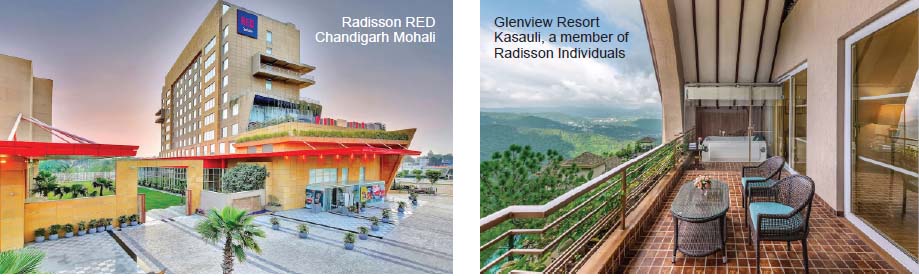
Nikhil Sharma: So, I can speak for Radisson because if you see our brandscape it is all Radisson or By Radisson. We have not created new brands and our philosophy is very simple.
Right
Nikhil Sharma: Yes, we’ve continued to stay in the same brand scale. I can’t answer this for other brands.
No, okay so how do you, so where do you think is the differentiator for an investor to come to Radisson? I mean what’s a typical kind of a sales pitch you’d say, you know that big differentiator between Radisson and so many of the other brands, Indian or international. Is there any defining characteristic which makes Radisson different?
Nikhil Sharma: I would say three things. System contribution, and we don’t take OTAs into our system contribution. But that clearly distinguishes us on that piece. Operational and commercial efficiencies, I mean, at a portfolio level, I’m running at a 50% GOP, which for an upscale, upper upscale, is unheard of. Whether I get it or not, I mean, it’s a different matter, but operationally I want us to be, let’s just say, efficient, cleaner. And I don’t mean, let me actually take a step back. I am not saying we want to cut manpower. But I am saying because we have the opportunity to make people grow, the middle management is where we have a lot of manpower which I want to grow into larger roles.
Understood.
Nikhil Sharma: System contribution of course loyalty every time speaks about loyalty, but you need an India specific loyalty program because at the end of the day, 85 to 90 percent of traffic in the country is domestic, right, so your loyalty program needs to cater to Indians. You may have millions of loyalty members in the US and lots of teams in the US. But as an Indian, how does it help me if I don’t have a HDFC or ICICI card? I’m just using these names for reference purposes only.
I’m keen to check from an overall industry perspective, from an all-India perspective. There are so many of these small players around, who are unbranded, you know like 2 star, 3 star and would need some professional guidance and help, professional management techniques; how to grow the business, how to become part of a larger network, booking network, marketing network, getting access to new technologies. So, I am also looking for some entry level brand which is nursed and nurtured by somebody like Radisson across the country which gives you another 500 hotels perhaps in the next 10 years. Any possibility like that?
Nikhil Sharma: We started mid-scale not in the economy segment as an organization. So actually, Park Inn was invented for India in the mid-scale segment. And there’s a lot of work that’s gone into that. So, let me just say, three-star segment is where we would start. And Park Inn & Suites or Radisson Individuals are brands that are there to cater to that market. But if you are asking how we can become another Treebo or OYO, or some such, that to me is most unlikely.
Take the case of a hotel like Radisson Individual in Kasauli, one that I get to visit often. It is a very fine hotel, very functional hotel, very good hotel. I was wondering how much of a Radisson, what you call, flavour should I expect from there? Being an Individual, a Radisson individual, how much is it Radisson?
Nikhil Sharma: Well, our, okay so, our five pillars on service remain the same whether it’s an Individual or a Park Inn & Suites. But other than that, the product, the property per se, will have its own individuality, if I can say that. From that perspective, I mean, we monitor all the given scores in the system. All that will be similar.
Taking the next subject of concern, what are you seeing, apart from West Asia or any war prospects, constraints to the larger growth of the industry?
 Nikhil Sharma: Constraints to growth?
Constraints to growth. You visualize, you know, like typically we talk about manpower and other issues. What do you see?
Nikhil Sharma: Think about the GST input for hotels below 7,500. So basically some mid-scale hotels and below where the GST input credit does not come back to us?
Second, I mean, I think the industry needs to do more on talent. I mean, we all speak about talent crunch. But I don’t see too many players. So, in our case, what we are doing is, I’m diverting most of our CSR funds, not all of it. Most of our CSR funds to THSC and JobPlus. So we’ve trained 600 kids, 1000 kids actually as of I think April or May, would have been trained by us in the last year and a half.
Trained at what levels
Nikhil Sharma: This is basic. This is entry level and obviously because it’s a part of our CSR, they will not be absorbed by us. They are there for the industry to be absorbed.
Understood.
Nikhil Sharma: So yeah, I mean I think if all of us just start, yes, we are working with IHMs, yes, all of us are working on this front, but I think the real issue is skilling at the base level and if we can supplement that support it would really become life-changing for our country. We are the second largest employer in the country, after agriculture, so the base level needs skilling. It’s not hotel management schools, in my view, that we need more; we need more skilling centers at the baseline.
High points of development that you see, new cities, I remember you were amongst the first I think, again I could be wrong, but at least a prominent player in Indore, then Gorakhpur, and now you have a hotel in Kumbhalgarh. So, these are little tucked away destinations. So, what kind of further penetration are you seeing across the country? And how are these playing, giving you back so to say to your network?
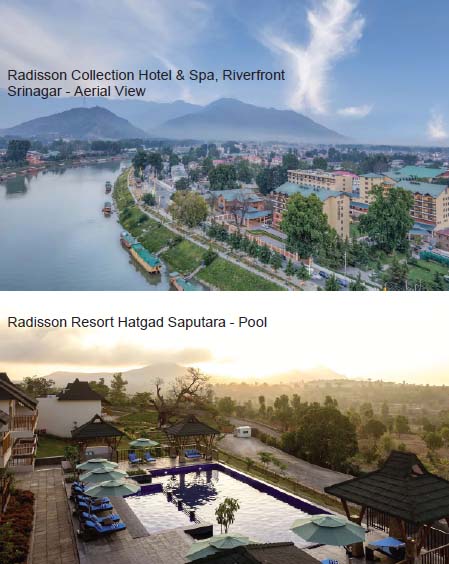
Nikhil Sharma: I think, the onus is also on the brands to be the pioneers, right? I mean, last year, we opened a hotel in Saputara. I had no idea where Saputara is. And I thought I knew India. And I’ve really well travelled from that perspective domestically. But it’s a market that is two hours away from Surat, it’s in Maharashtra. There’s alcohol allowed. It’s a vegetarian hotel. That we’ve opened because 95% of the clientele is Gujarati that’s coming there.
Understood.
Nikhil Sharma: But yeah, I mean, we are just at the cusp, right? Look at it, India has 200,000 rooms today by various reports. China has 2.2 million rooms. Like just as an example, I’m not saying we have to compete with China. But just the same population as a average, if you were to calculate, just think how many rooms we will absorb as a country. I think we are on the cusp. I mean, if we are opening hotels in locations where we are the first branded players as you said. The future is bright, for sure.
And the most prominent group in Kashmir?
Nikhil Sharma: In the valley, yes.
In the valley. And how is Kashmir playing out as a market?
Nikhil Sharma: It’s picking up now. Srinagar till January was the only market that was doing 30-50% occupancy depending on the size of the rooms and inventory. Beyond Srinagar, there was not so much take. Now, in the summer season, we are expecting, because the business on books is looking far better than what it was. We should see much better occupancies in the summers. There is good pick up on the books, very good pick up And of course, Amarnath Yatra starts so traffic for Amarnath Yatra also has an effect.
ABOUT THE AUTHOR
 Navin Berry, Editor, CS Conversations, over five decades has edited publications like CityScan, India Debates and Travel Trends Today. He is the founder of SATTE, India’s first inbound tourism mart, biggest in Asia.
Blogs at: https://www.csconversations.in/nb-blogs