Introduction
Technologies such as drones, hypersonic ammunition and cyber warfare have been at the forefront of the ongoing conflicts. This has led to a vision that modern warfare can take place at a stand-off distance and even be managed virtually. Operation Epic Fury for example has seen a remarkable display of such warfare by deep precision strikes, naval control, and rapid suppression of air defence capabilities.
But the campaign demonstrates something more important about modern war: Even in a fight with calibrated use of violence centered on airpower and naval dominance, the joint force cannot succeed without land power. The roles of air power and precision weapons have shifted, but the reality has not. From the operation’s beginning, Army capabilities were not additive or symbolic. They were essential to protecting the force, enabling joint operations, and delivering effects that air and naval power alone could not achieve.
The war has also proved that without boots on ground, power by remote control can only go so far. Robots, drones, and missiles notwithstanding. Hence, geography remains decisive and the possession of territories is vital for winning.
Precision bombs and remote wars lead to a different understanding of warfare. co-relating the US-Israel- Iran conflict in the Indian context is not prudent, since Iran does not share a border with either Israel or the US.
Lessons for Indian Warfighting
While geographic barriers remain a reality which India cannot ignore. Being surrounded with an unresolved border with China in the form of the Line of Actual Control covering 3,488 km and also the Line of Control with Pakistan apart from the International Border on our Western front, hence Indian wars cannot be conducted remotely alone. They can start by using remotely controlled weapon systems, but for any meaningful result the soldier will have to be deployed on the ground. The ownership of the territory will continue to define the sovereignty of a nation and ensure political stability.
The era of voluntarily yielding territories is today consigned to history. The loss of even an inch of territory is a matter of pain in the psyche of the country.
The advantage of remote war is its speed, reach and reduced risk. Thanks to precision weapons, the captivating image is of victory with ground forces being at the periphery of conflict as they are manpower intensive and expensive. That idea may be appealing but events prove otherwise.
During Operation Epic Fury, the Air Forces of the US and Israel attacked Iran, with more than 900 air strikes within 12 hours and successfully disrupted Iranian missile attacks. Nevertheless, Iran did not concede. The Strait of Hormuz which has far greater strategic value than even their nuclear programme, and even greater than their proxies, remains blocked, oil prices have risen and the threat of escalation remains. What mattered in this case is not the efficacy of the air strike, but the threat of an American ground invasion.
The point is that air power is used to weaken the opponent, but it can neither capture nor conquer territories. The role of the Navy is no less constrained. Contemporary naval forces operate at extended ranges in order to avoid the impact of the A2/AD systems on land and missiles. Despite technical achievements, littoral zones continue to be contested and land-based denial capabilities become even more effective.
Air power and the Navy operate as enablers of war; ground forces are responsible for seizing and holding territory and imposing national will.
Operation Epic Fury showed that success in modern war demands coordination and capabilities across all domains. Air and Naval forces struck thousands of targets overall, yet the Army’s contributions in the form of air and missile defence, long-range fires, sensor networks, ground forces, and rapid-response posture proved essential for force protection, access, and deep effects.
War is not only destruction of the enemy’s war waging potential. Sovereignty is still exercised territorially and political authority is grounded. Hence conflicts that begin with long distance strikes need control of the terrain in their decisive phases. The ability to seize and hold key terrain that can directly threaten an enemy’s centre of gravity is the key. Even the most modern war depends on control, access and political aims rooted on ground. The fact is that other military forces do not possess coercive finality. The truth is that victory needs to be felt by the defeated party, as every Indian war has demonstrated.
Therefore, in the Indian context, one must understand the psyche of the adversary(s), their capability and their ultimate aim. While all this is extremely important, understanding geography is equally important. Geography must be used as an advantage, and ground forces kitted accordingly. Relying only on stand-off weapon systems in the Indian context would be a strategic blunder.
Drones
A case in point is ‘Drones’, the current ‘flavour’ integrates readily into combined arms teams, but they are no substitute for armour’s shock action, the infantry’s ability to hold ground, engineers’ persistent mobility and counter-mobility functions, or artillery’s sustained ability to suppress. Drones no doubt have their relevance as robust force multipliers as additions, not replacements.
Ukraine’s innovative use of drones has garnered considerable worldwide attention. But, for all their successes, drones have produced limited strategic effect for either side. Rather than restoring manoeuvre in pursuit of achieving operational and strategic objectives, widespread drone employment by both sides has done the opposite. It has contributed to a static, attritional battlefield reminiscent of the 1916 stalemate.
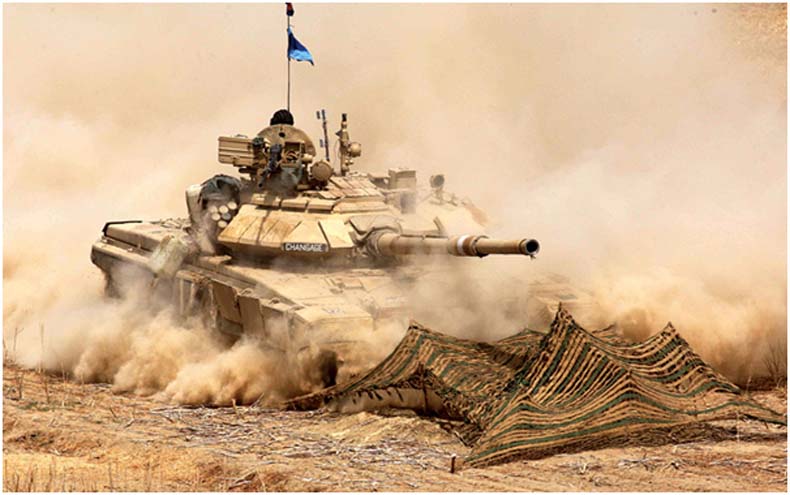
History suggests that such stalemates are broken not by aerial bombardment manned or unmanned. Instead, breakthroughs have been achieved by the rapid deployment of combat power by restoring mobility through armoured forces. The sudden appearance of T-90 tanks on the Kailash Range post the Galwan episode is a case in point.
The fact is that Drones cannot seize, control, or retain terrain. Their full potential lies in combined arms integration, to maximize their effect, as well as to counter their abilities to restore battlefield mobility. Skill, aggression, and superior tactics will always overcome technology. The truth is that a single capability or technology cannot be decisive in delivering an enduring advantage. Technology alone cannot determine outcomes.
The question that needs to be answered is whether technological innovation has overcome the friction of physical terrain and the need for territorial power, thereby signalling a decline in usefulness of land power?
The Geography of War
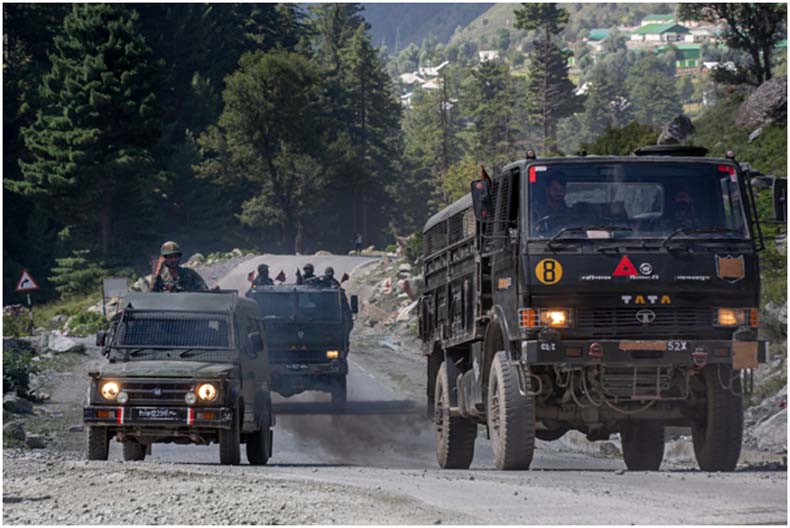
India faces a specific security environment, depending on geography. Adversaries of India are able to use tanks and soldiers near Indian borders. Even in the Galwan Valley clash in June 2020, it turned out that issues in high altitudes could be solved only by human soldiers and not unmanned systems. No missile attack took place because of controlling escalation and operations were conducted by ground troops. From these facts, it follows that the presence of human element in terrain becomes crucial when the definition of sovereignty is based on the human presence in territory.
Even though standoff weapons such as missiles and drones are vital for India, infantry is irreplaceable for some missions, in particular, the ones taking place at high altitudes. Ground troops, are capable of discrimination, isolation of danger and bringing peace through human judgment, which is not achievable through contemporary algorithms.
Population-centric sub-conventional wars require the presence of human soldiers. An infantry battalion can switch to sub-conventional warfare and decentralised command when necessary. There is nothing special in the field formation that makes it incapable of fighting against the enemy in difficult and varied circumstances, as opposed to ships at seas and squadrons in air.
In the Indian context forces on ground are necessary to hold ground and to deter, deny, destroy and defeat an adversary. Besides, representing the spirit and Will of the nation.
Why land Forces Matter
Multi domain operations (MDO), which is what is being witnessed need a coherent theory of victory. While MDO promises to deliver battlefield dominance through the integration of capabilities across land, sea, air, cyber, and space, it is unable to translate its gains into strategic success. Without a clear theory linking tactical actions to strategic outcomes, technological optimism cannot override operational reality.
Losing and gaining territories significantly affects the national morale and legitimacy. Therefore, territorial changes remain the currency of victory, which means that ground forces protect the survival of the state.
Armies create faits accompli. National Will of a State is determined by the man on the ground, which was demonstrated in 1971 by the formal surrender that took place among international witnesses.
Land invasion of a state represents the greatest threat to it. Armies are the buffer between the intention of a hostile country and its capitulation. In the Indian context, geography, topography and threat landscape create a number of land-centric dilemmas.
Next is the human dimension of warfare, that is leadership, courage, the ability to operate amid uncertainty due to the friction of war and sustain risk. The enduring qualities of determination, resolve, discipline and commitment. The qualities of a force that need to be preserved and not eroded.
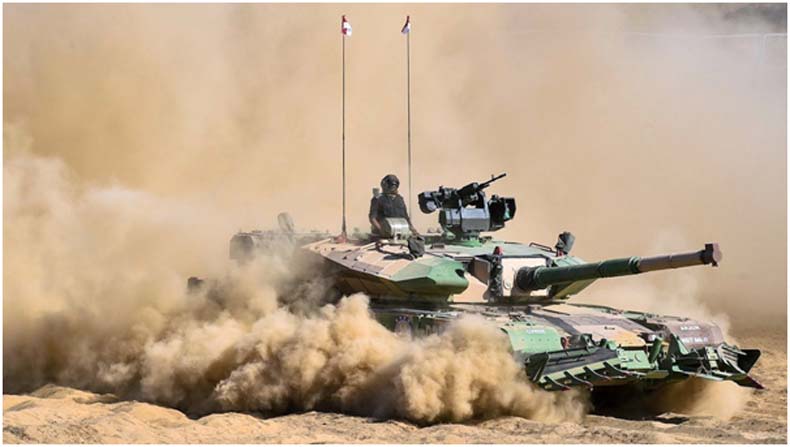
Indian doctrine cannot succumb to the myth of the efficiency of stand-off warfare. Missiles, loitering munitions and drones represent important standoff capacities and deserve proactive investments. Formation of integrated battle groups that include infantry, tanks, artillery, engineers and drones is the example of a multi-domain formation. Yet, one should focus on training, equipping and logistics of these formations. Experience of West Asia proves that while air and missile power can influence the operation environment, they fail to capture and conquer territory and force a resolute opponent to make political concessions.
Conclusion
The operational environment is undeniably changing and becoming more and more complex, requiring military capabilities and capacities to transform and adapt to new realities of contemporary warfare.
Operation Epic Fury reflects years of work on multidomain concepts and showed joint coordination in practice. It reinforced a central reality of modern war. No campaign succeeds without integrating capabilities across domains. Land power provides capabilities that air and naval forces cannot. Even in an air, or maritime-dominant fight, it delivers capacity, protection, reach, and coercive pressure that the other domains cannot replicate alone.
While future Indian wars may begin with informational and aerial warfare, yet they would terminate with land troops fighting on the ground. India therefore needs to guarantee its ability to project, sustain and conduct land combat at any price.
Historic experience reveals that only through land wars can victory be ensured. For India, the task is to recognise this lesson and ensure that land forces remain a key instrument for conducting wars prescribed by geography. The truth is that even as warfare changes, land power remains vital. Nothing can substitute for the soldier who holds a line.
We cannot take the US-Iran war template and superimpose it on the Indian sub-continent. Every region has its own peculiarities, its own geography, its own history, its own reasoning for going to battle. A logical option for India is to build up the capability of its Defence Forces to meet that challenge, and not prepare to fight somebody else’s war in our neighbourhood.
ABOUT THE AUTHOR
 Maj Gen VK Singh, VSM was commissioned into The Scinde Horse in Dec 1983. The officer has commanded an Independent Recce Sqn in the desert sector, and has the distinction of being the first Armoured Corps Officer to command an Assam Rifles Battalion in Counter Insurgency Operations in Manipur and Nagaland, as well as the first General Cadre Officer to command a Strategic Forces Brigade. He then commanded 12 Infantry Division (RAPID) in Western Sector. The General is a fourth generation army officer.
 Major General Jagatbir Singh was commissioned into 18 Cavalry in December 1981. During his 38 years of service in the Army he has held various command, staff and instructional appointments and served in varied terrains in the country. He has served in a United Nations Peace Keeping Mission as a Military Observer in Iraq and Kuwait. He has been an instructor to Indian Military Academy and the Defence Services Staff College, Wellington. He is a prolific writer in defence & national security and adept at public speaking.