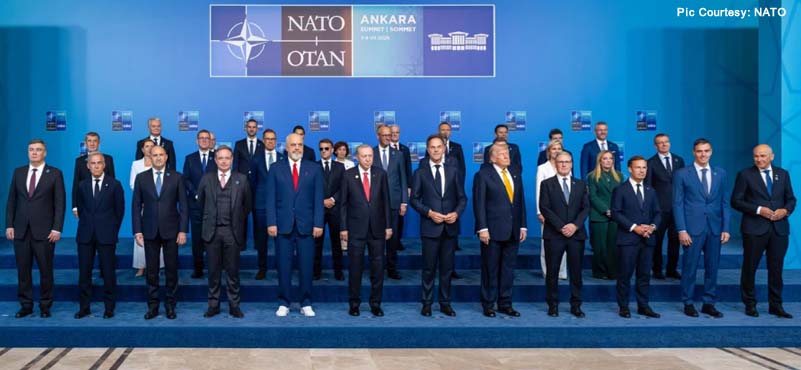
The 36th NATO summit, which concluded in Ankara this week, will be remembered less for its declarations than for the contradiction it exposed. Leaders arrived pledging accelerated progress towards spending five per cent of GDP on defence and security by 2035, announced over fifty billion euros in fresh procurement, launched a forty-billion-dollar programme to expand uncrewed systems, and reaffirmed seventy billion euros in support for Ukraine over the coming year. By any conventional measure of alliance vitality, NATO looks formidable. Yet the same summit unfolded amid open friction between Washington and several European capitals, a six-month review of the American troop presence on the continent, and a host nation more interested in showcasing its own defence industry than in reinforcing collective purpose. An alliance can expand its arsenal and narrow its political coherence in the same fortnight. That is precisely what is happening, and it deserves closer analytical attention than the celebratory language of summit communiqués usually allows.
The temptation is to read this as a familiar cycle. NATO has weathered the end of the Cold War, the Balkan interventions, divisions over Iraq, and years of American frustration over burden sharing. Each time, critics who predicted its dissolution were proven wrong. That history is real, but it should not be mistaken for a guarantee. Institutions rarely collapse because they lose a battle. They erode as the political consensus that gives their military power meaning gradually thins, until the alliance retains its formations but loses the shared conviction that made deterrence credible in the first place. Deterrence is not an engineering problem solved by spending targets. It is a psychological one, resting on an adversary’s confidence that every member will honour its commitment, regardless of cost. That confidence is harder to sustain in 2026 than it was a decade ago, not because Europe’s arsenals are weaker, but because the political signals surrounding them are more mixed.
Three structural pressures explain this. The first is the widening gap between America’s stated expectations and Europe’s actual capacity to substitute for the security guarantees it has relied on for seventy years. Washington’s attention is shifting towards the Indo-Pacific and its long-term contest with China, and successive administrations, regardless of party, have made clear that European security cannot remain a permanently subsidised arrangement. Europe has responded with genuine increases in expenditure, yet its command networks, satellite architecture, strategic airlift, and nuclear guarantee remain substantially American. Raising the spending ratio is a fiscal decision. Rebuilding sovereign capability in intelligence, space, and strategic lift is an industrial and institutional undertaking that will not be completed on an electoral timeline, and the gap between the two is where strategic vulnerability actually lives.
The second pressure is the alliance’s expanding mandate. NATO was built to deter a single, identifiable military threat. It now manages cyber defence, space security, critical infrastructure resilience, artificial intelligence adoption, energy security, and information warfare, alongside its original conventional mission. Each addition is defensible in isolation. Together, they risk a form of strategic diffusion in which an institution accumulates responsibility faster than it builds the corresponding capability to discharge it. This pattern has weakened larger, better-resourced powers throughout history. China compounds this diffusion without ever presenting NATO with a conventional continental threat. Its technological reach, investment footprint in European infrastructure, and deepening alignment with Moscow now shape alliance planning, even though NATO has never formally extended its geographic mandate to account for it. Holding that balance, attentive to China without diverting focus from the European theatre that remains NATO’s founding purpose, will be one of the alliance’s harder tests over the coming decade.
The third pressure is technological, and it operates differently from the first two. Artificial intelligence, autonomous systems, and the transatlantic warfighting cloud that NATO is now building promise real military advantage, but they also compress decision cycles to a pace political leadership was never designed to match. When targeting and engagement can occur at machine speed while escalation judgement still depends on human deliberation, the scope for miscalculation widens even as precision improves. Ukraine has offered a second, more traditional lesson alongside the technological one. Modern warfare consumes precision munitions and air defence interceptors at a rate peacetime industrial planning did not anticipate. NATO’s belated recognition that manufacturing depth is itself a component of deterrence, visible in Ankara’s new investment in fuel infrastructure and production capacity, confirms that classical principles of logistics and industrial endurance have not been superseded by technology. They have been extended into new domains.
None of these pressures originates in Moscow or Beijing. They stem from within the alliance’s own democracies, from the ordinary friction of electoral cycles, coalition politics, and public opinion that fluctuates with economic conditions. Adversaries understand this, and the more sophisticated among them now pursue disinformation and infrastructure disruption as a cheaper way to weaken an alliance than any conventional confrontation. Strategic competition has shifted from contests over territory to contests over societal resilience, and an alliance built to count divisions and warships is still learning to measure cohesion, institutional trust, and public will with the same seriousness.
For India, watching from outside any formal alliance structure, NATO’s trajectory offers instruction rather than reassurance, and the lessons are specific rather than general.
First, India’s defence modernisation should resist the temptation to equate higher expenditure with higher readiness. NATO’s experience shows that capital committed to spending targets does not automatically translate into combat-ready forces without parallel investment in training, doctrine, and industrial absorption. This caution is directly relevant to India’s procurement planning and its indigenous production base.
Second, India’s pursuit of strategic partnerships with the United States, France, and other technology partners should be deliberate, to avoid the dependency trap that now constrains European autonomy. Interoperability and access to technology are valuable, but they should be pursued alongside sustained investment in indigenous command, surveillance, and precision strike capability, so that India is never in the position Europe now finds itself in, wealthy in commitment and dependent in substance.
Third, India’s ongoing reorganisation towards jointness and eventual theatre commands should draw directly on NATO’s lessons about institutional mandate, building functional integration in logistics, cyber, and doctrine before layering geographic command structures on top, rather than accumulating organisational ambition faster than the underlying jointness can support.
Fourth, and perhaps most important, India should treat industrial and munitions self-reliance not as an economic aspiration but as a strategic necessity, since Ukraine’s experience and NATO’s belated correction both confirm that a nation’s ability to sustain high-tempo operations depends on production depth that cannot be improvised once a crisis begins.
To conclude, NATO’s future will not be decided by the number of brigades it fields or the percentage of GDP it commits, useful as both measures are. It will be decided by whether political consensus can be sustained at the pace that military modernisation now demands. India need not replicate NATO’s institutional model to absorb its central lesson. The most consequential form of national power in this decade is not the size of an arsenal but the coherence among political will, technological adaptation, and industrial endurance. Nations that internalise that lesson early will shape the strategic environment of the next decade. Those that wait for a crisis to teach it will pay a price that NATO itself is only now beginning to calculate.
ABOUT THE AUTHOR
 Lieutenant General A B Shivane, is the former Strike Corps Commander and Director General of Mechanised Forces. As a scholar warrior, he has authored over 200 publications on national security and matters defence, besides four books and is an internationally renowned keynote speaker. The General was a Consultant to the Ministry of Defence (Ordnance Factory Board) post-superannuation. He was the Distinguished Fellow and held COAS Chair of Excellence at the Centre for Land Warfare Studies 2021 2022. He is also the Senior Advisor Board Member to several organisations and Think Tanks.