
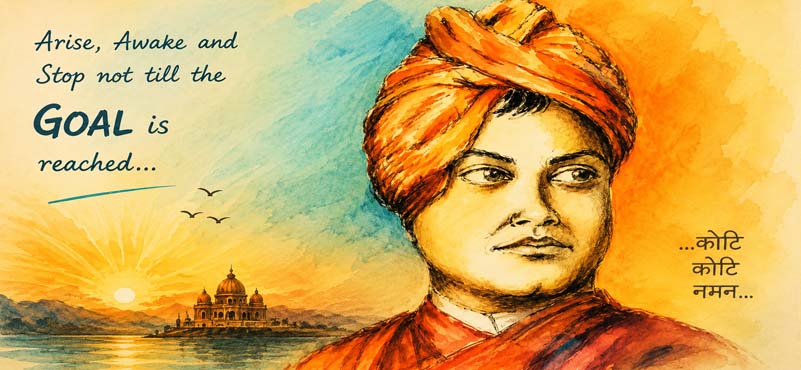
The Monk Who Awakened a Nation
On the anniversary of Swami Vivekananda’s Mahasamadhi, India does not merely remember a monk. It remembers a force of nature. Clad in saffron robes but armed with ideas sharper than swords, Vivekananda awakened a civilisation that had almost forgotten its own strength. He did not ask India to conquer the world. He asked India to conquer its own doubts.
More than a century later, his words continue to echo with astonishing relevance. India has emerged as one of the world’s fastest-growing economies, a technological powerhouse, a spacefaring nation and an increasingly influential voice in global affairs. Yet, if Vivekananda were to walk through India today, he would ask a simple question: Have we become a strong nation merely in wealth and weapons, or have we also become strong in character?
Vivekananda’s India
- Strength is the Soul of a Nation. For Vivekananda, national strength was never measured solely by military power, economic prosperity or political influence. These were necessary, but they were not sufficient. The true strength of a nation lay in the strength of its people—their courage, integrity, compassion and unshakeable confidence in themselves.His immortal declaration still resonates:“Strength is life, weakness is death.”He was not speaking merely of physical strength. He spoke of intellectual strength that rejects mediocrity, moral strength that resists corruption, spiritual strength that rises above hatred and emotional strength that refuses despair. Weakness, in his eyes, was not poverty alone. It was self-doubt. It was dependence. It was the loss of civilisational confidence.
- Wisdom of Our Scriptures. Long before the language of nation-building became fashionable, India’s ancient scriptures had already articulated the foundations of a strong civilisation. The Rig Veda called upon society:“Sangachchhadhwam Samvadadhwam”—Move together. Speak together. Let your minds be in harmony.Nationhood, therefore, was not merely geography. It was shared purpose.The Maha Upanishad offered another timeless ideal:“Vasudhaiva Kutumbakam”—The whole world is one family.This profound declaration has often been misunderstood as an invitation to weakness. Only a confident civilisation can embrace the world without fearing it. Universal brotherhood is meaningful only when rooted in self-respect. A nation uncertain of its own identity cannot become a moral guide to humanity.
- Confidence Without Arrogance. Vivekananda understood this better than anyone. He never advocated isolation, nor did he preach imitation. His message was one of confident engagement. India, he believed, should learn from every civilisation while remaining firmly anchored in its own spiritual foundations. Modernity and tradition were not adversaries; they were partners in national renewal.This confidence reached its finest expression during his address at the Parliament of Religions in Chicago in 1893. He did not seek applause. He represented an ancient civilisation with quiet dignity. His opening words, “Sisters and Brothers of America,” reflected not diplomacy but India’s timeless worldview—that humanity is one family.Yet, Vivekananda repeatedly warned that spirituality without strength degenerates into helplessness. Equally, strength without morality descends into tyranny. The genius of Indian civilisation has always been its ability to balance power with restraint, courage with compassion and ambition with duty.
- Duty: The Foundation of Nationhood. The Bhagavad Gita captures this balance with remarkable clarity:“Karmanye vadhikaraste ma phaleshu kadachana.”Perform your duty without attachment to the rewards.Duty, or dharma, lies at the heart of Indian nationhood. Rights are essential, but nations endure because citizens fulfil their responsibilities. A strong India cannot be built by governments alone. It is built every day by honest teachers, dedicated soldiers, ethical entrepreneurs, conscientious civil servants, hardworking farmers, innovative scientists and responsible citizens who quietly perform their duty.
- Service Is the Highest Patriotism. Vivekananda dreamt of precisely such an India.He famously declared:“They alone live who live for others.”In those few words lies perhaps the finest definition of patriotism. Patriotism is not merely an emotion expressed on ceremonial occasions. It is service. It is sacrifice. It is placing the nation above narrow self-interest. Every bridge honestly built, every classroom sincerely taught, every patient compassionately treated and every law fairly enforced becomes an act of national service.
- India’s Civilisational Responsibility. India’s rise in the twenty-first century presents an extraordinary opportunity. The world today faces crises that cannot be solved by technology alone. Conflict, environmental degradation, loneliness, declining trust, ethical uncertainty and social fragmentation reveal the limitations of material progress divorced from moral purpose.The Atharva Veda proclaims:“Mata Bhumih Putro’ham Prithivyah”—The Earth is my mother, and I am her son.Similarly, the ancient invocation:“Sarve Bhavantu Sukhinah, Sarve Santu Niramayah”—May all be happy; may all be free from illness—extends India’s moral imagination beyond its own borders.Vivekananda believed that India’s greatest contribution to the world would never be domination. It would be inspiration.
- Education for Nation Builders. He attached immense importance to education—not as a system for producing degree holders but as a process of building complete human beings. He famously observed:“Education is the manifestation of the perfection already in man.”Education must produce innovators with integrity, leaders with humility, professionals with compassion and citizens with character. The true dividend of education is not employability alone but enlightened nationhood.
The Unfinished Dream
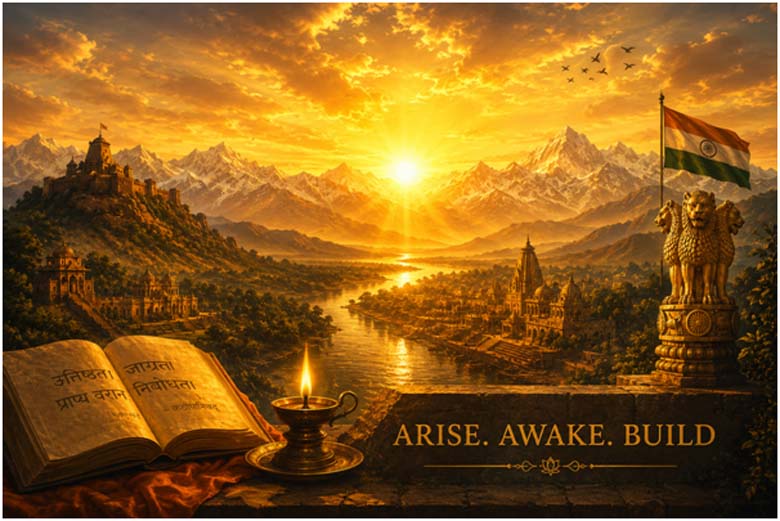
India’s demographic advantage, technological capabilities and economic potential will matter only if they are guided by ethical leadership. History repeatedly reminds us that civilisations decline not because they become poor but because they become complacent.
As India marches towards becoming a leading global power, the real challenge is not simply to build larger cities, stronger infrastructure or bigger industries. It is to build stronger citizens.
Vivekananda once said, “Arise, awake, and stop not till the goal is reached.” That call was never meant for one generation alone. It is India’s perennial summons.
A strong India is not merely one that commands respect because of its economy or its military. It is one that commands admiration because of its character. It is a nation that is fearless without being arrogant, prosperous without being selfish, modern without losing its civilisational soul and powerful without abandoning compassion.
That is the India Vivekananda envisioned.
That is the India our scriptures have inspired for millennia.
And that is the India we must continue to build.
ABOUT THE AUTHOR
Lt Gen Rajeev Chaudhry (Retd) is a social observer and writes on contemporary national and international issues, strategic implications of infrastructure development towards national power, geo-moral dimension of international relations and leadership nuances in changing social construct.