
Why Tiny Nations Reach the FIFA World Cup While India Watches
Elephant Missing from the Stadium
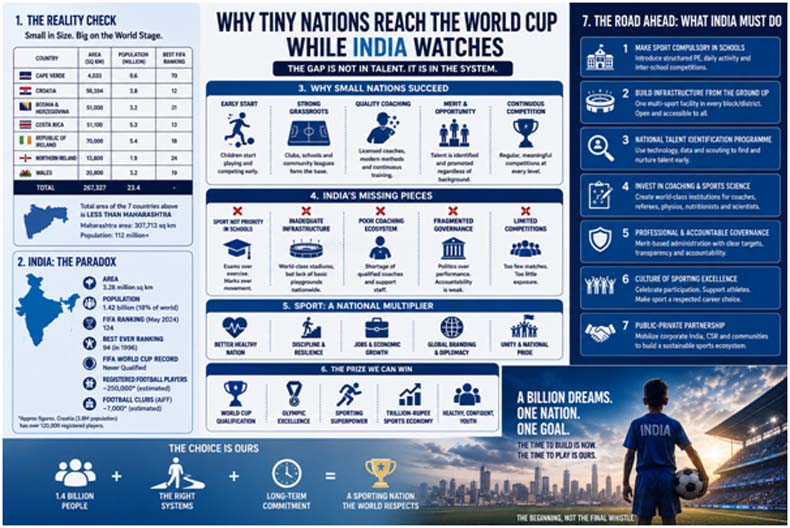
Every FIFA World Cup throws up its share of surprises. This year, one of the most remarkable stories belongs to Cabo Verde, a tiny island nation in the Atlantic Ocean. Covering barely 4,000 square kilometres—less than one-tenth the area of Maharashtra—it has earned its place among the world’s finest footballing nations.
It is not alone. Croatia, Bosnia and Herzegovina, Costa Rica, the Republic of Ireland, Northern Ireland and Wales have all competed on football’s biggest stage. Collectively, these seven nations occupy less land than the single Indian state of Maharashtra. Their combined population is smaller than that of many Indian cities.
India, in contrast, is home to nearly one-fifth of humanity. We are the world’s most populous nation, the fastest-growing major economy and an aspiring global power.
Yet when the World Cup begins, India is once again watching rather than playing. This is not merely a football statistic. It is a national paradox.
Population is Not Destiny
Whenever India’s absence from the World Cup is discussed, a familiar explanation emerges: football simply isn’t our sport. That answer is convenient, but incomplete.
Sporting greatness has never been determined by population alone. If numbers guaranteed success, India and China would dominate world football. They do not.
Nor is geography the deciding factor. Tiny island nations with limited resources routinely compete against football’s giants. Countries with populations smaller than Pune or Lucknow have produced players admired across the world.
The difference lies elsewhere. Talent is distributed generously by nature. Opportunity is not. Champions are not born because a country is large. They emerge because a nation creates systems that discover talent early, nurture it patiently and reward excellence consistently.
Population provides possibility. Institutions create champions.
What Small Nations Get Right
The success of smaller footballing nations is not an accident. It is the outcome of decades of thoughtful investment.
Children begin playing organised football at a very young age. Schools compete seriously. Local clubs become community institutions. Every talented child has a pathway from neighbourhood grounds to professional academies.
Coaches are trained. Scouts travel extensively. Sports science supports performance. Nutrition, psychology and fitness are treated as integral parts of development rather than expensive luxuries.
Most importantly, selection is based on merit. No system is perfect, but talent is rarely ignored simply because it comes from a remote village or an ordinary family. Small nations understand something profound: they cannot afford to waste gifted athletes.
India, unfortunately, wastes them every day. Across our villages, towns and cities, countless boys and girls display extraordinary athletic ability. Yet many never meet a qualified coach, never play on a proper ground and never participate in structured competition.
Potential quietly disappears—not because it was insufficient, but because the system failed to recognise it.
India’s Missing Sporting Ecosystem
India’s sporting challenge is not the absence of talent. It is the absence of an ecosystem.
Our education system continues to reward examination scores far more than sporting achievement. Physical education often receives less importance than mathematics tuition. Parents understandably encourage stable careers, while sport is viewed as an uncertain gamble.
Infrastructure presents another contradiction. We proudly inaugurate magnificent stadiums, yet millions of children lack access to safe neighbourhood playgrounds where sporting dreams truly begin.
Governance remains another weak link. Sports administration is too often dominated by bureaucracy, politics and personalities instead of professional management and long-term planning. Coaching standards vary enormously, and grassroots competitions remain fragmented.
Perhaps the biggest challenge, however, is cultural. We celebrate champions after they win. We invest very little in creating them. Every Olympic medal sparks national pride. Every cricket victory becomes a festival. But sustained sporting excellence cannot be built on occasional celebrations. It requires patient investment extending over decades.
Champions are not manufactured in training camps a few months before international competitions. They are shaped throughout childhood.
Sports is Nation Building.
Many still regard sport as recreation. Successful nations regard it as strategic investment.
Sport improves public health, strengthens discipline, builds teamwork and develops resilience. It creates employment for coaches, physiotherapists, nutritionists, sports scientists, broadcasters, event managers and equipment manufacturers.
Football alone supports an industry worth hundreds of billions of dollars globally. It also enhances diplomacy. Sporting success strengthens national identity and projects soft power across continents far more effectively than advertising campaigns ever can.
Countries like Croatia have become globally recognised not merely through geography but through consistent sporting excellence.
India possesses the talent to build one of the world’s great sporting economies. What remains missing is the vision.
Lessons Beyond Football
This conversation is not really about football. It is about India’s entire sporting culture.
The same questions arise in athletics, swimming, gymnastics, cycling and countless Olympic disciplines. Why should exceptional performances remain pleasant surprises? Why shouldn’t they become expected outcomes? If India aspires to become a developed nation, excellence in sport cannot remain an afterthought.
Strong economies deserve strong sporting cultures. National confidence is built as much in playgrounds as in laboratories.
National Sporting Mission: Potential to Podiums
If India genuinely aspires to become a global sporting nation, incremental reforms will not suffice. What is needed is a National Sporting Mission with the same determination that transformed our space programme, digital payments and highway infrastructure.
- Nurturing at Schools. The first priority must be schools. Every school should treat sport as an essential component of education rather than an optional extracurricular activity. Structured physical education, qualified coaches and inter-school competitions should become as routine as academic examinations.
- Sports Infrastructure. Second, every district should possess world-class multi-sport facilities accessible to children regardless of their economic background. Sporting infrastructure should not be confined to metropolitan cities; talent is often born far from them.
- Nationwide Talent Identification Programme. Third, India needs a nationwide talent identification programme. Modern technology, sports science and data analytics can help identify promising athletes at an early age and guide them into specialised training pathways. No gifted child should remain undiscovered simply because of geography or poverty.
- Coaches and Support Staff. Fourth, coaching deserves the same attention as athletes. Great sporting nations invest heavily in developing coaches, referees, physiotherapists, nutritionists and sports scientists. Champions are built by capable support systems long before they stand on a podium.
- Sports Administration. Fifth, sports administration must become more professional, transparent and accountable. National federations should be judged by measurable outcomes—grassroots participation, athlete development and international performance—rather than by the longevity of their office bearers.
- Participation Culture. Finally, India must create a culture that celebrates participation as much as victory. Parents, schools, employers and governments should recognise that sport is not a distraction from education but an education in itself. It builds discipline, resilience, teamwork, leadership and self-belief—qualities every successful nation requires.
The objective should not merely be to qualify for the FIFA World Cup or improve our Olympic medal tally. It should be to create a sporting culture where every child has the opportunity to discover and develop his or her full potential.
Only then will India’s demographic dividend become a genuine sporting dividend.
Beginning, Not the Final Whistle
Somewhere in rural India today, a twelve-year-old boy is dribbling a worn-out football across an uneven field. Somewhere else, a young girl is outrunning everyone in her village without ever realising she may possess Olympic potential. Neither lacks talent. What they lack is opportunity.
The achievement of tiny nations like Cabo Verde is not a miracle of geography or population. It is the result of vision, planning and perseverance.
India often speaks of becoming a global power. That aspiration cannot be measured only through GDP, highways, digital infrastructure or military strength. Great nations also produce healthy citizens, confident youth and athletes who compete fearlessly on the world’s biggest stages.
The question before India is therefore much larger than football. Can a nation that dreams of leading the twenty-first century continue to remain a spectator in the world’s greatest sporting arena? The answer will not be found in our population. It will be found in our priorities.
The day India begins treating sport as national infrastructure rather than extracurricular activity, qualification for the FIFA World Cup will no longer be an extraordinary achievement. It will simply be the beginning.
And one day, perhaps sooner than we imagine, India will arrive at the World Cup not merely to participate, but to compete with belief, confidence and the conviction that it belongs there.
ABOUT THE AUTHOR

Lt Gen Rajeev Chaudhry (Retd) is a social observer and writes on contemporary national and international issues, strategic implications of infrastructure development towards national power, geo-moral dimension of international relations and leadership nuances in changing social construct.