

Walk into any college classroom and you will find bright young minds preparing for examinations that will determine their grades, degrees, and perhaps their first jobs. They will study accounting, economics, marketing, statistics, finance, artificial intelligence, and dozens of other subjects. Every hour spent in the classroom will add to their knowledge and sharpen their professional competence.
Yet, when they eventually step into the real world, they will discover an uncomfortable truth: life asks questions that were never part of the syllabus.
No examination paper asks whether you can be trusted when nobody is watching. There is no semester-end test on keeping your word, showing compassion to a struggling colleague, admitting a mistake, or standing up for what is right when it is inconvenient. Universities award degrees for academic excellence; life rewards character.
Everything important is outside the syllabus.
This is not an argument against formal education. On the contrary, education remains one of the greatest forces for personal and national progress. But education must never be confused with wisdom. A degree can help us earn a living; it cannot, by itself, teach us how to live.
The modern world often measures success by visible achievements—salary packages, promotions, designations, luxury homes, social media followers, and professional awards. These are not insignificant. They reflect effort and ability. But they are outcomes, not the essence of a meaningful life. Many people climb the ladder of success only to discover that it was leaning against the wrong wall.
The true examination begins after graduation.
It asks different questions. Can you make difficult decisions with integrity? Can you remain calm when circumstances turn hostile? Can you accept failure without losing confidence and success without losing humility? Can you inspire trust rather than fear? Can people depend on you when everything around them is uncertain?
These are not management skills. They are life skills.
Ironically, they are also the qualities that distinguish exceptional leaders from merely competent managers.
The future belongs to those who can combine knowledge with character. Artificial Intelligence can analyse data faster than any human being. Machines will increasingly perform routine cognitive tasks. Technology will continue to transform industries, professions, and even creativity itself. In such a world, the greatest human advantage will lie not merely in knowing more, but in being more.
Communication, empathy, judgment, ethical reasoning, creativity, resilience, and moral courage cannot be outsourced to algorithms. They must be cultivated through experience, reflection, and conscious effort. They grow outside classrooms—in friendships, failures, conversations, service, adversity, and quiet moments of self-examination.
Every young person, therefore, should strive to build not one but five forms of capital.
- Intellectual Capital—the knowledge and skills acquired through education.
- Physical Capital—a healthy body capable of sustaining an energetic life.
- Financial Capital, which provides independence and security.
- Social Capital—the relationships built on trust, respect, and mutual goodwill.
- Moral Capital. This is the invisible wealth of integrity, honesty, credibility, and reputation. Unlike money, moral capital cannot be inherited or purchased. It is earned slowly through thousands of small choices and can be lost in a single act of dishonesty.
A society flourishes when its citizens invest in all five capitals rather than only one.
Equally important is the ability to keep learning. Graduation should never be the end of education; it should merely mark the end of structured instruction. The world’s greatest learners remain curious throughout their lives. They read beyond their profession, seek different perspectives, welcome criticism, and possess the humility to say, “I do not know.”
In an age overflowing with information, curiosity has become more valuable than certainty.
Indian civilisation has understood this for centuries. The Upanishads speak of knowledge as a lifelong journey rather than a destination. The Bhagavad Gita reminds us that excellence lies not merely in achievement but in the quality of our actions. Our civilisational wisdom consistently teaches that external success without inner discipline eventually leads to decline.
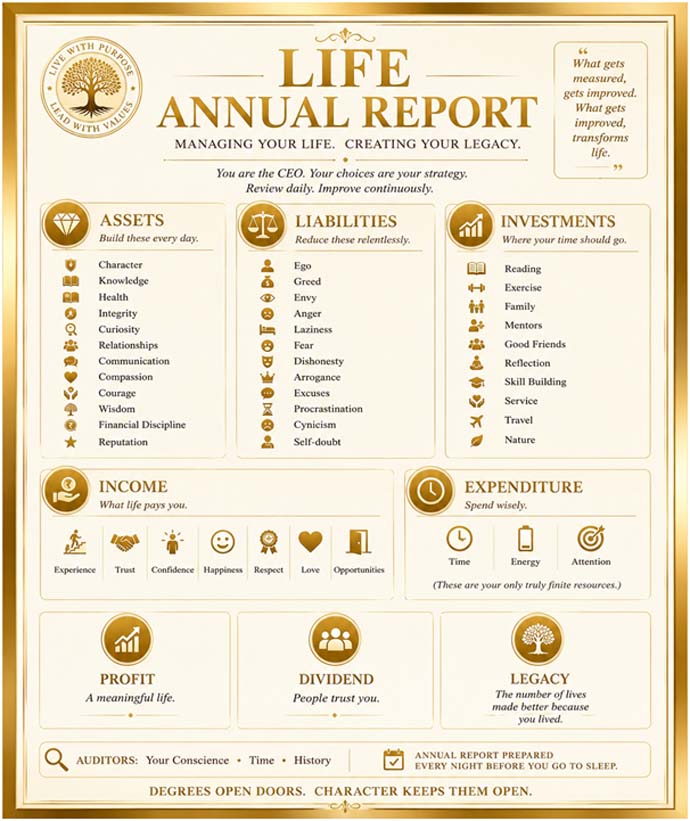
The workplace of the future will not simply require efficient professionals. It will require ethical professionals. Organisations need people who possess the courage to question wrong practices, the compassion to care for colleagues, and the conviction to choose long-term credibility over short-term gain. Leadership is not defined by authority; it is defined by responsibility.
The same principle applies to citizenship.
India today stands at a remarkable moment in history. It is one of the world’s youngest nations, one of its fastest-growing economies, and increasingly an influential voice on the global stage. The opportunities before today’s students are unprecedented. Yet the nation’s future will depend not merely on technological advancement or economic growth, but on the values of the generation that leads it.
A nation is strengthened not only by its scientists, entrepreneurs, soldiers, and policymakers, but also by every teacher who inspires honestly, every manager who acts ethically, every engineer who builds responsibly, every doctor who serves compassionately, and every citizen who performs ordinary duties extraordinarily well.
Patriotism is not measured only by what we say about our country. It is measured by the quality of work we contribute to it every single day.
Perhaps that is the most important lesson outside every syllabus.
As students begin their educational journey, they naturally dream of successful careers. They should. Ambition is healthy. Excellence is admirable. Prosperity is desirable. But alongside professional competence, they must cultivate humility, resilience, integrity, kindness, and purpose. Success without values is fragile. Achievement without character is incomplete.
Years from now, employers may not remember your marks. Society may forget your titles. Even your profession may change several times over. But people will always remember whether you were honest, dependable, compassionate, and fair. Those qualities outlive every certificate.
Education should therefore prepare us for two examinations. The first is conducted by universities and ends with a degree. The second is conducted by life and continues until our last day.
The first measures what we know. The second measures who we have become. Everything important is outside the syllabus.
(This is essence of my address to the students of premier Management School of India, delivered on 30 Jun 2026).
ABOUT THE AUTHOR

Lt Gen Rajeev Chaudhry (Retd) is a social observer and writes on contemporary national and international issues, strategic implications of infrastructure development towards national power, geo-moral dimension of international relations and leadership nuances in changing social construct.