

The global economy is being reshaped by geopolitical tensions, technological disruption, shifting trade patterns, climate risks, and evolving monetary policies. As energy security, supply-chain resilience, and AI become increasingly important, economies must adapt to navigate rising uncertainty and seize new opportunities.
India enters this period from a position of strength, supported by robust growth, expanding exports, resilient financial markets, technological progress, and a diversified manufacturing base. However, challenges such as uneven rural demand, inflationary pressures, climate risks, and global uncertainties remain.
Recent developments underscore that economic growth is now closely linked to geopolitics, technology, energy security, and climate change. This changing global landscape presents India with a unique opportunity to accelerate its economic transformation and expand its global influence.
Exports, Trade and Economic Resilience
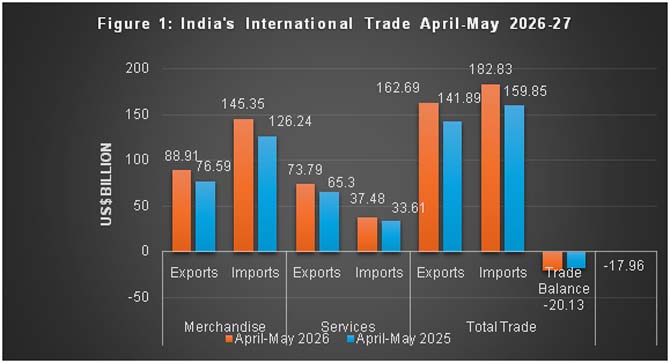
India’s external sector remains resilient despite a volatile global environment. Total exports rose 14.7 per cent to US$162.7 billion during April–May 2026 (Figure 1), driven by strong growth in engineering goods, electronics, chemicals, pharmaceuticals, petroleum products, and technology-enabled services. The broad-based expansion across merchandise and services exports highlights improving global demand for Indian products and services. However, the widening trade deficit (from US$ -17.96 billion in April-May 2025 to US$ -20.13 billion in April-May 2026) highlights the need to sustain export momentum amid growing import demand.
Equally important is the changing geography of India’s trade. While the US and Europe remain key markets, India is expanding trade ties with Asia, Africa, and other emerging economies, reducing dependence on traditional destinations. The implementation of the India–UK Comprehensive Economic and Trade Agreement (CETA) from 15 July 2026, alongside progress in trade talks with the EU and Canada, underscores India’s strategy of diversifying markets and deepening global economic integration.
Inflation, Fiscal Pressures and Growth
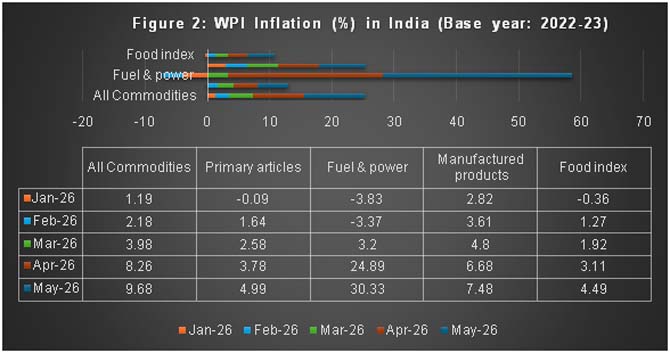
Despite strong growth indicators, inflation remains an area requiring vigilance. Wholesale inflation has shown signs of acceleration due to pressures from fuel, power, and industrial commodities (Figure 2). Although the recent decline in crude oil prices offers some relief, energy markets remain vulnerable to geopolitical developments, particularly in West Asia.
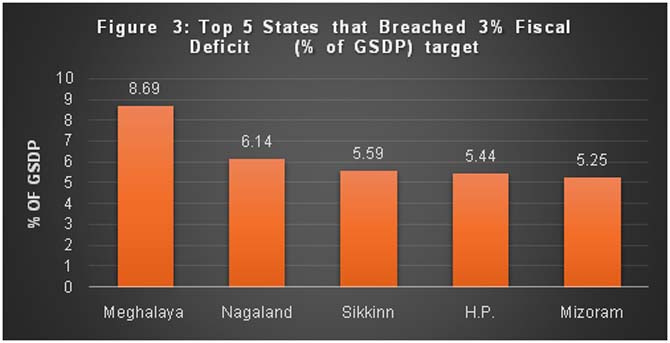
Fiscal sustainability is another important consideration. Recent assessments indicate that a significant number of Indian states exceeded recommended fiscal deficit thresholds during 2025-26 (Figure 3). Rising expenditure commitments towards salaries, pensions, subsidies, and interest payments have constrained fiscal flexibility in several states. Maintaining fiscal discipline while continuing investments in infrastructure, education, healthcare, water, and sanitation will remain a delicate balancing act. At the same time, targeted public investment continues to support growth. Allocations under the Sixteenth Finance Commission for water and sanitation infrastructure, alongside investments in transportation, logistics, and urban infrastructure, are expected to strengthen long-term productivity and improve quality of life.
Rural India: Mixed Signals
Recent indicators present a mixed picture of the rural economy. Labour market data and commentary from consumer goods companies suggest that rural demand has softened due to inflationary pressures, weather uncertainties, and slower income growth. However, entry-level automobile sales have recovered, indicating continued spending on mobility and productivity-enhancing assets. The emerging trend is one of selective consumption, with rural households prioritising essential expenditures while remaining cautious on discretionary spending. The progress of the monsoon and agricultural output will be crucial in shaping rural demand in the coming months.
Agriculture and Food Security
Agriculture remains central to India’s economic and social stability, supported by record rice stocks and the highest wheat inventories in several years, which provide a buffer against food inflation and supply disruptions. The sector is increasingly shifting towards value addition, export competitiveness, digital agriculture, and climate resilience, supported by investments in irrigation, warehousing, farmer-producer organisations, and food processing. However, delayed monsoons, rainfall deficits, and recurring heatwaves underscore the need for climate-smart agriculture and improved water-use efficiency.
Technology, Artificial Intelligence and India’s Next Growth Story
Technology is emerging as a major driver of India’s future growth, with artificial intelligence (AI), digital infrastructure, cloud computing, and satellite communications becoming increasingly important for competitiveness and productivity. Reliance Industries’ investments through Jio Platforms in AI-enabled services, digital ecosystems, and next-generation connectivity, along with its proposed IPO, reflect growing confidence in India’s digital economy. At the same time, rising investments in AI, research, and digital public infrastructure indicate that India is steadily moving from being a technology adopter to becoming a creator of advanced technological solutions.
Manufacturing and Defence-Led Growth
Manufacturing has regained strategic importance globally as countries seek to strengthen domestic capabilities and diversify supply chains, and India is emerging as a major beneficiary of this shift. The defence sector illustrates this trend, with defence production and exports reaching record highs in 2025-26, supported by the Atmanirbhar Bharat initiative, rising indigenisation, and growing global demand. Beyond defence, India is expanding its capabilities in electronics, electric mobility, renewable energy equipment, batteries, and advanced engineering. Sustained policy support, strong order books, and rising investments are expected to make manufacturing an increasingly important driver of growth, employment, and exports.
Banking and Financial Services
India’s banking and financial sector remains resilient despite global uncertainties, supported by regulatory reforms, stronger balance sheets, improved asset quality, and growing digitalisation. Recent RBI measures to attract foreign capital and improve liquidity, including relaxations for FCNR(B) and NRE deposits and concessional hedging facilities, have boosted investor confidence and lowered funding costs. Indian banks are also increasingly tapping international debt markets, while SEBI’s reforms are expected to deepen capital markets and broaden financing options. Together, these developments strengthen the sector’s ability to support investment, innovation, and economic growth.
Financial and Commodity Markets
Indian financial markets remained resilient during 15–19 June 2026, supported by lower crude oil prices, improving foreign investor sentiment, and strong macroeconomic fundamentals. Reflecting this confidence, the market capitalisation of listed companies once again crossed US$ 5 trillion.
Global equity markets also advanced during the week as easing tensions in West Asia and lower oil prices improved risk sentiment, offsetting concerns over the US Federal Reserve’s cautious stance. Crude oil prices softened on expectations of a peace framework in West Asia, easing inflationary pressures and supporting growth prospects for energy-importing economies such as India.
Gold prices weakened amid a stronger US dollar and expectations of higher-for-longer US interest rates, while the Indian rupee remained relatively stable, supported by lower oil prices, renewed capital inflows, and RBI measures to attract overseas funds.
G7 Prioritises AI, Critical Minerals and Energy Security
The recent G7 Summit highlighted the strategic priorities likely to shape the global economy in the coming decade, including AI, critical minerals, energy security, resilient supply chains, and digital infrastructure. Competition for critical minerals such as lithium, cobalt, and rare earth elements is intensifying as countries seek to secure supplies for clean energy technologies and advanced manufacturing. The Summit also emphasised the need to balance AI innovation with responsible governance and cybersecurity, while reaffirming that energy security, supply-chain resilience, and the transition to cleaner energy sources must advance together. For India, these trends present significant opportunities to strengthen its role in global technology and manufacturing value chains.
Global Corporate Developments
Corporate developments worldwide continue to reflect the rapid pace of technological and economic change. Major companies are investing heavily in AI, cloud computing, semiconductors, and carbon-removal technologies, underscoring the growing importance of innovation in shaping future competitiveness.
The substantial funding secured by Chinese AI firm DeepSeek highlights the intensifying global race for technological leadership, while rising investments in carbon-removal technologies point to increasing efforts to complement emissions reduction with climate-focused innovation.
Meanwhile, Fox’s proposed US$22 billion acquisition of Roku signals continued consolidation in the media and streaming industry. By combining premium content with a large digital distribution platform, the deal strengthens Fox’s position in the rapidly expanding ad-supported streaming market.
Overall, corporate strategies are increasingly shaped by the convergence of technology, sustainability, and geopolitical considerations, with businesses focusing not only on growth but also on resilience, supply-chain security, and long-term competitiveness.
Global Monetary Policy: A New Phase of Tight Financial Conditions
Monetary policy developments during the week reflected differing economic conditions across major economies. The US Federal Reserve kept interest rates unchanged while maintaining a hawkish stance, signalling continued vigilance on inflation and reducing expectations of near-term rate cuts. The Bank of Japan raised interest rates to their highest level in more than three decades, while the Reserve Bank of Australia adopted a cautious approach amid moderating growth. Together, these decisions suggest that major central banks remain focused on price stability, indicating that global financial conditions are likely to remain relatively tight in the near term. For emerging economies such as India, this underscores the importance of maintaining macroeconomic stability and strong external fundamentals.
Climate Change: From Environmental Challenge to Economic Imperative
Climate change is increasingly moving to the centre of economic policymaking, as rising temperatures, extreme weather events, and changing rainfall patterns pose growing risks to agriculture, water security, infrastructure, public health, and labour productivity. Recent reports highlighting the vulnerability of children to climate hazards, rising food insecurity, and increasing exposure to droughts, floods, heatwaves, and air pollution underscore the economic and social costs of climate change. At the global level, debates on climate science, emissions reduction pathways, and climate finance reflect the growing recognition that climate resilience is now integral to long-term economic stability and development.
At the same time, the transition to a low-carbon economy is creating significant opportunities for investment, innovation, and employment. Rapid growth in renewable energy, green hydrogen, climate-smart agriculture, carbon-removal technologies, electric mobility, and resilient infrastructure is opening new avenues for sustainable growth. For India, strengthening climate resilience while accelerating the adoption of clean technologies will be critical not only for managing environmental and economic risks but also for enhancing competitiveness, attracting investment, creating jobs, and supporting long-term sustainable development.
Conclusion
The global economy is entering a new era shaped by technological change, energy transition, climate risks, and shifting trade and investment patterns. In this environment, economic success will increasingly depend on resilience, innovation, and adaptability.
Recent developments, from the G7’s focus on AI, critical minerals, and energy security to evolving monetary policies in major economies, highlight the growing interdependence of technology, strategic resources, and macroeconomic stability. India is well positioned to benefit from these shifts, supported by strong exports, expanding trade partnerships, technological innovation, manufacturing growth, financial-sector resilience, and favourable demographics.
While challenges such as strengthening rural demand, managing climate risks, and maintaining fiscal discipline remain, India has a unique opportunity to leverage its economic strengths and help shape the emerging global economic order.
This article is based on Weekend Macro by InsPIRE (Vol I, Issue 9, 20 June 2026), the weekly newsletter from the Institute for Pioneering Insightful Research Pvt. Ltd. (InsPIRE), Greater Noida. InsPIRE is a startup policy research and consulting firm specializing in economic development, international trade, financial sector, climate policy, sustainability, strategic advisory services, and executive education.
ABOUT THE AUTHOR
 Dr Debesh Roy is the Founder-Chairman of the Institute for Pioneering Insightful Research Pvt. Ltd. (InsPIRE), Greater Noida, a startup research and consulting firm (website: https://inspire-solutions.in/). He has over three-and-a-half decades of professional experience, including 32 years at NABARD. Dr Roy holds a PhD in economics, and has extensive experience in macroeconomic policy, international trade, agricultural development, infrastructure financing, financial inclusion, climate policy and sustainability. (Email ID: debeshroy_chairman@inspire-solutions.in )