
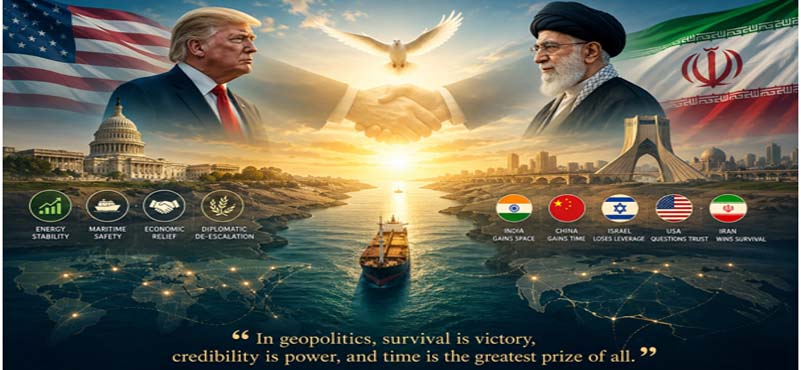
Wars usually end with a victor and a vanquished. Diplomacy, however, is far more complicated. It often produces outcomes where every participant claims success, every stakeholder interprets events differently, and historians spend years debating who really gained and who lost.
The recently signed US–Iran MoU belongs to this category. At first glance, it appears to be a diplomatic breakthrough that has reduced the immediate risk of a wider regional war. Oil markets have responded positively, shipping routes appear safer, and governments across the world have welcomed the reduction in tensions. Yet beneath the reassuring headlines lies a deeper strategic story.
The true significance of this agreement is not whether fighting has stopped. It is how the balance of leverage, credibility and influence has shifted among the principal actors.
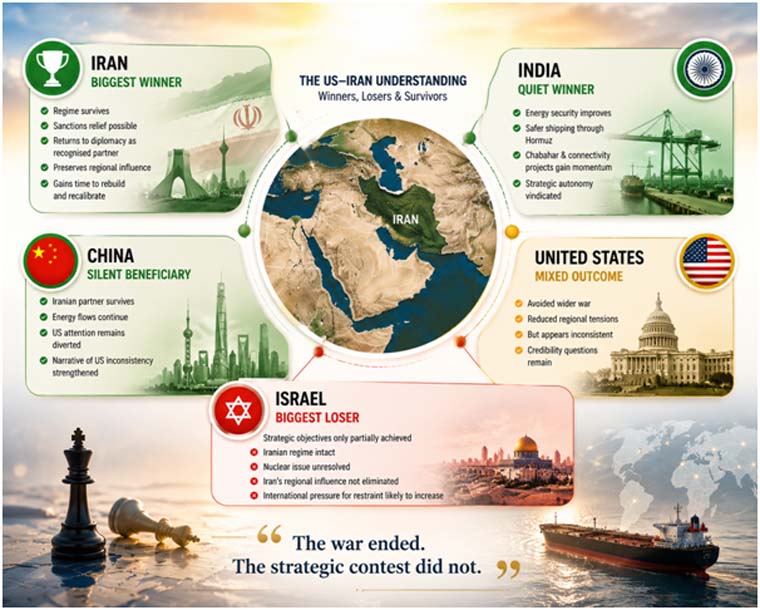
Measured through that lens, the agreement has produced clear winners, significant losers and several unexpected beneficiaries.
The Biggest Winner: Iran
Conventional wisdom often assumes that the side possessing superior military power emerges victorious. History repeatedly demonstrates otherwise.
Iran entered the crisis under severe pressure. Its economy had suffered from sanctions, its regional network had been weakened, and it faced the possibility of military escalation involving both the United States and Israel. Many observers predicted that Tehran would emerge strategically crippled or politically isolated. Instead, the Iranian regime survives.
That single fact may prove to be the most important outcome of the entire episode. The Islamic Republic remains intact. It continues to govern, negotiate and represent itself as a sovereign actor. It has not been subjected to regime change, nor has it been forced into unconditional surrender. More importantly, it has returned to the diplomatic table as a recognised negotiating partner rather than as a defeated state.
Potential sanctions relief, improved economic prospects and reduced international isolation may follow. Whether all these materialise remains uncertain. What is certain is that Iran has gained something every state values above all else: time.
In strategy, survival is often the first and greatest victory. Many wars are fought not to win outright but to avoid losing decisively. By that standard, Iran has achieved its primary objective. It absorbed pressure, endured confrontation and emerged with its political system intact. The regime may be bruised, but it remains standing.
History suggests that nations which survive crises often recover faster than those who appear dominant in the midst of them.
The Biggest Loser: Israel
If Iran emerges as the principal winner, Israel appears to be the principal loser—not because it lacks military strength, but because strategic objectives seem only partially fulfilled.
Israel demonstrated extraordinary military capability throughout the confrontation. Its intelligence reach, precision targeting and operational effectiveness once again reinforced its reputation as one of the most capable military powers in the world. Yet military excellence and strategic success are not always synonymous.
For decades, Israel’s core objective regarding Iran has been remarkably consistent: prevent Iran from becoming a long-term strategic threat. This objective extended beyond military exchanges. It involved limiting Iran’s regional influence, constraining its nuclear ambitions and reducing its ability to challenge Israeli security interests. The current outcome appears to leave many of those questions unresolved.
Iran’s regime survives. Its influence, though reduced, remains significant. The broader strategic contest continues. What was expected by some to be a transformative moment may instead become another chapter in a prolonged rivalry. This distinction is crucial. Israel won the battle of capability. Iran won the battle of endurance.
Military power can destroy infrastructure and neutralise threats. Strategic power changes political realities. The latter is always more difficult.
Israel remains militarily dominant, but it may find itself confronting the same strategic challenge tomorrow that it faced yesterday. That is rarely the outcome sought after a major confrontation.
India’s Quiet Victory
Amid the noise surrounding Washington, Tehran and Jerusalem, one country emerges as a quiet but important beneficiary: India.
For New Delhi, stability in West Asia is not an abstract geopolitical concept. It is an economic necessity. A significant proportion of India’s energy security is linked directly to the Gulf region. Any disruption in maritime traffic through the Strait of Hormuz immediately affects shipping costs, insurance premiums and energy prices. The reduction of tensions therefore carries tangible economic benefits for India. Beyond energy lies connectivity.
A calmer regional environment improves prospects for projects such as Chabahar Port and the International North-South Transport Corridor. These initiatives are central to India’s efforts to access Central Asia and Eurasia while reducing dependence on traditional routes. Perhaps most importantly, the episode validates India’s long-standing doctrine of strategic autonomy.
New Delhi resisted pressure to become part of any rigid geopolitical bloc. It maintained productive relations with the United States while preserving channels of communication with Iran and other regional actors. The outcome vindicates that approach. In a fragmented world, flexibility often proves more valuable than alignment.
India gains strategic space without having fired a shot or issued an ultimatum. That is diplomacy at its most effective.
China’s Silent Gain
China may be the least discussed beneficiary of the agreement, yet its gains are substantial.
Beijing’s interests in the region are straightforward. It seeks stable energy supplies, preservation of key economic partnerships and avoidance of major disruptions that could threaten trade flows. The survival of Iran serves all three objectives.
China’s long-term strategic partnership with Tehran remains intact. Energy flows are likely to continue. Regional instability has been reduced without requiring significant Chinese intervention. Yet the most significant Chinese gain may be geopolitical rather than economic.
Every crisis that absorbs American attention in West Asia diverts strategic bandwidth from the Indo-Pacific. Beijing understands this reality better than most. For years, China has argued that the United States is increasingly transactional, inconsistent and unpredictable in its international commitments. Developments such as this provide additional evidence for that narrative.
China therefore benefits not only from regional stability but also from the perception that American strategic focus is increasingly divided. The gain is indirect, but it is real.
America’s Mixed Verdict
The United States occupies a unique position in this assessment.
On one hand, Washington succeeded in preventing a wider regional war. It reduced tensions, reassured energy markets and demonstrated its continued ability to influence events across the Middle East. These are not insignificant achievements.
On the other hand, the agreement raises uncomfortable questions about consistency. For years, American political discourse criticised diplomatic arrangements with Iran as inadequate or overly accommodating. Yet the current understanding appears to contain several familiar elements: negotiation, phased concessions and continued diplomatic engagement.
This creates a perception problem. Power and credibility are not the same thing. Power compels behaviour. Credibility shapes expectations. The United States remains the world’s most powerful nation by most conventional measures. Its military reach, economic influence and technological advantages remain formidable.
The question increasingly asked by allies and adversaries alike is different. Is America predictable? Strategic uncertainty does not arise from weakness. It arises when others struggle to anticipate your actions.
That challenge may prove more significant than any immediate gains achieved through the agreement.
The Real Casualty: Credibility
Ultimately, the most important loser may not be a nation at all.
It may be credibility itself. The international system functions not merely because nations possess power but because others believe their commitments, declarations and assurances. When policies shift rapidly, objectives evolve and positions change dramatically, confidence begins to erode. Allies start hedging. Adversaries become more adventurous. Neutral states pursue greater strategic autonomy.
This phenomenon is visible across the world today. The movement from a rules-based order towards a more transactional system of international relations reflects a deeper crisis of trust. Nations increasingly assume that interests will override commitments and expediency will outweigh principles. That perception has profound consequences.
Great powers rarely decline because they lose individual battles. They decline when other states stop organising their futures around their promises.
Trust, once lost, is extraordinarily difficult to rebuild.
Conclusion
The US–Iran understanding may well reduce tensions and prevent a wider conflict. For that reason alone, it deserves cautious welcome. Yet its strategic consequences extend far beyond the immediate crisis.
Iran gained survival and valuable time. Israel lost leverage without securing finality. India gained strategic space and economic relief. China benefited from stability and continued American distraction. The United States avoided war but raised new questions about predictability.
Above all, the episode reminds us that modern geopolitics is increasingly defined not by decisive victories but by negotiated ambiguities.
In such a world, survival becomes success, leverage becomes power and credibility becomes the most precious strategic currency of all. And it is that currency which appears most diminished after this agreement.
ABOUT THE AUTHOR

Lt Gen Rajeev Chaudhry (Retd) is a social observer and writes on contemporary national and international issues, strategic implications of infrastructure development towards national power, geo-moral dimension of international relations and leadership nuances in changing social construct.