How Pakistan-Based Terror Networks Rebuilt, Relocated and Resurfaced After Operation Sindoor
Every terrorist incident in Jammu and Kashmir this year has, understandably, been read as a story about what happened on Indian soil. The more important story is unfolding across the Line of Control, where the networks responsible for these attacks have spent the past year rebuilding, relocating and restructuring themselves after the losses in May 2025. The attacks of 2026, from the infiltration killings near the Line of Control to the Behibagh shooting in February and the Kellam brick kiln attack in July, are best understood as the visible output of that reconstruction, not as isolated incidents.
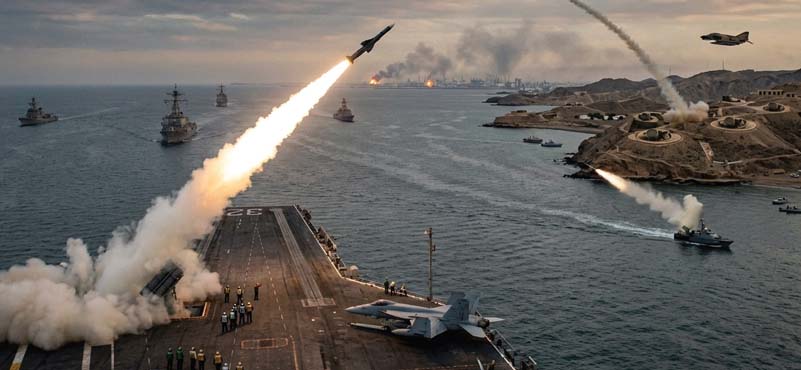
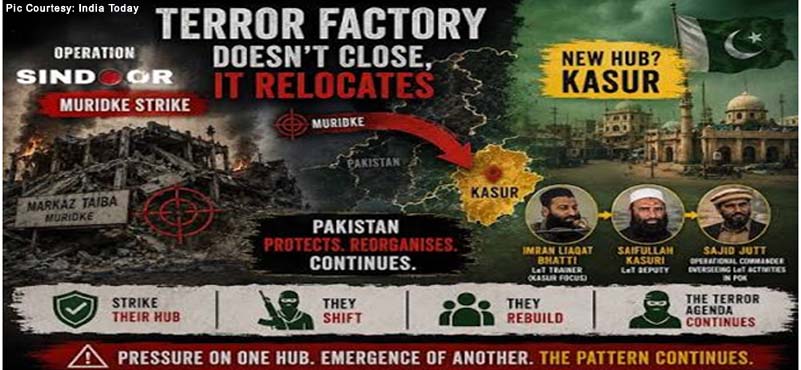
Operation Sindoor struck nine sites in May 2025, destroying the Jaish-e-Mohammed headquarters in Bahawalpur, the Lashkar-e-Taiba training complex in Muridke, Hizbul Mujahideen facilities in Sialkot, and several forward launch pads near the Line of Control. Between seventy and a hundred militants were killed. For an organisational structure built around a small number of large, symbolically important centres, this was a severe blow. What has happened since is a methodical effort, backed by the Pakistani state, to reassemble the network in a form that survives the next strike.
Relocation: Moving Beyond Reach
The first change is geographical. Camps that once sat in Pakistan-occupied Kashmir, within easy reach of Indian strike aircraft and missiles, are being pushed further back. Intelligence reports from September 2025 noted Jaish-e-Mohammed and Hizbul Mujahideen facilities shifting into Khyber Pakhtunkhwa, with Lashkar-e-Taiba following soon after, as a new training and residential centre, Markaz Jihad-e-Aqsa, was under construction in the Kumban Maidan area of Lower Dir district, roughly forty-seven kilometres from the Afghan border. Moving training infrastructure this far from the Line of Control trades operational convenience for survivability, a trade the network appears willing to make after watching its old flagship camps burn.
Dispersal: Smaller, Agile, Harder to Hit
The second change is scale. Rather than rebuild the handful of large camps destroyed by Operation Sindoor, Pakistani agencies have overseen the reconstruction of many more smaller ones. Facilities previously flattened at Luni, Putwal, Tipu Post, Jamil Post, Umranwali, Chaprar Forward, Chhota Chak and Janglora have reportedly been rebuilt, each housing fewer than a hundred terrorists, rather than the concentrated strength of the old Muridke and Bahawalpur model. An Intelligence Bureau assessment in August 2025 counted as many as fifteen new camps and launch pads under construction in Pakistan-occupied Kashmir alone, deliberately dispersed to limit what any single Indian strike could achieve. This is not merely repair. It is a redesign intended to make a repeat of Operation Sindoor far less decisive.
Disguise: Rebuilding Under Cover
The third change is disguise. The reconstruction of the two most symbolically significant sites, Muridke and Bahawalpur, has proceeded under religious and charitable cover. Satellite imagery shows the damaged domes of the Jamia Subhan Allah mosque complex at Bahawalpur repaired and repainted, with construction financed in part by funds raised under the banner of flood relief, a pattern the group has used before to move money without attracting scrutiny. At Muridke, Pakistani authorities have reportedly provided direct funding for rebuilding the Lashkar-e-Taiba headquarters, with senior commanders overseeing a project timed for completion around Kashmir Solidarity Day in early February, turning reconstruction itself into a propaganda event for a domestic and diaspora audience.
Rehabilitation: Building Political Cover
The fourth change is political rehabilitation. Lashkar-e-Taiba leadership, including Hafiz Talha Saeed, has been meeting political figures in Pakistan-occupied Kashmir under the guise of religious and community outreach, using madrassas as recruitment and staging platforms while portraying the organisation as a legitimate voice on the Kashmir issue rather than a banned terrorist group. This is a longer-term investment. It is aimed less at this year’s attacks than at ensuring the network has a durable base of local sympathy and recruitment across a new generation, insulated from the reputational damage caused by Pahalgam and Operation Sindoor.
Against this backdrop, the pattern of attacks in Jammu and Kashmir in 2026 looks less like a series of separate tactical choices and more like the output of a network still finding its footing after reconstruction. The infiltration fatalities recorded in the first quarter, largely foreign nationals killed while attempting to cross the Line of Control near Udhampur, Kishtwar, Samba and Kathua, are consistent with a dispersed network sending smaller groups across a wider stretch of the border rather than concentrated pushes from a handful of established routes. The February attack on a veteran’s family in Behibagh and the July killing of two labourers in Kellam both required local reconnaissance, safe movement and an exit plan, capabilities that depend on functioning support networks on the ground rather than on any single training camp. Their continuation through the year suggests that whatever damage Operation Sindoor inflicted on physical infrastructure, the logistical chain feeding operatives into south Kashmir has not been broken, only rerouted.
What This Means for the Response
This has direct implications for how India calibrates its response over the next phase of the conflict.
First, the target set has changed, and so must the intelligence effort. A network organised around fifteen or more dispersed camps of fewer than a hundred fighters each, spread across both Pakistan-occupied Kashmir and Khyber Pakhtunkhwa, poses a fundamentally different collection problem than the old model of a few large, well-known headquarters. Satellite and signals coverage need to extend further into Pakistani territory than before, and Indian agencies will need sustained investment in human sources capable of tracking a more mobile, more dispersed set of facilities.
Second, the financial pipeline deserves as much attention as the physical camps. Reconstruction funded through disguised charitable appeals is a vulnerability that can be addressed through financial intelligence and pressure on the international bodies that monitor terror financing, rather than through kinetic means alone. Pakistan’s past record of expanding terror infrastructure soon after being removed from the Financial Action Task Force grey list is a pattern worth flagging repeatedly in that forum.
Third, the political and religious legitimisation effort in Pakistan-occupied Kashmir requires a counter-narrative response, not merely a security one. Engagement by banned terrorist leaders with political and religious figures across the Line of Control aims to normalise these groups among a new generation. If left unaddressed in the information space, that normalisation will outlast any single wave of camp reconstruction.
Fourth, on the Indian side of the Line of Control, protective measures for migrant labour, veterans and other recurring soft targets should be treated as a standing requirement rather than a response triggered after each attack, since the network’s continued ability to reach these targets throughout the year confirms that its ground-level support structure in south Kashmir remains functional despite the setbacks it absorbed in Pakistan.
The infrastructure destroyed in May 2025 has not simply been rebuilt. It has been redesigned, dispersed and repackaged to withstand the next confrontation. The steady drumbeat of smaller attacks across Jammu and Kashmir this year is the clearest evidence that the redesign is, for now, working well enough to keep operatives moving across the Line of Control.
Toward a Counter-Ecosystem Doctrine
The pattern traced here points to a single conclusion. India must move from counter-terrorism to counter-ecosystem. Killing operatives and destroying camps treat each attack and each facility as a discrete target, and it is precisely this model that Muridke and Bahawalpur have proven able to absorb and outlast. What survived Operation Sindoor was not a camp. It was the ecosystem around it, with financing routed through disguised charitable appeals, a dispersed camp network built to withstand the next strike, and a political rehabilitation campaign designed to outlast any single leader or facility. Strike one part of that system, and the other three keep the network alive, exactly how Muridke was rebuilt within a year.
A counter-ecosystem doctrine would treat the financing, the political legitimisation and the physical dispersal as one connected target, not three separate problems. That means sustained financial intelligence and FATF pressure against disguised fundraising, information operations to counter the political rehabilitation underway in Pakistan-occupied Kashmir, deeper penetration of the dispersed camp network rather than periodic strikes on flagship sites, and standing protective postures inside Jammu and Kashmir rather than reactive ones after each attack. The camps are replaceable within months. The ecosystem that funds, shelters, legitimises and restaffs them is the target that would make reconstruction expensive enough actually to deter.
In addition, India must periodically mow the lawn of terrorism through covert and overt operations, irrespective of geography or relocation. New strategies require new responses.
ABOUT THE AUTHOR
 Lieutenant General A B Shivane, is the former Strike Corps Commander and Director General of Mechanised Forces. As a scholar warrior, he has authored over 200 publications on national security and matters defence, besides four books and is an internationally renowned keynote speaker. The General was a Consultant to the Ministry of Defence (Ordnance Factory Board) post-superannuation. He was the Distinguished Fellow and held COAS Chair of Excellence at the Centre for Land Warfare Studies 2021 2022. He is also the Senior Advisor Board Member to several organisations and Think Tanks.