“India is the cradle of the human race, the birthplace of human speech, the mother of history, the grandmother of legend, and the great-grandmother of tradition. Our most valuable and most instructive materials in the history of man are treasured up in India only.” Mark Twain, Following the Equator (1897).
The Indian economy enters the second half of 2026 from a position of relative strength, yet with heightened vulnerabilities arising from an increasingly uncertain global environment. Strong domestic demand, robust GDP growth, improving liquidity, resilient banking, and renewed foreign portfolio inflows continue to drive economic activity. Elevated crude oil prices, geopolitical tensions, rupee depreciation, volatile capital flows, fiscal constraints, uneven employment generation, and climate-related risks have, however, marred the macroeconomic outlook. The central challenge is no longer merely sustaining growth, but ensuring that growth is productive, inclusive, resilient and globally competitive. India has demonstrated remarkable resilience through successive shocks—from the pandemic to global inflation and geopolitical conflicts—but the next stage of development requires deeper structural reforms rather than reliance on cyclical growth impulses.
Global Environment: Rising Uncertainty
The international economic landscape has deteriorated sharply over the past month. Escalating geopolitical tensions in West Asia have pushed Brent crude prices above US$100 per barrel, reviving inflationary pressures and threatening global growth prospects. The unfolding situation evokes the grim atmosphere of the Mahabharata, where conflict, vengeance and moral ambiguity ultimately engulfed all sides. Ramdhari Singh Dinkar captures this tragic reality with extraordinary poignancy in his magnum opus Rashmirathi:
“वृथा है पूछना, था दोष किसका?
खुला पहले गरल का कोष किसका?
ज़हर अब तो सभी का खुल रहा है,
हलाहल से हलाहल धुल रहा है।”
In essence: What use is asking whose fault it was or who first unleashed the venom? The poison within everyone is now surfacing; and, tragically, poison itself is being used to cleanse poison.
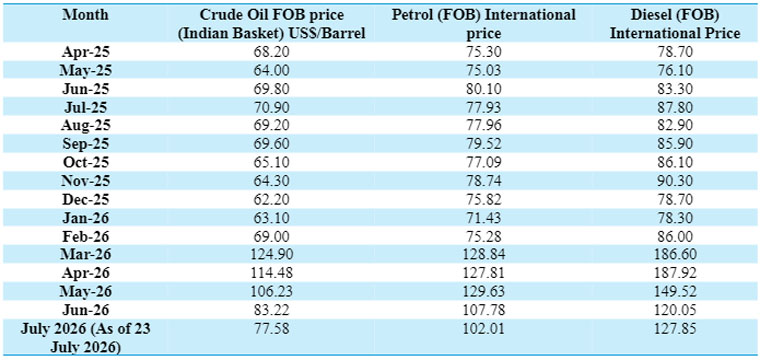
For India, which imports nearly 85% of its crude oil requirements, sustained high oil prices have immediate macroeconomic consequences, including higher import bills, widening trade deficits, inflationary pressures, and exchange-rate volatility. In view thereof, the International Monetary Fund (IMF) has revised India’s FY27 growth forecast to about 6.4%, citing elevated oil prices and the possibility of an uneven monsoon as major downside risks. The energy shock has also complicated global monetary policy. Persistently high commodity prices may delay interest-rate cuts by major central banks, keeping global borrowing costs elevated. Higher interest rates strengthen the US dollar, reduce global liquidity, and increase the risk of capital outflows from emerging economies. Consequently, financial markets have become more volatile, while global bond yields have risen as investors reassess inflation risks.
Beyond immediate macroeconomic concerns lies a deeper structural transformation. The global economy has become increasingly characterised by geopolitical fragmentation, trade restrictions, technology rivalries, sanctions, supply-chain diversification and industrial policy competition. While these developments weaken global trade, they also create opportunities for countries that can provide stable manufacturing and service platforms.
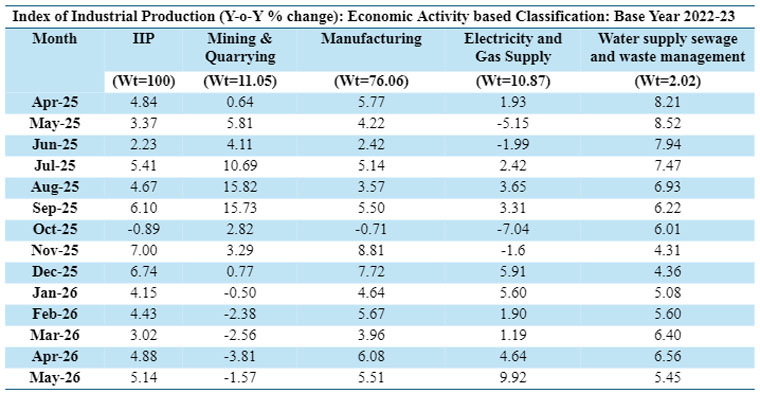
Table 1: Industrial Growth
India remains among the world’s fastest-growing major economies, with FY26 GDP growth estimated at around 7.7%, while most projections place FY27 growth between 6% and 6.6%, considerably above expected global growth. Nevertheless, recent revisions to India’s GDP series, coupled with rupee depreciation, have lowered India’s nominal GDP in dollar terms, placing it around sixth in global rankings. This reflects valuation effects rather than any collapse in real economic activity.
Global investors continue to view India favourably because of its large domestic market, demographic advantages and policy reforms. However, investor confidence increasingly depends on policy consistency, regulatory certainty and institutional quality alongside growth prospects. India’s long-term aspiration of becoming a US$10 trillion economy by 2030—or even the more conservative projection of US$8–8.5 trillion—will depend less on cyclical expansion and more on sustained improvements in productivity, innovation and competitiveness.
Domestic Economy: Strong Fundamentals, Emerging Pressures
India’s domestic economy continues to exhibit considerable resilience. Real GDP expanded by 7.7% during FY26, supported by broad-based contributions from private consumption, investment, services, manufacturing and public infrastructure spending. Liquidity conditions have improved significantly, supporting credit expansion, while banking-sector balance sheets remain healthy. Corporate profitability has largely remained resilient despite global uncertainties.
Foreign Portfolio Investors have also returned to Indian markets after several months of outflows. Net inflows during July, amounting to roughly ₹42,000 crore, demonstrate that India continues to be perceived as an attractive long-term investment destination. Nevertheless, recent market volatility underscores the sensitivity of capital flows to global geopolitical developments and commodity price movements.
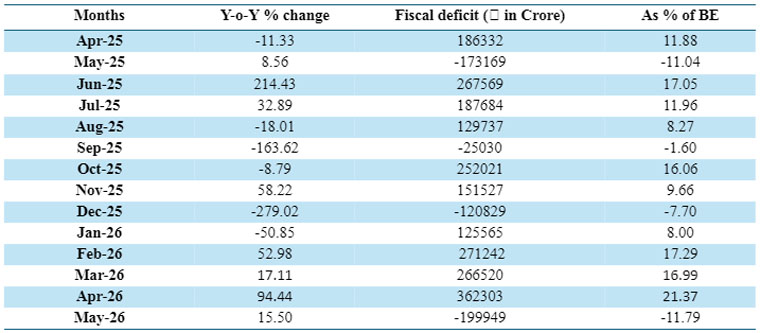
Table 2: Fiscal Deficit
The RBI Bulletin (July 2026) presents a broadly positive outlook for the Indian economy, supported by firm consumption, sustained momentum across industry and services, buoyant credit expansion and improving external resilience. Nevertheless, growth faces significant headwinds from uneven monsoon patterns, West Asian geopolitical tensions, volatile energy prices and persistent trade-policy uncertainties. India’s underlying macroeconomic stability provides a strong cushion, but maintaining momentum will depend on prudent policy, structural reforms and the ability to adapt swiftly to evolving global conditions.
Similarly, in an excellent piece in The Times of India (“Only Strong Macros Won’t Make Aam Aadmi Better Off”, 6 July 2026), Dr. Neeraj Kaushal, Professor at Columbia University, rightly draws attention to the remarkable strength of India’s macroeconomic fundamentals. The headline indicators are indeed impressive: real GDP growth of 7.7% in FY26; inflation at around 2%, its lowest level in five decades; a modest current account deficit of 0.6% of GDP; foreign exchange reserves of approximately $688 billion in June 2026; export growth of 4% in FY26, accelerating to 15% year-on-year in April–May 2026; and inward remittances at a record $140 billion, equivalent to about 3.5–4% of GDP and 16% higher than the previous year.
Chart 1: Current Account Deficit (CAD)
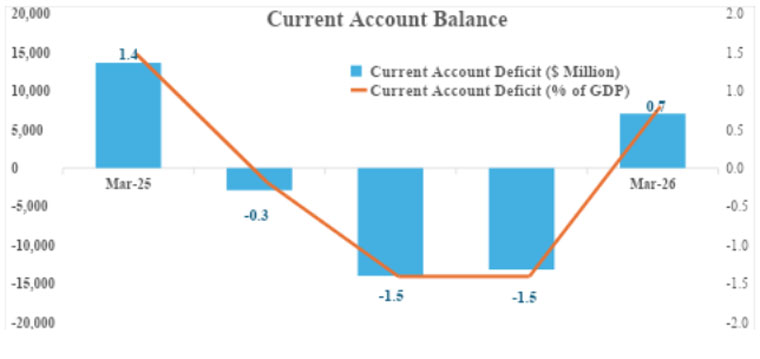
Taken together, these numbers point to an economy that has demonstrated considerable resilience, macroeconomic stability and external-sector strength. Yet, as Dr. Kaushal perceptively argues, strong macroeconomic aggregates, impressive as they are, do not automatically translate into commensurate improvements in the everyday economic well-being of the Aam Aadmi. The critical challenge, therefore, is to bridge the gap between macroeconomic resilience and microeconomic welfare to ensure that growth becomes more employment-intensive, incomes rise more broadly, productivity gains are widely shared, and the benefits of economic expansion reach households across the income distribution.
Growth remains uneven. Urban consumption continues to outperform rural demand, while employment generation has not kept pace with labour-force expansion. MSMEs continue to face challenges relating to access to affordable credit, rising input costs and uncertain export demand. Inflation presents a mixed picture. Wholesale inflation accelerated sharply due to higher global energy and commodity prices, while retail inflation has remained relatively moderate. This divergence reflects incomplete transmission of international price shocks to consumers. But the inflation outlook remains vulnerable to renewed oil-price increases and weather-related food inflation. The southwest monsoon assumes particular significance in this context. A deficient or erratic monsoon affects agricultural production, rural incomes, food prices and consumer demand simultaneously. Although India’s foodgrain reserves provide an important cushion, prolonged food-price pressures could complicate monetary policy by forcing the RBI to balance inflation control with growth support.
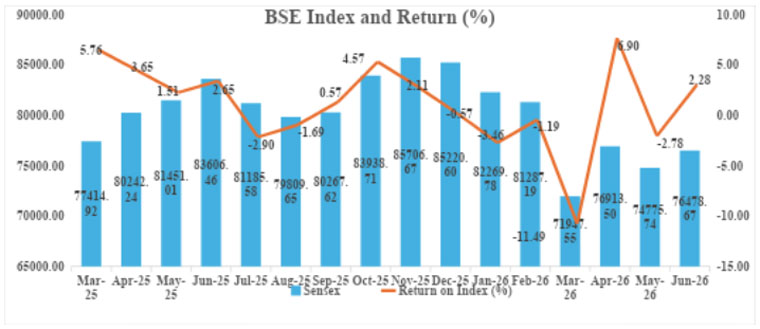
Chart 2: BSE Index
External Sector and Exchange Rate
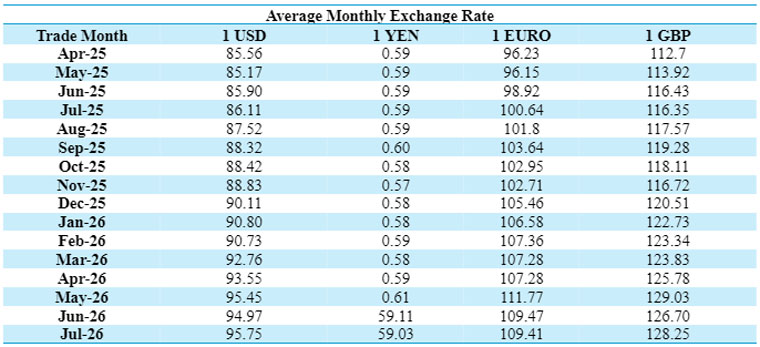
The external sector remains broadly stable despite increasing pressures. Services exports, remittance inflows and comfortable foreign exchange reserves continue to provide important buffers. However, rupee depreciation has emerged as one of the principal macroeconomic concerns. The currency has weakened toward ₹97 per US dollar, prompting RBI intervention to prevent excessive volatility.
Moderate depreciation can improve export competitiveness. Problems arise when depreciation reflects deteriorating fundamentals, such as higher oil imports, capital outflows and adverse market expectations. Such depreciation raises import costs, fuels inflation and reduces household purchasing power, creating adverse feedback effects. Recent exchange-rate movements have also reduced India’s nominal GDP in dollar terms, illustrating how currency valuation can significantly affect international economic rankings despite continued real growth.
Table 3: Rupee Movement
India’s external vulnerability remains significantly linked to its dependence on energy imports and exposure to global commodity-price volatility. Reducing these risks requires greater export diversification, stronger manufacturing competitiveness, expansion of high-value services and deeper regional trade integration. The WTO’s Trade Policy Review of India (WT/TPR/S/488, 26 May 2026) recognises India’s continuing efforts to improve the investment climate, while emphasising scope for further reforms. Tariff rationalisation, streamlined customs procedures and deeper integration into global value chains can enhance competitiveness, attract investment, expand exports and strengthen India’s resilience to external shocks, thereby supporting a more balanced and sustainable external sector.
Key Challenges
Managing the Oil Shock
Persistently high crude prices remain the single largest near-term macroeconomic risk. Higher oil prices widen the current account deficit, increase inflation and place downward pressure on the rupee. Reducing this vulnerability requires accelerating renewable energy deployment, electric mobility, domestic hydrocarbon exploration, energy efficiency, strategic petroleum reserves, green hydrogen and alternative fuels. Energy security must increasingly be viewed as an economic rather than purely environmental priority.
Table 4: Oil Prices
Improving the Quality of Growth
India’s growth story remains impressive, but concerns, as I have held in my series of papers and books down through the years, persist regarding inclusiveness, productivity and employment quality. Much of recent employment expansion has occurred in informal or low-productivity sectors. Public capital expenditure has supported growth, but labour-intensive manufacturing has not expanded sufficiently to absorb the growing workforce. The next phase of development must emphasise productivity enhancement through better education, skills, healthcare, technology adoption, urbanisation and infrastructure. Economic success should increasingly be measured not only by GDP growth but also by productivity per worker, per unit of capital and per unit of energy.
External Vulnerability
Although India’s external position is substantially stronger than in previous decades, dependence on imported energy continues to expose the economy to external shocks. Export diversification, stronger manufacturing, deeper integration into global value chains and expansion of services exports remain critical. The objective should be to transform India from primarily a large consumption market into a globally competitive production and innovation hub.
Fiscal Constraints
Fiscal consolidation has progressed steadily but remains constrained by rising social expenditure, infrastructure requirements and subsidy commitments. Maintaining growth-supportive public investment while reducing deficits requires improving tax buoyancy, expanding the direct-tax base, enhancing GST efficiency and rationalising expenditure. Capital expenditure on transport, logistics, digital infrastructure, education and healthcare generates significantly larger long-term returns than untargeted revenue spending. Greater transparency regarding contingent liabilities, off-budget borrowings and state finances would further strengthen fiscal credibility.
Structural Bottlenecks
Despite major reforms such as GST, the Insolvency and Bankruptcy Code, labour-law rationalisation and the National Logistics Policy, implementation gaps remain. Infrastructure deficiencies, regulatory complexity, urban governance challenges, judicial delays and uneven institutional capacity continue to constrain productivity and investment. Future reforms should focus on effective implementation rather than introducing numerous new schemes.
Five Trilemmas – Cognisable Quandaries
As India traverses an increasingly complex domestic and global landscape, it is useful to view its policy challenges through the lens of five interrelated trilemmas, trilemmas which make the choice even more difficult than between the Devil and the Deep Sea. Each highlights a fundamental reality of economic policymaking: governments often face choices among competing objectives, where achieving all desirable goals simultaneously is either impossible or prohibitively costly. As I have consistently demonstrated for about thirty years in my writings and speeches (for example, my series of articles on the Mundell Effect on Monetary Policy in Hindu Business Line going back to 2005), sound policymaking lies not in eliminating trade-offs but in managing them judiciously.
The first is the Mundell-Fleming Trilemma, also known as the Impossible Trinity, formulated by economists Robert Mundell and Marcus Fleming in the 1960s. A foundational principle of international macroeconomics, it posits that no country can simultaneously maintain free capital mobility, a fixed exchange rate, and an independent monetary policy. A nation can achieve only two of these objectives at any given time. India has largely chosen monetary policy autonomy and increasing capital mobility while operating a managed-float exchange rate regime, allowing the Reserve Bank of India to respond to domestic inflation and growth conditions without committing to a rigid exchange-rate peg. In an era of volatile capital flows, shifting geopolitical alignments, and heightened financial uncertainty, this trilemma continues to shape central-bank decision-making across the world.
The second is Dani Rodrik’s political trilemma of globalization, articulated in his seminal 2011 book, The Globalization Paradox. Rodrik argued that deep economic globalization, national sovereignty, and democratic politics cannot coexist in their fullest form. A country can simultaneously pursue only two of these objectives. Excessive globalization often requires governments to subordinate domestic policy preferences to international market disciplines and multilateral rules. Conversely, preserving national sovereignty and democratic accountability necessitates sufficient policy space to pursue domestic developmental priorities. For India, which seeks to deepen its integration with global value chains while simultaneously promoting Atmanirbhar Bharat, safeguarding strategic autonomy, and responding to the aspirations of the world’s largest democracy, Rodrik’s framework has become more relevant than ever.
The third is the Indian fiscal trilemma, as highlighted by economist Pramit Bhattacharya. It centres on three politically compelling yet economically conflicting objectives: ensuring remunerative minimum support prices (MSPs) for farmers, keeping food affordable for consumers, and maintaining low overall inflation. Higher procurement prices improve farm incomes but tend to push up food inflation and increase the government’s subsidy burden. Suppressing consumer prices through subsidies or administrative controls strains fiscal resources and distorts market incentives. Controlling inflation often requires tighter monetary and fiscal policies, limiting the government’s ability to support agriculture. Balancing these competing priorities remains one of the most persistent challenges in Indian economic management.
The fourth is the growth-inflation-fiscal consolidation trilemma, which has become particularly pronounced in the aftermath of the pandemic and amid recurrent global shocks. Policymakers naturally aspire to sustain high economic growth, keep inflation under control, and reduce fiscal deficits. Yet these objectives frequently pull policy in different directions. Fiscal expansion through higher public expenditure stimulates demand and accelerates growth but can aggravate inflationary pressures and widen fiscal deficits. Conversely, aggressive fiscal consolidation may strengthen macroeconomic stability and improve debt sustainability but risks slowing economic activity and weakening employment generation. Tight monetary policy helps contain inflation but may dampen private investment and consumption. India has sought to navigate this trilemma through a calibrated strategy of gradual fiscal consolidation, targeted capital expenditure, inflation targeting by the RBI, and structural reforms aimed at enhancing productivity rather than merely stimulating demand. The challenge lies in preserving macroeconomic stability without sacrificing the tempo of inclusive growth.
The fifth is the energy security-affordability-decarbonization trilemma, perhaps the defining policy challenge of the twenty-first century. Every nation seeks to ensure reliable energy supplies, affordable energy prices, and rapid decarbonization to combat climate change. Yet achieving all three simultaneously is extraordinarily difficult. Accelerating the transition to renewable energy requires substantial investments in generation, storage, and transmission infrastructure, often increasing costs in the short run. Keeping energy prices artificially low through subsidies undermines fiscal sustainability and discourages efficient energy use. Ensuring uninterrupted energy security often requires continued reliance on conventional fossil fuels, particularly coal and imported crude oil, thereby slowing progress toward climate goals. India, as the world’s fastest-growing major economy and the third-largest energy consumer, must carefully balance these competing imperatives. Its strategy of expanding renewable energy capacity, promoting green hydrogen, strengthening domestic manufacturing under the Production-Linked Incentive (PLI) scheme, investing in battery storage and transmission networks, improving energy efficiency, and diversifying crude oil import sources reflects an effort to harmonise these conflicting objectives. Nevertheless, the energy transition will remain one of India’s most demanding policy balancing acts over the coming decades.
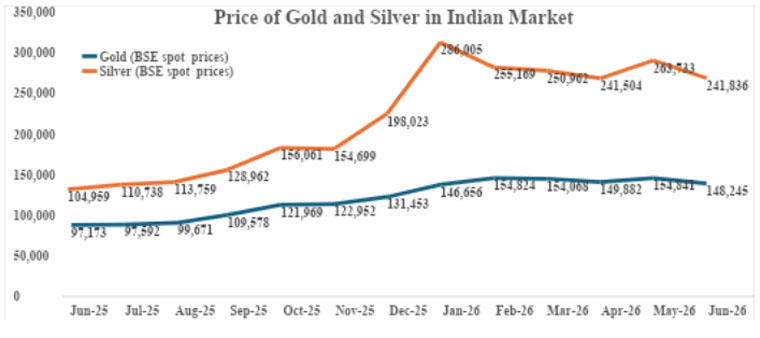
Chart 3: Gold and Silver Prices
These five trilemmas collectively illustrate that policymaking in a large, open, democratic, and rapidly developing economy is fundamentally an exercise in balancing competing objectives rather than maximising each one independently. This thought is succinctly captured in these Urdu lines,
“ज़िंदगी के अजब ही अफ़साने हैं यहाँ,
तीर भी चलाने हैं और परिंदे भी बचाने हैं।”
Translation: Life has its own strange stories here; here, we must fire arrows and yet save the birds as well.
They also underscore an important lesson: there are no costless choices in economic policy- you cannot have your cake and eat it too! Every gain entails an opportunity cost, and every policy intervention generates trade-offs that must be carefully evaluated. The quality of governance, therefore, is determined not by the ability to eliminate these trade-offs but by the wisdom with which they are managed.
For India, the challenge is especially formidable. It must simultaneously sustain rapid economic growth, preserve macroeconomic stability, generate productive employment, ensure social inclusion, maintain fiscal prudence, accelerate the green transition, strengthen strategic autonomy, and deepen integration with the global economy. Successfully navigating these multiple trilemmas will determine whether India can convert its demographic dividend, digital transformation, and geopolitical opportunities into durable, sustainable, and inclusive prosperity. The road ahead demands not ideological rigidity but pragmatic policymaking, institutional resilience, and a willingness to continuously recalibrate policies in response to an increasingly uncertain and interconnected world.
“The Times They Are A-Changin’” (Bob Dylan, 1964)-Resetting Strategic Priorities
Strengthening Macroeconomic Stability
Maintaining low inflation, sustainable fiscal deficits and orderly exchange-rate adjustment remain fundamental. Close coordination between monetary and fiscal authorities will become increasingly important if global commodity prices remain elevated.
Accelerating Energy Transition
India must significantly expand renewable energy, battery storage, nuclear power, electric vehicles, green hydrogen and energy-efficient industrial technologies. Reducing dependence on imported fossil fuels would simultaneously improve energy security, external stability and environmental sustainability.
Enhancing Manufacturing Competitiveness
PLI schemes have provided initial momentum, but sustained competitiveness requires efficient logistics, modern ports, reliable power, skilled labour, predictable taxation and simplified regulation. Government initiatives such as PM GatiShakti and the National Industrial Corridor Development Programme should continue to strengthen India’s integration into global value chains, particularly in electronics, semiconductors, defence, pharmaceuticals and renewable-energy equipment.
Investing in Human Capital
India’s demographic dividend can only be realised through sustained investment in education, healthcare, vocational training and digital skills. Future growth will increasingly depend on capabilities in artificial intelligence, semiconductors, robotics, biotechnology, advanced manufacturing and green technologies. Continuous skilling and reskilling must become central components of national development strategy.
Modernising Agriculture
Agriculture must become more productive, resilient and market-oriented. Expanded irrigation, climate-resilient farming, improved storage, food processing, crop diversification and greater use of technology can simultaneously raise farm incomes and moderate food-price volatility.
Leveraging Digital Public Infrastructure
India’s digital public infrastructure, including Aadhaar, UPI, Direct Benefit Transfer (DBT) and digital governance platforms, has become a major competitive advantage. The next phase should integrate artificial intelligence, digital health, education technology, supply-chain digitisation and data-driven public administration to improve productivity and service delivery and emerge as a game changer.
Strengthening Institutions
Institutional quality increasingly determines investment decisions. Transparent regulation, efficient dispute resolution, stable taxation, effective contract enforcement and credible statistical systems are essential for sustaining investor confidence and attracting long-term capital.
Employment and Private Investment
Public investment has successfully supported economic recovery, but private investment must become the principal engine of future growth. A sustained revival of corporate investment depends on stronger demand, policy stability, infrastructure quality, lower financing costs and improved access to international markets. Employment generation deserves equal priority. Labour-intensive manufacturing, construction, tourism, logistics, healthcare, education, digital services and export-oriented industries possess significant potential to create productive jobs for India’s expanding workforce.
India’s Geoeconomic Strategy
India’s external economic strategy should continue leveraging strategic partnerships while diversifying trade, technology and investment relationships. Cooperation in semiconductors, critical minerals, clean energy, defence manufacturing and advanced technologies can reduce dependence on concentrated supply chains. Simultaneously, India’s large domestic market remains a major attraction for global investors. However, sustained FDI inflows will increasingly depend upon regulatory certainty, legal predictability and institutional credibility.
Way Ahead
The Indian economy is at an inflexion point. The recent deterioration in the global environment, characterised by higher oil prices, geopolitical tensions, exchange-rate volatility and uncertain financial conditions, has undoubtedly increased near-term risks. Yet India’s underlying strengths remain substantial. Robust domestic demand, healthy financial institutions, resilient services exports, expanding digital infrastructure, improving credit conditions and renewed investor interest provide significant buffers against external shocks. The larger challenge is to translate resilience into sustained transformation. Rather than focusing solely on headline GDP rankings, India must strengthen the foundations of long-term prosperity through higher productivity, better institutions, fiscal discipline, technological capability and quality employment. As Muhammad Iqbal wrote eloquently:
“ख़ुदी को कर बुलंद इतना
कि हर तक़दीर से पहले,
ख़ुदा बंदे से ख़ुद पूछे,
बता तेरी रज़ा क्या है।”
Translation: Make yourself so strong that before destiny is written, God Himself asks you: “Tell Me, what is your wish?”
Given this macroeconomic setting, the priorities are clear:
- Accelerate structural reforms in manufacturing, logistics and factor markets.
- Improve institutional capacity, governance and policy predictability.
- Maintain credible fiscal consolidation while protecting productive public investment.
- Diversify energy sources and trading partners to reduce external vulnerabilities.
- Invest aggressively in human capital, innovation and digital technologies.
- Create productive employment through labour-intensive manufacturing and globally competitive services.
The conclusion of the Monthly Economic Review of the Department of Economic Affairs, Government of India (July 2026) would enjoy a fair measure of consensus. The Review held, “There is no doubt that the economy has continued to demonstrate resilience amid a challenging global backdrop. Nonetheless, global challenges show no sign of letting up, with uncertainties mounting. So, India has to reinvent itself and reimagine its responses to global imperatives if it has to achieve strategic leverage. As external conditions evolve, the continued interplay of domestic reforms, prudent macroeconomic management and swift policy responses, backed by consistent on-ground implementation, will remain important in shaping India’s economic trajectory.”
India cannot influence global oil prices, geopolitical conflicts or international interest rates. C. Rangarajan and D. K. Srivastava in their perceptive piece in The Hindu (“India’s Economic Prospects after the West Asian Crisis”, July 8, 2026) have cogently argued, “The prospects of the Indian economy … is on the assumption that peace will prevail in West Asia from now on. If this assumption turns out to be incorrect and if the war continues, India along with many other countries will face an extremely difficult situation”.
India must strengthen its own competitiveness, resilience and institutional capacity. The next phase of economic policy must therefore combine macroeconomic stability with structural reform, productivity with inclusion, and ambition with prudence. If these priorities are pursued consistently, India will not merely withstand global turbulence but emerge as a more productive, innovative and globally influential economic power, translating resilience into sustained and inclusive prosperity. There is no substitute for coordinated and concerted effort with a sense of urgency. As a famous centuries-old Sanskrit saying aptly puts it,
“उद्यमेन हि सिद्ध्यन्ति कार्याणि न मनोरथैः।
न हि सुप्तस्य सिंहस्य प्रविशन्ति मुखे मृगाः॥”
Translation: Tasks are accomplished through effort, not merely by wishes or daydreams. Just as no deer walks into the mouth of a sleeping lion, success does not come without hard work.
Disaggregated Picture
India in July 2026 presents a mixed picture. Let us examine some important metrics for a proper assessment and perspective. Since this information and data are given in the form of tables and charts, they are explicit and self-explanatory. Hence, no attempt is made once again to explain these data points.
ABOUT THE AUTHOR
 Dr. Manoranjan Sharma is Chief Economist, Infomerics, India. With a brilliant academic record, he has over 250 publications and six books. His views have been cited in the Associated Press, New York; Dow Jones, New York; International Herald Tribune, New York; Wall Street Journal, New York.