There is something strangely beautiful about the coincidence.
In November 2023, Samantha Harvey published Orbital, a slender, lyrical novel about six astronauts and cosmonauts aboard the International Space Station. A year later, it won the 2024 Booker Prize. Its characters circle Earth sixteen times in a single day, watching continents, oceans, storms, glaciers and deserts pass beneath them, while gradually confronting a question larger than space itself: what does it mean to be human when you can see the whole of humanity below you?
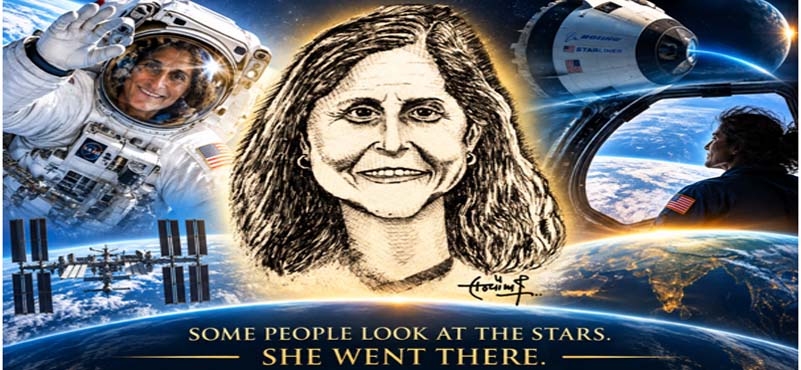
Then, in June 2024, Sunita Williams went into that very world. Except hers was not fiction. She launched aboard Boeing’s Starliner with Barry “Butch” Wilmore for what was expected to be a short test mission. Technical problems changed everything. Their planned stay stretched from days into weeks, then months, and finally 286 days. Starliner returned to Earth without them; Williams and Wilmore eventually came home aboard SpaceX’s Dragon in March 2025.
Reading Orbital alongside the story of Sunita Williams made something clear to me: Harvey imagined the emotional truth of living above Earth; Williams lived it.
Sunita Williams was born on 19 September 1965 in Euclid, Ohio, to Dr Deepak Pandya and Bonnie Pandya. Her father was of Indian origin, while her mother was of Slovenian ancestry. She grew up in Needham, Massachusetts, and eventually found her first great calling not in space, but in the United States Navy.
She graduated from the U.S. Naval Academy in 1987 with a degree in physical science and earned a master’s degree in engineering management from the Florida Institute of Technology. In 1989 she became a naval aviator. She flew helicopters, served operationally, became a test pilot and instructor, and accumulated thousands of hours across numerous aircraft before NASA selected her as an astronaut in 1998.
That journey is important because it tells us something about fame.
Sunita Williams did not become famous because she was selected for a glamorous destination. She became famous because she spent years preparing herself for environments in which mistakes have consequences. That is perhaps the first lesson of her life: extraordinary destinations are usually reached through very ordinary disciplines practised extraordinarily well.
Williams first travelled into space in December 2006 aboard Space Shuttle Discovery. She became part of Expeditions 14 and 15 aboard the International Space Station and conducted four spacewalks. Her second long-duration mission came in 2012, when she spent 127 days aboard the station as part of Expeditions 32 and 33. She became commander of Expedition 33 and conducted three further spacewalks.
She also became the first person to run a marathon in space, completing the Boston Marathon virtually while running on the station’s treadmill.
These details are delightful, but they also reveal something about her personality. Space did not turn Williams into an austere symbol of human achievement. She carried ordinary human enthusiasm with her into an extraordinary environment.
Perhaps that is why Orbital resonates so strongly with her story.
Harvey’s astronauts see Earth repeatedly—not as a collection of countries, arguments and borders, but as one luminous object suspended in darkness. The Booker judges described the novel as a work in which six astronauts observe “the fragility of borders and time zones.”
Then came Starliner.
On 5 June 2024, Williams and Wilmore launched aboard Boeing’s Starliner on its first crewed flight. They reached the International Space Station the following day. But thruster problems and helium-system leaks created uncertainty about the spacecraft’s ability to safely return its crew. NASA ultimately decided that Starliner should return uncrewed.
That decision transformed an eight-day mission into a 286-day experience.
The phrase “stuck in space” is convenient journalism, but it does not quite capture the human reality. Williams did not know exactly when she would come home. But she continued to work on her research. She maintained the station. She exercised. She participated in scientific and operational activities. Eventually, she once again became commander of the International Space Station. That is where the Starliner story becomes more than a story about technology. It becomes a story about waiting without surrendering purpose. The spacecraft may have failed to follow its original timetable. Williams did not allow her life to do so.
This is where Orbital became, for me, an unexpected companion to the Williams story. Samantha Harvey wrote her novel largely during the COVID lockdowns, using footage of Earth from the International Space Station as a constant visual reference. She described the experience as writing about people living in a “tin can” while being able to look at the entire planet. Harvey asks us to imagine what happens to human consciousness when borders disappear beneath us. Williams gives us the lived answer. From orbit, India is not separated from Pakistan by a line visible from space. Europe is not divided from Asia by political argument. A hurricane does not recognise a passport. The atmosphere does not belong to one nation.
That is the extraordinary complementarity between the two women. One travelled into space through imagination. The other travelled into space through engineering, discipline and courage. One wrote about astronauts looking down at Earth. The other actually looked down. One made us feel the fragility of the planet through fiction. The other spent 286 days living inside that fragility. Together, they make space feel less like an escape from Earth and more like a new way of seeing it.
NASA records that Williams spent 608 cumulative days in space across three missions. She completed nine spacewalks, totalling 62 hours and six minutes, the most spacewalking time by a woman and fourth-most on NASA’s all-time list. She also became the first person to run a marathon in space. Her 286-day Starliner-related mission ranks among the longest single spaceflights by an American.
But records eventually become statistics.
Williams retired from NASA on 27 December 2025 after 27 years with the agency. By then, she had travelled from naval aviation to the International Space Station, from test pilot to commander, from a short Starliner test flight to an unexpected nine-month orbital mission. Her career demonstrates that leadership is not always about controlling circumstances. Sometimes it is about responding magnificently when circumstances refuse to be controlled.
At 61, Sunita Williams’s story has acquired a perspective that was perhaps impossible to see when she first became an astronaut. Yet the most important thing she brought back was not a record. It was perspective. From space, Earth has no borders. It has one atmosphere, one fragile blue skin and billions of human beings sharing the same thin envelope of life.
She went into orbit to explore the universe; she returned with a lesson about the one planet we all share.
ABOUT THE AUTHOR
Lt Gen Rajeev Chaudhry (Retd) is a social observer and writes on contemporary national and international issues, strategic implications of infrastructure development towards national power, geo-moral dimension of international relations and leadership nuances in changing social construct.