

Two blows to India’s energy security landed in the same week, and neither was of India’s making. Saudi Aramco has reportedly halted crude supplies to Indian refiners after an attack shut down the kingdom’s East-West pipeline, the workaround Riyadh uses to move oil to its western ports when the Strait of Hormuz is unsafe. That strait has been disrupted since the end of February. Together, the two chokepoints have cut off more than 400,000 barrels a day bound for India, according to Bloomberg, at a moment when Brent has already climbed past 105 dollars a barrel. Saudi crude makes up roughly nine percent of India’s imports since the current Gulf conflict began, so this is not a marginal supplier walking away. It is one of the older, steadier relationships in India’s crude basket suddenly going quiet.
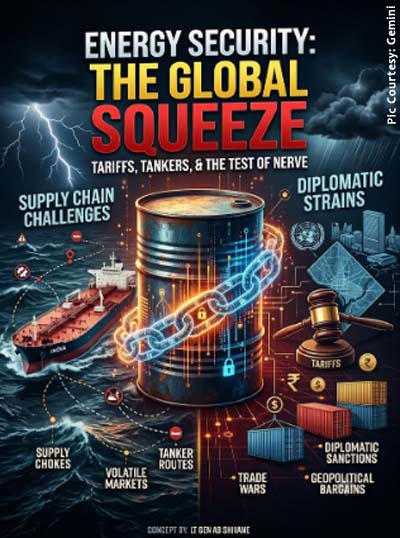 The second blow is still unfolding in Washington. The US House passed the Lindsey Graham Sanctioning Russia and Iran Act by a wide margin. The bill would give President Trump the authority to impose tariffs of up to 100 percent on countries that continue buying Russian oil and gas. India and China are the obvious targets. This comes on top of a bruising year: a 50 percent tariff applied for much of 2025, rolled back to 18 percent in February 2026 only after India committed to cutting Russian purchases and deepening defence ties with Washington. If Trump signs this bill, that February bargain effectively unravels, and India is back to negotiating trade policy at gunpoint. As of this writing, the Senate vote has reportedly been delayed, so nothing is final, but the direction of travel is clear enough that New Delhi cannot afford to wait and see.
What makes this moment genuinely hard is that the two crises pull in opposite directions. India leaned on discounted Russian crude to cushion the loss of predictability elsewhere, and that crude now supplies a large share of what refiners process. Washington wants that share gone. At the same time, one of the Gulf suppliers that could plausibly replace it has just gone offline. India is being squeezed from both ends of the same barrel.
None of this should trigger panic, but it does call for a plan with several moving parts.
First, buy time with reserves. India holds strategic petroleum stocks, though by most public estimates they cover only a matter of days, not weeks, so this buys breathing room rather than a solution. Refiners can also draw on the spot market. Aramco itself is reportedly still selling spot cargoes, some of which may still reach India through the Strait of Hormuz, though without the certainty of a term contract.
Second, further widen the supplier base beyond what it already is. The diversification over the last decade towards US, West African and Latin American grades was built for exactly this kind of shock. It should be pushed harder now, even at a cost premium, because paying more for certainty beats a refinery running below capacity.
Third, pursue diplomacy on both fronts simultaneously. With Riyadh, the ask is straightforward: restore the term contracts once the pipeline is repaired, and treat this as a one-off disruption rather than a redrawing of the relationship. With Washington, India’s negotiators have precedent to cite. Pharmaceuticals and smartphones have already been carved out of earlier tariff rounds, so carve-outs are not unprecedented when the economic case is made well. That argument needs to be made now, before a bill becomes law, rather than after.
Fourth, treat this as another argument for accelerating what India was already doing: expanding renewable capacity, pushing domestic exploration, and giving refiners the flexibility to process a wider range of crude grades so no single supplier or sanctions regime can do this much damage again. This is a slower lever, but every barrel of demand that doesn’t need to be imported is one less pressure point for either Riyadh or Washington to lean on.
Underneath all of this lies a familiar strategic question. India has spent years trying not to choose between Washington and Moscow, buying cheap Russian crude while deepening a defence and technology partnership with the US. That balancing act is now being tested from a third direction entirely, a Gulf supply shock nobody scripted. The right response is not louder rhetoric in either direction. It is a calm, well-briefed diversification strategy, quiet diplomacy conducted before deadlines rather than after, and an energy security desk inside government that is watching this hour by hour rather than briefing the press once a week. The numbers in this piece could be out of date within days. The strategy behind them should not need to be.
ABOUT THE AUTHOR
 Lieutenant General A B Shivane, is the former Strike Corps Commander and Director General of Mechanised Forces. As a scholar warrior, he has authored over 200 publications on national security and matters defence, besides four books and is an internationally renowned keynote speaker. The General was a Consultant to the Ministry of Defence (Ordnance Factory Board) post-superannuation. He was the Distinguished Fellow and held COAS Chair of Excellence at the Centre for Land Warfare Studies 2021 2022. He is also the Senior Advisor Board Member to several organisations and Think Tanks.