Lawrence Wong, Prime Minister of Singapore, has rightly cautioned that the world today confronts a grave and deepening crisis — one marked by slowing growth, persistent inflationary pressures, geopolitical fragmentation, financial instability, and the ominous spectre of “stagflation.” The optimism that once accompanied globalisation and unprecedented economic integration is steadily giving way to anxiety, uncertainty, and strategic distrust. This poly-crisis reminds us of the famous lines of the Urdu poet Muin Ahsan Jajbi,
“जब कश्ती साबित–ओ–सालिम थी साहिल की तमन्ना किस को थी
अब ऐसी शिकस्ता कश्ती पर साहिल की तमन्ना कौन करे”
English translation:
“When the boat was sound and unbroken, who cared to reach the shore?
Now, upon such a shattered boat, who would even wish for the shore?”
After the Cold War, many believed that growing trade and deeper economic ties would naturally bring more stability and prosperity. But supply chains have become battlegrounds of strategic rivalry. Trade wars, sanctions, technology embargoes, disruptions in energy and commodity markets, armed conflicts, and growing protectionism are steadily eroding the foundations of the liberal global economic order that underpinned decades of growth.
This time has seen countries become more connected than ever before. Capital, technology, energy, information, and markets now move across borders with unprecedented speed. Yet the same interconnectedness that once accelerated prosperity has also amplified vulnerability. A banking tremor in one region, a war in another, a shipping disruption in a distant sea lane, or an energy shock thousands of miles away can now trigger cascading consequences across continents within days. No country can stay completely unaffected; no country can be an “island in the stream” (Nobel Laureate Ernest Hemingway).
India has proclaimed for millennia through the timeless civilisational maxim “Vasudhaiva Kutumbakam” — the world is one family. Today, this ancient wisdom acquires renewed relevance. Humanity’s destinies are now inextricably linked. When turbulence engulfs the global order, every nation inevitably feels the impact, though the burdens are distributed unevenly. Emerging economies, heavily dependent on imported energy, volatile capital flows, and external markets, are particularly exposed to this irreversible structural transition in the global economy.
The world is facing a prolonged era of instability rather than a temporary economic downturn— an age characterised by slower growth, higher costs of living, strategic competition, technological disruption, demographic pressures, climate-related shocks, and mounting fiscal stress. The old certainties no longer hold. The age of easy money, cheap energy, frictionless globalisation, and limitless consumption is ending. A harsher economic realism is beginning to replace it.
Impact of the Global Scenario on India
India may be in a stronger position than many other economies to withstand the present geopolitical stress test. However, it cannot remain insulated from the tectonic shifts reshaping the global order. Recent developments have decisively exposed the fallacy of the so-called “decoupling hypothesis.” India’s deep integration with global energy markets, capital flows, supply chains, trade corridors and investor sentiment makes any notion of economic isolation unrealistic. India today is simply too large, too interconnected and too consequential to decouple from global turbulence. The cascading impact of the intensifying Middle Eastern crisis illustrates this vulnerability with stark clarity.
Rising crude oil prices (Petroleum, Oil, and Lubricants, sometimes called POL in the RBI’s lexicon) threaten to transmit inflationary pressures across the Indian economy, widening the import bill, exacerbating the current account deficit (CAD) and straining fiscal calculations. In other words, the grim situation worsens the triple deficits – the trade deficit, the CAD and the fiscal deficit – not a pretty picture, is it?
Financial markets have already reacted sharply: benchmark indices declined by nearly 2 per cent over May 11–12, 2026, wiping out an estimated Rs. 17 lakh crore in investor wealth within just forty-eight hours. Retail inflation, which had remained relatively contained in recent months, edged up to a four-month high of 3.5 per cent in April 2026, raising concerns over imported inflation, particularly in fuel, transport and food prices.
The Rupee: Steady Fall
My papers and interviews across both print and electronic media have consistently emphasised that the link between economic strength and currency strength is neither linear nor automatic. A robust economy does not translate mechanically into a proportionately stronger currency. While sustained economic performance can support a currency over the medium term, exchange rates are ultimately financial variables driven by capital flows, relative investment returns, and shifts in global risk sentiment.
In the Indian context, several structural factors help explain this divergence. India remains heavily dependent on imports, particularly crude oil, electronics, machinery, and gold. Unfavourable interest rate differentials relative to the United States and other advanced economies have also constrained support for the rupee. Persistently higher domestic inflation compared with key trading partners has also eroded the rupee’s competitiveness over time; while recurring current account deficits have continued to pressure the external balance. These domestic vulnerabilities have been further amplified by global developments, including prolonged phases of U.S. dollar strength, episodes of heightened risk aversion, and elevated commodity and crude oil prices.
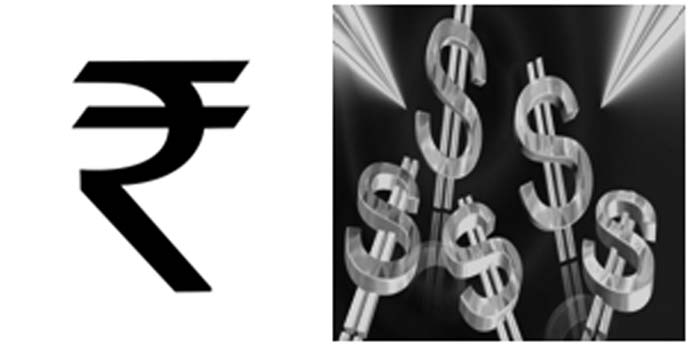
Against this backdrop, the Indian rupee continued to weaken and slipped further, touching a fresh record low of ₹95.80 against the U.S. Dollar on May 13, 2026. The depreciation stemmed from rising crude oil prices, sustained capital outflows—triggered partly by higher capital gains taxes and a significant reallocation of global funds toward AI-led markets in Taiwan and South Korea—and mounting external sector pressures. The ongoing West Asia crisis and the consequent surge in energy prices intensified these challenges.
Although a weaker rupee may provide some support to exports, it simultaneously increases import costs and fuels domestic inflationary pressures. Reserves reached approximately US$688 billion as of April/May 2025 and have been reported in the $688–$704 billion range in early 2026. The RBI’s efforts to stabilise the currency have also come at a cost, resulting in a drawdown of nearly US$40 billion in foreign exchange reserves, which declined to US$688 billion.
Broader Picture
Yet these broad indicators show only part of the picture. Nearly 85 per cent of India’s crude oil requirement is imported, making the macroeconomy acutely susceptible to disruptions in West Asian energy supplies and maritime trade routes. Any prolonged escalation in the region could push Brent crude well beyond current levels, aggravating pressure on both the economy and household consumption. Elevated energy costs would inevitably ripple through manufacturing, logistics, aviation, fertilisers, and power generation, potentially slowing industrial output and dampening economic momentum.
Moreover, global uncertainty has begun to trigger classic “risk-off” investor behaviour. Foreign institutional investors are reassessing exposure to emerging markets, leading to heightened volatility in Indian equities and debt markets. Currency depreciation, while beneficial for certain export sectors, simultaneously raises the cost of imports, external borrowing, and corporate balance-sheet servicing. The resulting policy dilemma for the Reserve Bank of India is becoming increasingly complex: defending currency stability without excessively tightening liquidity or compromising growth.

The geopolitical climate is also speeding up a wider fragmentation of the global economic architecture. Trade realignments, sanctions regimes, disruptions to shipping lanes, weaponisation of technology, and strategic competition among major powers are reshaping the contours of globalisation itself, as clearly reflected in my steadily burgeoning body of publications during the last four decades.
For India, this brings both risks and opportunities. Decelerating global demand and supply-chain uncertainty could constrain exports and investment inflows. Multinational corporations (MNCs) seeking diversification away from concentrated manufacturing hubs, however. increasingly view India as a strategic alternative, particularly in electronics, semiconductors, defence manufacturing, pharmaceuticals, and digital services. This makes for a peculiar mix: as the famous opening line of Charles Dickens’ 1859 novel A Tale of Two Cities goes, “It was the best of times, it was the worst of times”. This almost two-century-old sentence captures an era of extreme contradictions well, highlighting both immense progress and profound upheaval, and it resonates effectively today. India’s relative resilience stems from several structural strengths: robust domestic consumption, strong foreign exchange reserves, a diversified services sector, rapid digitalisation, and sustained public infrastructure investment. However, resilience must not be mistaken for immunity.
The current crisis highlights India’s need to strengthen its energy security, diversify import sources, accelerate renewable energy adoption, strengthen export competitiveness, and reduce dependence on volatile external capital. The unfolding global disorder is not just a temporary economic shock; it marks a strategic turning point. India enters this uncertain era from a position of relative strength, but the scale and interconnectedness of the Indian economy ensure that external tremors will continue to reverberate domestically. The challenge before policymakers is not merely to weather the storm, but to convert this period of disruption into an opportunity for long-term strategic and economic repositioning.
Where Do We Go from Here?
So this is no time for complacency. It is not a time to bury our heads ostrich-like in the sand and hope the storm will pass of its own accord. Nor can nations afford the dangerous illusion that temporary relief measures or political rhetoric alone can shield societies from deeper structural challenges.
Rather, this is the hour for realism, resilience, and resolute action. Prudence must replace excess; discipline must triumph over-indulgence. Governments, institutions, businesses, and households alike must recognise that difficult periods demand difficult adjustments. Economic endurance will increasingly depend not merely on wealth creation but on financial discipline, strategic foresight, and national cohesion.
In difficult times, thrift is not merely a personal virtue; it becomes an economic necessity. A penny saved today may well become the basis of stability tomorrow. Across history, societies that cultivated moderation, savings, productive investment, and social discipline have weathered crises more successfully than those driven by speculative excess and consumerist exuberance.
Recent developments show just how serious the challenge is. Reports indicate that import duties on gold and silver have been sharply increased from 6% to 15%, reflecting the urgent need to curb non-essential imports and preserve macroeconomic stability. Gold imports — second only to crude oil and petroleum products in India’s import bill — exert substantial pressure on foreign exchange reserves and widen the structural imbalance in the balance of payments. Excessive dependence on imported commodities leaves economies vulnerable to exchange-rate volatility, external shocks, and sudden reversals in global capital flows.
India’s vulnerability is not limited to gold. The nation’s growth engine still runs on imported crude oil, electronics, semiconductors, fertilisers, and advanced technologies. A shock in any of these global supply chains can instantly ripple through the economy — driving inflation, weakening the rupee, slowing industry, and straining public finances. The writing on the wall is clear; the message of history is unmistakable: nations that fail to secure critical resources pay the price in instability. For India, strategic self-reliance is no longer a distant aspiration. It is the unavoidable cornerstone of economic survival and long-term sovereignty.
In a time of growing uncertainty, wasteful consumption and luxury-driven expenditure are no longer sustainable models of economic behaviour. What is required instead is the cultivation of a national ethos rooted in restraint, responsibility, productivity, and long-term thinking. An austerity drive — not born of panic but of prudence — must permeate every level of society.
We must rationalise energy consumption, minimise waste, encourage domestic production, strengthen savings, reduce avoidable imports, and discourage conspicuous consumption. The culture of ostentation and competitive materialism — the endless race of “keeping up with the Joneses,” where prestige is measured by display rather than substance — weakens both social resilience and economic sustainability. Nations, like households, cannot indefinitely spend beyond their means without eventually inviting painful consequences.
It is equally important to shift national priorities toward productive capacity. Investment in infrastructure, manufacturing, agriculture, technological innovation, renewable energy, education, and skill development must take precedence over speculative consumption. Economic sovereignty in the twenty-first century will increasingly belong to nations capable of producing critical goods, securing energy supplies, building technological competence, and maintaining food security under adverse global conditions.
This also requires a psychological shift. Societies accustomed to uninterrupted growth and rising consumption must prepare for a world where volatility is the norm- “the new normal”, so to speak. Economic resilience will depend not only on government policy but also on public attitudes — patience instead of panic, discipline instead of excess, cooperation instead of fragmentation.
History, however, gives us reasons to stay confident. As I have repeatedly demonstrated, India has weathered crises far more daunting than the present one — colonial exploitation, partition, wars, droughts, sanctions, oil shocks, food shortages, financial crises, pandemics, and periods of profound geopolitical uncertainty. Each time, through resilience, sacrifice, institution-building, and collective determination, the nation emerged stronger.
The generation that fought for India’s freedom endured the “trial of adversity.” Ours may well be the “trial of prosperity” — the challenge of preserving national stability, social cohesion, and economic balance in an age of abundance, aspiration, and global turbulence. Prosperity without discipline breeds fragility; growth without resilience invites instability.
Yet there is no cause for fatalism or despair. India possesses immense structural strengths: a young population, entrepreneurial dynamism, technological capability, democratic institutions, agricultural capacity, and a growing strategic role in the emerging multipolar world. If guided wisely, these strengths can help the nation not merely withstand the coming turbulence but emerge more self-confident, more resilient, and more globally influential.
Until calmer waters prevail, however, caution must guide both policy and conduct. This is the time for measured decisions, financial conservatism, strategic self-reliance, institutional integrity, and national solidarity. Governments must govern responsibly; corporations must invest responsibly; citizens must spend responsibly.
If we act with foresight, discipline, and a shared purpose, today’s trials can become the crucible from which a stronger and more resilient India emerges — an India better aligned with the challenges of the present and the expectations of the future. The road ahead may indeed be difficult, but difficulty is not destiny. With prudence, courage, and collective resolve, the nation can navigate this uncertain era not with fear, but with confidence tempered by realism. This will enable us to meet the challenges of today and the expectations of tomorrow. Difficult, yes, but not undoable- no cause for all gloom and doom.
ABOUT THE AUTHOR
 Dr. Manoranjan Sharma is Chief Economist, Infomerics, India. With a brilliant academic record, he has over 250 publications and six books. His views have been cited in the Associated Press, New York; Dow Jones, New York; International Herald Tribune, New York; Wall Street Journal, New York.