
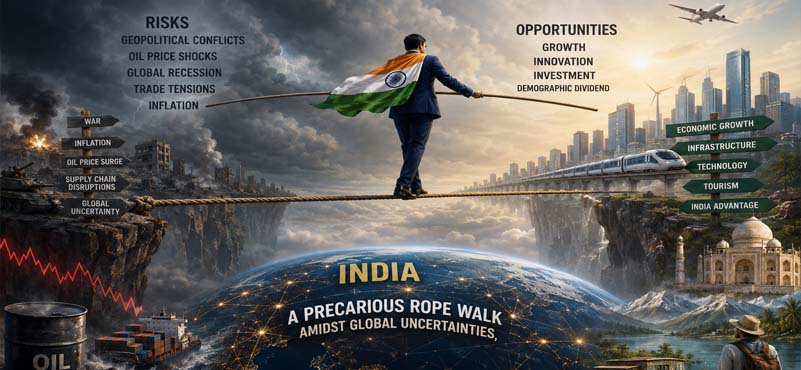
The global economy entered the second half of 2026 confronting a convergence of forces that are reshaping economic prospects, financial markets, business strategies, and public policy. Geopolitical tensions in West Asia, rising energy prices, the rapid advancement of artificial intelligence (AI), growing climate-related disruptions, and evolving monetary policy challenges have created a highly uncertain environment for policymakers and investors alike.
Yet amid these uncertainties, India continues to demonstrate remarkable economic resilience. Supported by macroeconomic stability, a robust external sector, strong services exports, and accelerating digital transformation, India remains one of the brightest spots in the global economy.
Global Growth Faces New Headwinds
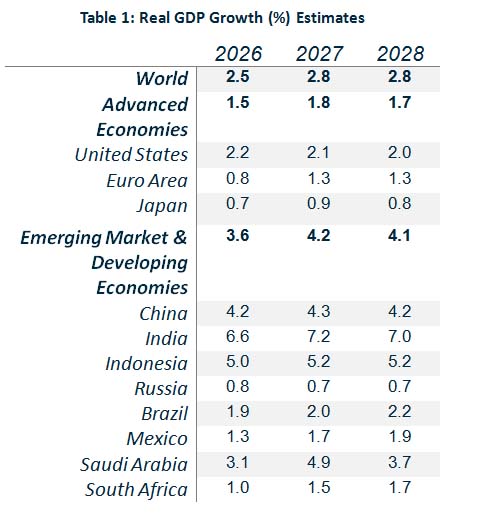
According to the World Bank’s Global Economic Prospects (June 2026), global economic growth is projected to slow from 2.9 per cent in 2025 to 2.5 per cent in 2026 (Table 1), marking the weakest expansion since the pandemic years. Higher energy prices, geopolitical disruptions, inflationary pressures, and tighter financial conditions are weighing on economic activity across regions.
Advanced economies are expected to record modest growth of around 1.5 per cent, while many emerging economies face rising debt burdens and narrowing fiscal space. The United States is projected to grow by 2.2 per cent, while growth in the Euro Area is expected to remain subdued at 0.8 per cent.
Against this backdrop, India is projected to remain the world’s fastest-growing major economy, with growth estimated at 6.6 per cent in 2026. China, by comparison, is expected to grow by around 4.2 per cent. The divergence highlights India’s growing importance as a driver of global economic growth.
The World Bank also identifies artificial intelligence, clean energy investment, and regional economic integration as potential engines of long-term productivity growth capable of transforming the global economy over the next decade.
India’s Economy Remains Resilient
Recent macroeconomic indicators suggest that India’s economic fundamentals remain relatively strong despite global turbulence.
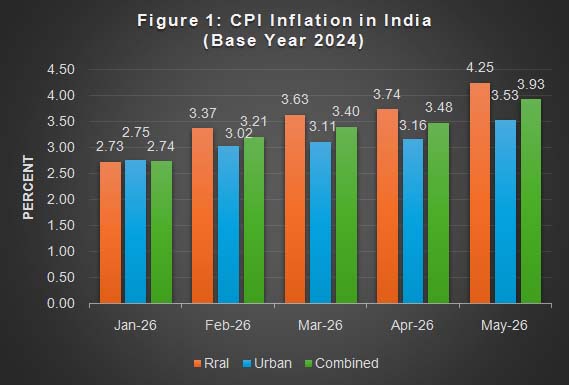
Retail inflation increased modestly to 3.93 per cent in May 2026 (Figure 1) but remained below the Reserve Bank of India’s medium-term target of 4 per cent. While food inflation accelerated due to rising vegetable prices, core inflation remained largely contained, indicating that broader price pressures are still manageable.
India’s external sector has also shown resilience. The country recorded a current account surplus in the fourth quarter of FY2025-26, supported by strong services exports and record remittance inflows. Information technology services, business services, and overseas remittances continue to provide critical support to the balance of payments.
Foreign exchange reserves experienced considerable volatility during May and early June amid geopolitical tensions and currency market interventions. Nevertheless, reserve levels remain among the highest in India’s history, providing an important buffer against external shocks.
The Reserve Bank of India has further strengthened the country’s external position by introducing a special FCNR(B) deposit mobilisation scheme designed to attract foreign currency inflows from non-resident Indians. Banks have responded by significantly increasing deposit rates, potentially encouraging substantial inflows and strengthening foreign exchange reserves.
Geopolitical Risks Return to Centre Stage
Escalating tensions involving Iran, Israel, and the United States initially triggered sharp increases in crude oil prices and renewed concerns regarding energy security. Investors worried that disruptions in the Strait of Hormuz, through which nearly one-fifth of global oil supplies transit, could lead to sustained inflationary pressures and slower global growth.
However, market sentiment improved significantly toward the end of the week following reports of possible diplomatic engagement between Washington and Tehran. Expectations of a potential agreement led to a sharp correction in oil prices and triggered a broad recovery across global financial markets.
The episode highlighted the continuing vulnerability of the global economy to geopolitical shocks. For energy-importing countries such as India, developments in West Asia remain particularly important because of their direct implications for inflation, fiscal balances, external accounts, and economic growth.
Central Banks Face New Challenges
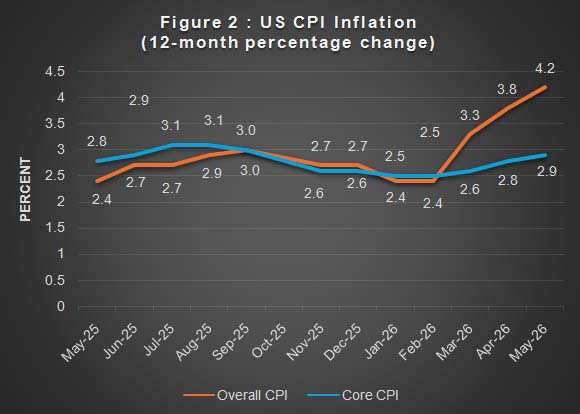
Inflation developments in major economies continue to complicate monetary policy decisions. In the United States, consumer inflation accelerated to 4.2 per cent in May 2026 (Figure 2), largely due to rising energy prices. While core inflation remained comparatively moderate at 2.9 per cent, persistent increases in housing and service-sector costs suggest that underlying inflationary pressures have not fully subsided. Higher inflation has reinforced concerns that the US Federal Reserve may need to maintain elevated interest rates for longer than previously expected. Such an outcome could affect capital flows, borrowing costs, and financial conditions globally.
Europe faces a similar dilemma. The European Central Bank recently raised policy rates by 25 basis points in response to inflationary pressures linked to higher energy costs. However, the Euro Area simultaneously faces slowing growth and weakening business confidence, raising fears of stagflation—a combination of weak growth and persistent inflation.
The policy challenge for central banks increasingly lies in balancing inflation control with the need to support economic activity amid rising geopolitical uncertainty.
Financial Markets React to Shifting Narratives
Global financial markets experienced considerable volatility during the week 08-12 June 2026. Initial concerns over energy supply disruptions and geopolitical risks triggered widespread risk aversion. Investors moved towards safe-haven assets while equity markets weakened across regions.
Sentiment improved later as crude oil prices declined and prospects for diplomatic progress in West Asia strengthened. Major equity indices in the United States, Europe, and Asia recovered strongly.
Indian markets reflected this pattern. After sharp declines earlier in the week, benchmark indices staged a powerful rebound as oil prices eased and concerns over inflation and energy costs diminished. Domestic institutional investors continued to provide strong support, offsetting substantial foreign portfolio investor outflows.
An important structural trend visible in Indian markets is the growing role of domestic investors. Mutual funds, insurance companies, pension funds, and retail investors have increasingly become the primary stabilising force in the equity market, reducing dependence on volatile foreign capital flows.
Artificial Intelligence Continues to Reshape Business
Perhaps the most transformative economic story of the decade remains the rapid advance of artificial intelligence. Several major developments during the week (08-12 June 2026) underscored the accelerating pace of AI-driven change.
Meta announced a partnership with Reliance Industries to establish its first AI-focused data centre in India. The project represents a major endorsement of India’s digital infrastructure ecosystem and highlights the country’s growing role in the global AI economy.
Tata Consultancy Services entered into a strategic partnership with Anthropic, one of the world’s leading AI companies. The collaboration is expected to accelerate enterprise AI adoption across sectors including financial services, healthcare, telecommunications, and public administration.
Meanwhile, Nvidia strengthened partnerships with South Korean technology leaders SK Hynix and Naver to secure access to advanced memory chips required for next-generation AI systems. The agreements highlight the strategic importance of semiconductor supply chains in the emerging AI era.
These developments demonstrate that AI is rapidly moving from experimentation to large-scale commercial deployment. Countries and firms capable of investing in digital infrastructure, talent development, and innovation ecosystems are likely to gain significant competitive advantages.
The Rise of Space Economy and New Wealth Creation
The emergence of Elon Musk as the world’s first trillionaire underscores the extraordinary wealth creation driven by technological innovation and capital markets. The milestone was driven largely by the extraordinary success of SpaceX, which completed a record-breaking $75 billion initial public offering and achieved a valuation approaching $1.8 trillion. The achievement reflects the growing economic significance of frontier technologies including space exploration, satellite communications, AI, robotics, and advanced manufacturing.
Beyond its symbolic significance, Musk’s rise highlights how technological innovation is increasingly becoming a primary source of wealth creation in the twenty-first century. It also raises important questions regarding market concentration, corporate influence, and the governance of transformative technologies.
Agriculture Confronts New Challenges
Agriculture remains central to India’s economic and social landscape. Recent discussions on agricultural reform have increasingly focused on improving market efficiency, promoting crop diversification, and facilitating labour mobility out of low-productivity farming activities.
At the same time, the government faces growing fiscal pressures. Food subsidy expenditures are expected to rise due to higher procurement costs and increased minimum support prices. Fertiliser subsidies may increase sharply because of rising global fertiliser prices linked to geopolitical disruptions.
Yet encouraging developments are also emerging. Purchases of organic manure during the ongoing kharif season have increased significantly, suggesting growing adoption of sustainable farming practices. Greater emphasis on soil health and balanced nutrient management could contribute to more resilient agricultural systems over the long term.
Climate Change Emerges as a Defining Economic Risk
Western Europe experienced exceptionally early and intense heatwaves, with temperatures reaching record levels in several countries. Scientists increasingly link such extreme weather events to long-term climate change.
Even more significant was the official onset of El Niño conditions in the Pacific Ocean, confirmed by the US National Oceanic and Atmospheric Administration (NOAA). Climate experts warn that the current episode could become one of the strongest on record, potentially rivalling or exceeding major El Niño events such as those of 1997-98, 2015-16, and 2023-24.
A strong El Niño has implications far beyond weather patterns. It can affect agricultural production, food prices, water availability, energy demand, and overall economic activity across large parts of the world. The World Bank has already warned that El Niño-related disruptions could exacerbate food inflation at a time when fertiliser costs are elevated because of geopolitical tensions.
At the same time, encouraging progress continues in the global energy transition. The United States recorded new milestones in solar power generation, while international discussions ahead of COP31 have highlighted ambitious targets to increase the share of electricity in global final energy consumption.
These developments reinforce a central reality of the twenty-first century: climate change is no longer merely an environmental issue. It has become a fundamental macroeconomic, financial, and development challenge.
Looking Ahead
The world today has become deeply interconnected. Geopolitical conflicts influence energy prices; energy prices affect inflation; inflation shapes monetary policy; monetary policy drives capital flows; and capital flows influence growth prospects across countries.
Simultaneously, transformative technologies such as artificial intelligence are creating new opportunities for productivity growth and wealth creation, while climate change is generating new risks that increasingly affect economic outcomes.
For India, the challenge will be to navigate this complex environment while maintaining macroeconomic stability, accelerating technological innovation, strengthening climate resilience, and sustaining inclusive growth. The country’s strong economic fundamentals, expanding digital ecosystem, and growing global influence provide important advantages. However, success will ultimately depend on the ability to convert emerging opportunities into long-term competitive strengths while effectively managing the risks arising from geopolitics, climate change, and technological disruption.
This article is an abridged version of Weekend Macro by InsPIRE (Vol I, Issue 8, 13 June 2026), the weekly newsletter from the Institute for Pioneering Insightful Research Pvt. Ltd. (InsPIRE), Greater Noida. InsPIRE is a startup policy research and consulting firm specializing in economic development, international trade, financial sector, climate policy, sustainability, strategic advisory services, and executive education.
ABOUT THE AUTHOR
 Dr Debesh Roy is the Founder-Chairman of the Institute for Pioneering Insightful Research Pvt. Ltd. (InsPIRE), Greater Noida, a startup research and consulting firm (website: https://inspire-solutions.in/ ). He has over three-and-a-half decades of professional experience, including 32 years at the National Bank for Agriculture and Rural Development (NABARD). Dr Roy holds a PhD in economics, and has extensive experience in macroeconomic policy, international trade, agricultural development, infrastructure financing, financial inclusion, climate policy and sustainability.