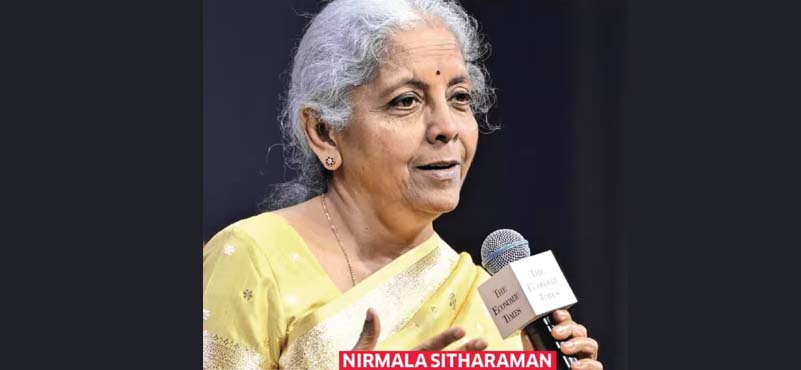
Finance Minister Nirmala Sitharaman was the chief guest at the recent ET Awards ceremony. The longest serving FM in a single continuous innings, she has weathered many a storm. Confident, never to duck any question, she reiterated the government is working on fresh reforms to ease regulatory compliance burden for India Inc, adding that a reforms package could be unveiled for businesses to temper the impact of the West Asia conflict. Sitharaman, in a conversation with Sruthijith KK, also expressed confidence that robust domestic consumption will help absorb mounting external shocks. We produce selective excerpts, keeping the questions out, for reasons of space, focussed upon what the FM said.
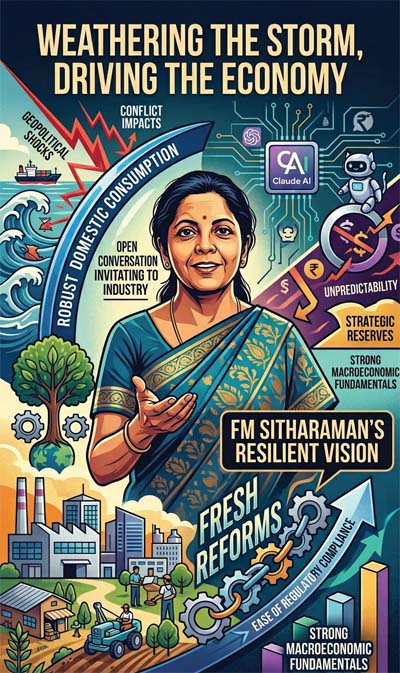 Uncertainty marked the Covid outbreak, the Russia-Ukraine war, the Israel-Iran conflict, and now the Strait of Hormuz issue. There has been uncertainty, unpredictability, and challenge for critical inputs, including fertiliser and fuel, that India and its economy need. So, it just seemed to be an unending, relentless challenge for these particular commodities, which are so critical for any country, particularly for India, because we import most of our requirements of crude oil and related products. But the blessing that we have is that we have the refining capacity, and what little we get, we use for our country and are also able to export.
- I think our domestic consumption is what is giving us that shock-absorbing capacity. So as long as we are not going to fail in keeping our consumption boosted and well supported, we can be sure to weather the storm. So, I think that is the biggest support that we have for our economy.
- There are no trade-offs. You’ll have to just work on all three simultaneously. An eternal vigil, keeping ourselves alert to the changes (is the way forward), like the latest cyber challenge that we have because of Mythos. We have spent some time in the ministry, with the banks, with government cyber agencies. Suddenly, (Anthropic’s) Claude Mythos AI model seems to have taken such a dimension that no one is aware of what exactly this animal is, and how exactly it is going to play out. Now, would you have imagined a few days or weeks ago that there is this new threat which is as big as the war threat, and which is going to hit our entire digital network? That has brought about a great change for India, and it’s a fantastic force multiplier.
- Every challenge is an opportunity. There’s no doubt. We will carry on with reforms. Not just the finance ministry but every ministry is working on how best to ease the compliance burden, the regulatory stiffness. So, work is happening on that, and you’ll gradually see a lot more things happening.
- Just when we had the additional US tariff, we came up with a package to help those who were exposed to the US market. Similarly, in December last year, we came up with a package again for people who are affected. I think it was discussed or even announced that we would give support similar to what was given during the pandemic, such as the emergency liquidity credit guarantee scheme, or something of that order, for most of the units that have been affected because of supply disruptions, price rise, or insurance risk.
- So, all this is being kept in mind, and things are being worked out.
- India has been very clear that its priority is its citizens. The government kept strategic reserves full and ready when global oil prices had crashed. And when prices went up, it extended support to oil marketing companies in bringing crude into the country and then refining and redistributing it. So, we have been very clear that what suits Indian interest will be the top of our priority—source oil from wherever it is cheap and whoever can supply the required volumes on time. So, irrespective of what anyone would say, I think the government has kept the country’s interest on top.
- Every factor—profit booking by investors, global uncertainty, the rupee-dollar exchange rate—will hold good when somebody wants to go out. Despite the fact that your macroeconomic fundamentals remain absolutely sound, the funds are going out, the investment monies are going out. There are more than just the commercial or money market principles which govern capital flows. You tend to think that if your macroeconomic fundamentals are fine, money will flow. No, it doesn’t. There are other considerations as well. And we can always flag ourselves or flog ourselves and say, more reforms are required.
- We are ready. The Prime Minister is always keen to say, ‘Go ahead with reforms, we need to make it easier for people to come and invest and operate and manufacturers; MSMEs should be able to function more easily’. We are not against reforms.
- This country needs an open conversation on this. It can’t always be “you have to do this; you have to do that”. Yes, we are ready to do all that. And under this prime minister, there is never a shut door when it comes to reforms. But please, look at what is happening. Tell us, is it our fundamentals which are worrying? Is it our inflation which has been kept completely under control for the last one-and-a-half years? Yes, the exchange rate could be a consideration.
- I’m still saying in 2023-24, India saw the highest investments into the country. Even then, we had the tax on capital gains and the STT. Yes, there was a time when everybody said, ‘It was a promise given some time ago that the STT, the tax, would be removed. I understand the logic. But that’s a question which was being asked even in 2023-24 when you had investments coming into this country. So, I’m neither saying yes nor am I saying no.
- First, if there is something which is worrying the industry, we’d love to hear it, because in response to what we had heard in 2019, we cut the corporate tax rates. Anything that has to be done for the ease of doing business, we are certainly willing to hear. Any other difficulty that stops the Indian industry from expansion or capacity building or investing in newer technologies, AI, we are willing to hear that. Your production formula itself is going through a change. So, we’ll be open to hearing anything of this sort and responding.
- Second, the domestic market still needs a lot of things for itself to be manufactured here in India. Everything that is imported also gives an opportunity to businesses to manufacture it within the country, whether these are finished or intermediate goods.
- If PM Modi is talking about Atmanirbhar Bharat, it is with the hope that Indian industry would start manufacturing those goods that we no longer need to import. So, please be in conversation with the government and tell us what you need; tell us what you want us to do so that you feel incentivised to further invest and grow. Equally, wouldn’t you want to look at the opportunities that exist within India and manufacture products instead of importing them? So, some more agility is my expectation from Indian industry.