
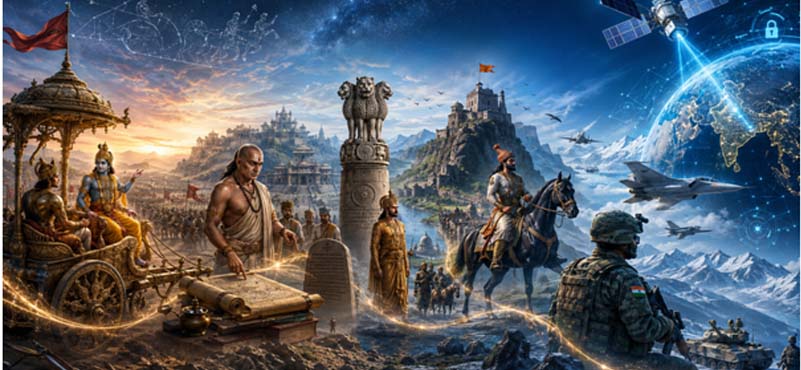
The Evolution of Indian Way of War
As Indian satellites watch over distant oceans, cyber specialists defend critical networks, and naval task forces operate across the Indo-Pacific, it is tempting to view modern warfare as a complete break from the past. The battlefields of today are populated by drones, algorithms, artificial intelligence, and precision-guided weapons. The warrior’s chariot has given way to the combat aircraft, and the spy’s whispered report to encrypted digital intelligence.
Yet beneath these technological transformations lies a deeper continuity.
India’s approach to war has never been merely about armies, weapons, or battles. It has been shaped by a civilisational understanding of power, morality, statecraft, geography, and national purpose. Across more than five millennia, India’s strategic thought has evolved from the ethical dilemmas of Kurukshetra to the cyber battlefields of the twenty-first century. Different eras produced different doctrines, but the underlying quest remained the same: how to preserve order, protect sovereignty, and secure national interests without losing moral legitimacy.
The story of the Indian way of war is therefore not simply military history. It is the story of the evolution of the Indian strategic mind.
Weapons change. Geography changes. Technology changes. The strategic questions remain remarkably constant.
Kurukshetra: Where Strategy Met Morality
The origins of Indian strategic thought lie not in a military manual but in an epic.
The Mahabharata is often viewed as a religious or literary work. Yet at its core it is also one of the world’s earliest explorations of war, power, leadership, and ethics. The battlefield of Kurukshetra is not merely a venue for combat; it is a forum where questions of justice, legitimacy, and duty are debated before the first arrow is released.
The central dilemma confronting Arjuna remains relevant even today. When is war justified? What limits should govern the use of force? Can morality survive in conflict?
The answers offered by Krishna are neither pacifist nor militaristic. They acknowledge that peace is desirable, but also recognise that evil cannot always be reasoned with. There are moments when force becomes a moral necessity.
The concept of Dharma Yuddha, or righteous warfare, established principles that resonate with modern notions of just war. Warfare was legitimate, but not limitless. Victory mattered, but so did conduct.
For India, war was never viewed as an end in itself. It was an instrument in the service of a larger moral and political order.
Kurukshetra taught India that power without morality is dangerous, but morality without power is futile.
Kautilya: Triumph of Strategic Realism
If the Mahabharata supplied the moral foundation, Kautilya provided the strategic toolkit.
Writing in a turbulent age of competing kingdoms, Kautilya approached statecraft with a realism that still appears startlingly modern. Long before Machiavelli, he understood that nations survive not through good intentions but through prudent management of power.
The Arthashastra is among the world’s most sophisticated works on strategy. It discusses diplomacy, intelligence, economics, military organisation, covert operations, alliances, and psychological warfare with extraordinary detail.
Kautilya’s famous Mandala Theory viewed neighbouring states as potential competitors and more distant powers as possible partners. It was a practical framework for navigating a complex geopolitical environment. His strategic instruments—Sama (conciliation), Daam (incentives), Danda (force), Bheda (division)—offered a spectrum of options far broader than military action alone.
For Kautilya, war was only one tool among many. The wisest ruler was not necessarily the one who fought most often, but the one who achieved objectives at the lowest cost. Intelligence gathering occupied a central place in his thinking. Spies, informants, deception, and covert influence were considered essential instruments of statecraft.
In many respects, modern concepts of deterrence, hybrid warfare, economic statecraft, and strategic partnerships reflect ideas that Kautilya articulated more than two thousand years ago.
Kautilya understood a truth that modern strategists continue to rediscover: the best victory is often the one achieved before the battle begins.
Ashoka and the Discovery of Strategic Restraint
The Mauryan Empire reached extraordinary military power under Ashoka. Yet paradoxically, Ashoka’s greatest strategic contribution emerged after a devastating military victory.
The carnage of the Kalinga campaign transformed the emperor’s worldview. Rather than abandoning power, he redefined its purpose. Ashoka shifted emphasis from conquest by the sword to influence through ideas, values, and governance. Buddhism spread across Asia not through armies but through culture, philosophy, and diplomacy. This was perhaps one of history’s earliest demonstrations of soft power.
Importantly, Ashoka did not dismantle the state. The empire remained organised and capable. What changed was the manner in which power was projected. The lesson endured. India repeatedly demonstrated a preference for legitimacy over coercion, influence over domination, and persuasion over intimidation.
Ashoka proved that the highest expression of power is not always conquest—it is restraint.
Shivaji and the Art of Strategic Innovation
The seventeenth century produced another major chapter in the evolution of Indian strategy.
Facing larger and better-resourced adversaries, Shivaji refused to fight on their terms. Instead, he reshaped the battlefield itself. Speed replaced mass. Intelligence replaced brute force. Mobility replaced static defence. The network of forts across the Western Ghats, sophisticated intelligence systems, rapid movement of forces, and mastery of terrain allowed a smaller power to challenge larger empires.
Shivaji also recognised the strategic significance of maritime power long before it became fashionable in Indian strategic discourse. Control of the coastline and protection of sea routes became integral elements of state security. His campaigns demonstrated that successful warfare is often less about strength than adaptability.
Modern military thinkers would recognise in Shivaji many principles associated with manoeuvre warfare, asymmetric conflict, and networked operations.
Shivaji’s greatest weapon was not the sword—it was strategic imagination.
British Indian Army and the Age of Professionalism
The colonial period introduced a different dimension to India’s military evolution.
The British Indian Army was created to serve imperial interests, yet it developed professional military traditions that would later become invaluable to independent India. Indian soldiers served across continents in Europe, Africa, the Middle East, and Burma. They gained exposure to industrial-age warfare, logistics, staff planning, and large-scale operations. Institutions, regimental traditions, command systems, and military education flourished during this period.
While the political purpose of the force was colonial, the professional foundations it established endured. When India became independent in 1947, it inherited not merely an army but a functioning military institution capable of adaptation and growth. This institutional continuity proved crucial during the difficult decades that followed.
Empires departed, but institutions remained—and institutions shape strategic outcomes.
Independent India: From Idealism to Realism
Independent India began its journey with enormous faith in diplomacy, international cooperation, and peaceful coexistence.
The trauma of Partition reinforced the desire to avoid conflict. Non-alignment reflected both moral conviction and strategic autonomy. Yet history imposed harsh lessons. The conflict with China in 1962 exposed serious weaknesses in preparedness and strategic assessment. The wars of 1965 and 1971 demonstrated the importance of military capability backed by political clarity.
The 1971 campaign remains one of the finest examples of integrated national strategy in modern history. Diplomacy, military planning, intelligence, and political leadership worked in harmony to achieve decisive results.
The nuclear tests of 1998 introduced a new era of deterrence. Kargil demonstrated how limited conflicts could occur even under a nuclear shadow. Gradually, India evolved toward a balanced strategic outlook—one that retained moral legitimacy while recognising the necessity of hard power. The result was neither idealism nor realism alone, but a synthesis of both.
India learned that peace is best preserved not by the absence of power, but by its credible presence.
New Frontiers: Space, Cyber and Cognitive Warfare
The character of warfare is once again changing.
Today’s conflicts increasingly unfold in domains that previous generations could scarcely imagine. Satellites, digital networks, artificial intelligence, cyber capabilities, and information ecosystems have become critical instruments of national power.
A cyber-attack can disrupt infrastructure without crossing a border. A disinformation campaign can weaken societies without firing a shot. A satellite can shape the outcome of military operations thousands of kilometres away.
Yet the deeper principles remain surprisingly familiar.
- Kautilya’s intelligence networks have evolved into cyber intelligence.
- Ashoka’s influence operations find echoes in strategic communications and narrative competition.
- Shivaji’s emphasis on information superiority appears in digital battle networks.
- Even Kurukshetra’s ethical dilemmas return in debates surrounding autonomous weapons and artificial intelligence.
Technology has changed the battlefield, but not the fundamental nature of strategy.
The tools of war may now run on code, but the logic of power remains timeless.
The Five Pillars of the Indian Strategic Tradition
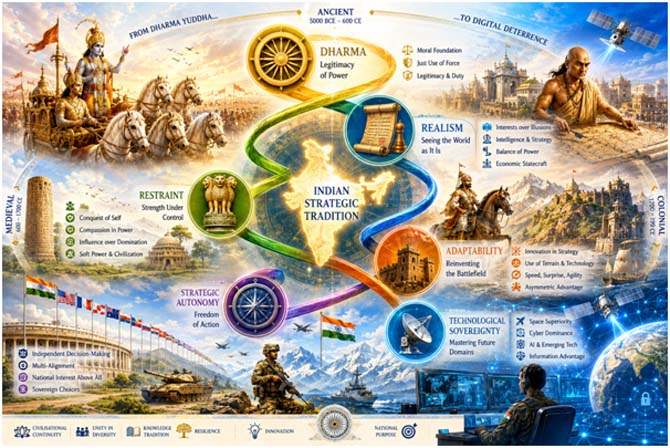
As India’s strategic journey is viewed across the centuries, a remarkable pattern emerges. Different eras produced different doctrines, leaders, and technologies, yet certain enduring principles repeatedly reappeared. Together, they constitute what may be called the Five Pillars of the Indian Strategic Tradition.
- Dharma: The Legitimacy of Power. From the Mahabharata onwards, India has viewed power not merely as an instrument of coercion but as a responsibility. The legitimacy of force has always mattered. Whether in ancient kingdoms or modern democracy, military action derives strength from moral and political justification. India has rarely celebrated conquest for its own sake. It has sought to align power with a larger sense of order and justice.
Legitimacy multiplies power; illegitimacy diminishes it.
- Realism: Seeing the World as It Is. Kautilya’s enduring contribution was to remind rulers that noble intentions are no substitute for strategic capability. The world is competitive, interests matter, and nations must prepare for uncertainty. Diplomacy, intelligence, alliances, economic strength, and military preparedness remain essential instruments of statecraft. Modern India’s balancing of major powers, pursuit of strategic partnerships, and emphasis on national capability reflect this Kautilyan inheritance.
Hope is not a strategy; capability is.
- Restraint: Strength Under Control. Ashoka’s transformation after Kalinga introduced a uniquely Indian dimension to statecraft—the conscious exercise of restraint. Restraint should never be confused with weakness. It is meaningful only when backed by strength. India’s nuclear doctrine, preference for responsible conduct, and emphasis on international legitimacy reflect this tradition. The ability to use force is important; the wisdom to limit its use is equally so.
The strongest hand is often the one that chooses not to strike.
- Adaptability: Reinventing the Battlefield. From Shivaji’s mountain warfare to India’s embrace of nuclear deterrence, space assets, and cyber capabilities, adaptation has repeatedly ensured survival. The character of war changes. Successful nations change with it. History suggests that India’s greatest strategic successes have occurred when it adapted quickly to new realities while preserving continuity of purpose.
Nations that fail to adapt become prisoners of their past.
- Strategic Autonomy: Freedom of Action. Perhaps the most enduring thread linking ancient and modern India is the desire to preserve independent decision-making. Whether in Kautilya’s alliance systems, Ashoka’s imperial diplomacy, Shivaji’s resistance to domination, or modern India’s non-alignment and multi-alignment, the objective has remained remarkably consistent: freedom of strategic choice. Strategic autonomy is not neutrality. It is the ability to pursue national interests without becoming captive to another power’s agenda.
The ultimate objective of strategy is freedom of action.
The Enduring Formula. Taken together, these five pillars—Dharma, Realism, Restraint, Adaptability, and Strategic Autonomy—form a uniquely Indian strategic framework.
Most nations build their strategic culture around power. India, at its best, has sought to balance power with legitimacy, realism with ethics, and strength with restraint. That balance has not always been perfect. Yet it explains why the Indian strategic tradition has endured through empires, invasions, colonialism, independence, nuclearisation, and now the digital age.
The Indian way of war is not a doctrine written in a manual. It is a civilisational conversation carried across thousands of years.
Conclusion: The Enduring Indian Way of War
The Indian way of war cannot be reduced to a doctrine, a weapon system, or a particular period of history. It is an evolving civilisational tradition that has repeatedly adapted to changing realities without losing its intellectual core.
From the ethical debates of Kurukshetra to the realism of Kautilya, from Ashoka’s restraint to Shivaji’s innovation, from the professionalism of modern military institutions to the emerging frontiers of cyber and space warfare, India has continuously redefined how power should be understood and employed.
The future battlefield may be populated by autonomous systems, quantum technologies, and artificial intelligence. Yet the central challenge will remain unchanged: how to align power with purpose, capability with legitimacy, and strength with wisdom. That, ultimately, is the enduring lesson of India’s strategic journey. And that may well be the true Indian way of war.
India’s greatest strategic asset has never been its armies alone. It has been its ability to adapt without losing its civilisational soul.
ABOUT THE AUTHOR

Lt Gen Rajeev Chaudhry (Retd) is a social observer and writes on contemporary national and international issues, strategic implications of infrastructure development towards national power, geo-moral dimension of international relations and leadership nuances in changing social construct.