
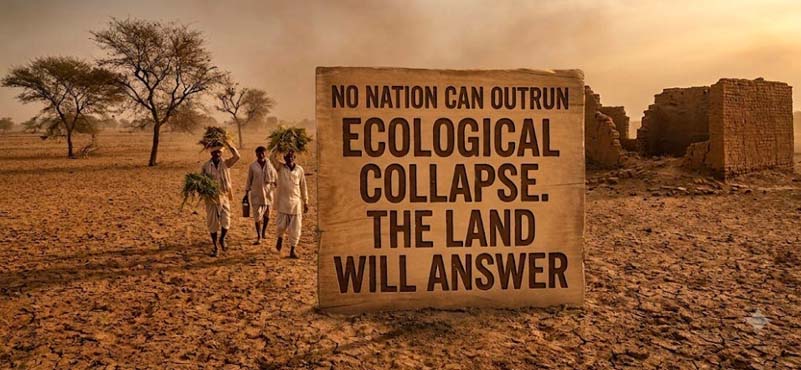
Awards cannot save nations from ecological ruin; true strength lies not in false brilliance, but in urgent action before the land answers back with collapse.
Development in the garb of capitalism has turned nature into collateral damage, treating forests, water, and land as expendable in the ceaseless pursuit of profit. A system that feeds on ecological loss cannot call itself progress; it is simply wealth built on ruin.
The Warning
In The Work of Nations: Preparing Ourselves for 21st-Century Capitalism, Robert Reich reminds us that the countries which preserve forests, soil, and water will be the ones best placed to lead the century. That is not a quaint observation; it is a hard political truth, because a nation that destroys the ground beneath its own feet cannot expect its future to remain upright for long.
Development’s False Promise
A country can present itself as advancing, can stage ceremonies, collect honours, and speak endlessly of progress, while the land beneath it is being steadily weakened by the very policies that claim to build the future. Forests are thinned, mountains are cut through, rivers are pushed to their limits, and the climate begins to answer with floods, landslides, erratic rains, and rising heat, as though the earth itself were registering a protest that institutions have chosen not to hear.
What is described as development is too often only extraction in a cleaner suit. Mountains are not vacant land waiting to be made useful; they are living systems that store water, hold soil, steady weather, and support communities whose survival depends on balance, not spectacle. To blast through fragile slopes, to permit aggressive riverbed mining, to clear forests in the name of speed and connectivity, is to confuse appetite with strategy and short-term gain with national strength.
The Weather Strikes Back
The climate is no longer speaking in abstractions. Rising temperatures and El Niño-linked disturbances are now part of a lived reality in which the monsoon becomes less reliable, rain arrives in destructive bursts, and dry spells stretch longer than before, placing agriculture, drinking water, and everyday life under severe strain.
When weather turns erratic, the damage does not stay inside scientific reports. It moves into fields, reservoirs, homes, roads, and kitchens, where it is felt as scarcity, loss, and insecurity. What was once called a season begins to behave like a warning.
The State’s Simplifying Gaze
James Scott’s Seeing Like a State helps explain why such failures repeat themselves. Development policy often fails when it treats complex local realities as if they can be neatly simplified from above. States make society legible through maps, categories, standards, and schemes, but in doing so they often erase local knowledge and produce harmful outcomes.
His example of scientific forestry is especially revealing. Forests were redesigned as uniform, measurable stands of timber so that they could be more easily managed by the state, but this “efficient” model made them far less resilient than diverse natural forests. What looked tidy on paper became vulnerable in life, and that is the same mistake being repeated wherever living landscapes are treated like profit making development diagrams.
Ecology as Ethics
Arne Næss gives the argument its moral depth. His distinction between shallow and deep ecology shows how weak it is to manage symptoms while leaving the underlying habit of domination untouched. Shallow ecology asks how nature may be used more carefully; deep ecology asks whether a civilisation that treats forests, rivers, mountains, and living beings as expendable can still call itself wise.
Aldo Leopold sharpens that point further. His land ethic insists that an action is right when it preserves the integrity, stability, and beauty of the biotic community. That is not an abstract ideal; it is a practical measure of whether a society understands that land is not a warehouse but a community of life, and that to wound it is to wound the conditions of its own endurance.
What Failure Means
A nation does not fail only when its economy stumbles or its institutions visibly crack. It also fails when it steadily degrades the forests, waters, soils, coasts, and mountains that make organised life possible in the first place.
That is why environmental negligence is not a side issue. It is a central test of whether a country understands the terms of its own survival. A state may continue to perform success, but if it is exhausting the earth while doing so, the performance will not last.
A Way Forward
The answer lies in a different political imagination: one that treats land as a community rather than a quarry. That means placing ecological restraint at the heart of development, protecting fragile landscapes, and judging policy by whether it strengthens the systems that sustain life.
There is still hope, but only if the lesson is taken seriously. A country that learns to live with the land rather than above it may yet endure; one that keeps treating nature as expendable will eventually discover that collapse is not an idea, but a consequence.
First published by Navina Jafa on open.substack.com
ABOUT THE AUTHOR
 Navina Jafa is a renowned curator and scholar on Cultural Heritage & Tourism, and a most accomplished classical dancer. She is a prolific writer and regular contributor to art discussions.