Why it Remains the Ultimate National Security Asset
The New Obsession
The vocabulary of national security has changed dramatically in the twenty-first century. Strategic discourse today revolves around artificial intelligence, quantum computing, hypersonic missiles, autonomous weapons, cyber warfare and space dominance. Defence budgets are scrutinised with forensic precision. Nations compete to acquire advanced platforms, cutting-edge technologies and sophisticated surveillance capabilities. The assumption is almost universal: superior technology will guarantee superior security.
It is an understandable assumption—but only a partial one.
History repeatedly reminds us that while technology shapes the conduct of war, it does not by itself determine the destiny of nations. Weapons amplify power, but they cannot create wisdom. Artificial intelligence may accelerate decision-making, but it cannot replace judgement. Military modernisation can strengthen deterrence, but it cannot compensate for weak leadership, failing institutions or the erosion of public trust.
In our fascination with technological transformation, strategic thinking has quietly neglected one of the oldest and most enduring determinants of national security—Character.
Character is often dismissed as an ethical virtue, relevant to philosophy or personal conduct but peripheral to statecraft. Yet the evidence of history suggests precisely the opposite. Character is not merely a moral ideal; it is a strategic asset. It shapes the quality of leadership, strengthens institutions, inspires public confidence and enables societies to endure adversity. It is the invisible force that determines whether a nation remains resilient under pressure or fragments from within.
The great paradox of national security is that while military power can deter external aggression, only character can prevent internal decay.
Nations rarely collapse because they suddenly run out of weapons. More often, they weaken because corruption replaces integrity, expediency overwhelms principle, institutions lose credibility and citizens lose faith in one another. When trust erodes, even formidable military capabilities begin to lose their strategic effectiveness.
The central proposition of this essay is therefore simple yet profound:
Weapons may win battles. Character determines whether nations endure.
History’s Greatest Strategic Lesson
The rise and fall of civilisations reveal a striking pattern. Material power alone has never guaranteed strategic success. Again and again, history demonstrates that the decisive factor is the quality of the people and institutions entrusted with that power.
The Roman Empire, at its zenith, possessed the finest military machine of the ancient world. Its disciplined legions, engineering brilliance and administrative sophistication made it seemingly invincible. Yet historians increasingly agree that Rome’s decline began not with the arrival of external enemies but with the gradual erosion of civic virtue, institutional integrity and public responsibility. Internal decay weakened the empire long before external invasion completed its fall.
The twentieth century offers equally compelling examples.
Finland’s resistance during the Winter War of 1939–40 presents a remarkable illustration. Facing overwhelming odds, the Finnish people demonstrated extraordinary unity, discipline and determination. Their character transformed limited military resources into disproportionate strategic effectiveness.
More recently, several conflicts have shown that societies possessing strong national cohesion often outperform materially superior opponents. The lesson extends beyond the battlefield.
Economic prosperity depends upon honesty in public institutions. Technological innovation flourishes where merit is rewarded and ideas are trusted. Diplomacy derives credibility from consistency of conduct. Investors place confidence not merely in markets but in the integrity of legal systems and governance. Military professionalism depends fundamentally upon honour, discipline and mutual trust.
In every sphere of national life, character multiplies capability.
Conversely, when integrity weakens, every instrument of national power gradually loses effectiveness. Sophisticated weapons cannot compensate for corruption. Advanced technologies cannot repair failing institutions. Large defence budgets cannot substitute for poor leadership. History therefore teaches a lesson that remains surprisingly absent from much contemporary strategic thinking.
Material strength may secure temporary advantage. Only character secures enduring power.
India’s Civilisational Wisdom: Character Before Power
Long before modern strategic studies began speaking of resilience, legitimacy, institutional trust and ethical leadership, Indian civilisation had already placed character at the heart of statecraft.
The two great epics of India—the Ramayana and the Mahabharata—are often read as religious or literary classics. They are equally profound works on leadership, governance and national security. Beneath their narratives lies a timeless strategic insight: power divorced from character ultimately becomes self-destructive, while character transforms power into legitimacy.
The Ramayana offers perhaps the finest illustration of moral leadership in strategic affairs. Rama does not command the largest army, nor does he possess overwhelming material resources. Yet he inspires unwavering loyalty across kingdoms, communities and even species. His authority flows not from fear, but from truthfulness, restraint, compassion and an unwavering commitment to dharma. His alliances are forged not through coercion but through trust. Sugriva, Hanuman and Vibhishana choose to stand beside Rama because they recognise the strength of his character before they witness the strength of his arms. The epic demonstrates a lesson of enduring relevance: moral authority is itself a strategic capability.
The Mahabharata complements this lesson with equal depth. After the devastation of Kurukshetra, the victorious Yudhishthira does not ask Bhishma how to build a larger army or acquire greater wealth. Instead, he seeks guidance on Rajadharma—the principles by which a kingdom should be governed. Bhishma’s response is revealing. He teaches that the true strength of a state lies in justice, integrity, self-restraint and righteous conduct. Wealth, military power and political authority may secure a throne, but only character secures the kingdom.
Across centuries, these epics have conveyed a strategic truth that remains remarkably contemporary: the legitimacy of power depends upon the character of those who exercise it.
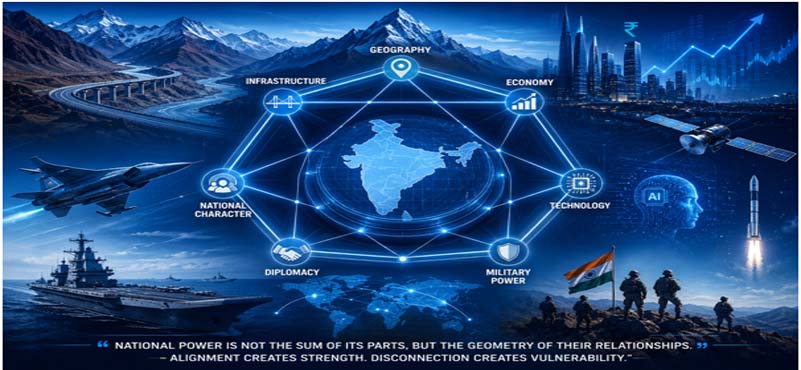
Modern strategic literature often speaks of comprehensive national power. Indian civilisation recognised this principle millennia ago. It understood that the strongest fortress of a nation is not built of stone or steel, but of trust, duty and ethical leadership.
In rediscovering character, therefore, we are not embracing an abstract moral ideal. We are recovering one of the oldest and most sophisticated principles of strategic statecraft.
Character is a Strategic Capability
If character is to be regarded as a strategic asset, it must demonstrate tangible strategic value. Fortunately, history and contemporary statecraft provide abundant evidence that it does.
Military organisations understand this instinctively. Modern armed forces invest heavily in advanced platforms, precision weapons and network-centric capabilities. Yet no professional military believes that technology alone wins wars. The foundation of combat effectiveness remains trust—trust between commanders and soldiers, between comrades in battle and between the military and the nation it serves. Courage, discipline, integrity and selfless service are not ceremonial virtues; they are operational necessities.
- A technologically superior force led by individuals lacking integrity will eventually suffer from poor morale, flawed decision-making and declining public confidence. Conversely, forces imbued with character often display extraordinary resilience under adversity. History repeatedly shows that disciplined soldiers inspired by purpose have overcome adversaries possessing greater numbers or superior equipment. The same principle extends beyond the military.
- Intelligence agencies depend upon credibility. Their assessments influence national decisions only when they are trusted to be objective, professional and free from political distortion.
- Diplomacy rests upon reputation. Nations honour commitments and build enduring partnerships with countries whose conduct is consistent, predictable and principled. Credibility, once lost, is exceedingly difficult to restore.
- Economic strength also has moral foundations. Investors are attracted not merely by market size but by confidence in institutions, rule of law, contractual sanctity and transparent governance.
- Innovation flourishes in societies where merit is recognised, ideas are encouraged and ethical standards are respected. Corruption, nepotism and institutional decay quietly erode national competitiveness long before economic indicators reveal the damage.
- Technological leadership also ultimately depends upon character. Scientific excellence thrives where curiosity is encouraged, failure is accepted as part of learning, intellectual honesty is valued and institutions reward competence over patronage.
In each of these domains, character acts as a force multiplier. It must be cultivated patiently through leadership, education, institutions and national culture.
This is why character deserves recognition not merely as a moral virtue but as a strategic capability—one that strengthens every instrument of national power while imposing no burden on the national exchequer.
India’s Strategic Advantage—and Responsibility
India enters an era of unprecedented strategic opportunity.
Its economic growth, demographic profile, technological capabilities, expanding infrastructure and growing geopolitical influence have positioned it among the world’s leading powers. Yet India’s most enduring advantage may lie elsewhere—in the strength of its civilisational values and institutional traditions.
For generations, the professionalism of the Indian Armed Forces has earned respect because it has remained firmly anchored in constitutional values, political neutrality and an unwavering commitment to duty. These qualities are not accidental. They are expressions of institutional character built painstakingly over decades.
Similarly, India’s democratic resilience, despite extraordinary diversity of language, religion and ethnicity, reflects a remarkable capacity for accommodation and consensus. Its constitutional framework, independent institutions, entrepreneurial energy and vibrant civil society provide reservoirs of national strength that cannot be measured solely by conventional indices of power.
Yet these strengths should never be taken for granted.
Character is not a permanent national possession. It must be renewed continuously.
Educational institutions must produce not only skilled professionals but responsible citizens. Leadership at every level must demonstrate integrity before demanding accountability from others. Public institutions must reward competence, transparency and ethical conduct. National service, whether in uniform or in civil administration, must remain a vocation defined by responsibility rather than privilege.
For a nation aspiring to global leadership, the challenge is therefore twofold. India must continue strengthening its military, technological and economic capabilities while simultaneously nurturing the moral and institutional foundations that give those capabilities legitimacy and endurance.
A nation that neglects character risks weakening the very foundations upon which its future power depends.
Conclusion: The Strongest Fortress
The twenty-first century will undoubtedly be shaped by extraordinary advances in technology. Artificial intelligence will transform decision-making. Autonomous systems will redefine warfare. Space, cyber and quantum technologies will alter the strategic landscape in ways we are only beginning to understand.
Yet amid these profound changes, one truth remains constant.
Every weapon system, every institution and every national strategy ultimately depends upon the character of the people who conceive them, build them and employ them.
History offers no shortage of powerful nations that declined because internal decay proved more dangerous than external threats. Equally, it celebrates societies that endured immense hardship because courage, integrity and public trust sustained them through adversity.
National security is therefore much more than the protection of territory. It is the preservation of the moral and institutional foundations that enable a nation to withstand crises, inspire confidence and pursue its interests with legitimacy.
The great epics of India understood this truth long before modern strategic theory gave it contemporary language. Rama’s leadership and Bhishma’s teachings on Rajadharma remind us that power without character is ultimately self-defeating, while character transforms power into enduring authority. In an age captivated by technological superiority, this ancient wisdom deserves renewed attention. Missiles may defend borders. Economies may finance ambition. Technology may multiply capability. But only character sustains a nation.
For in the final analysis, the strongest fortress in national security is neither built of concrete nor protected by steel. It is built within the character of a people.
ABOUT THE AUTHOR

Lt Gen Rajeev Chaudhry (Retd) is a social observer and writes on contemporary national and international issues, strategic implications of infrastructure development towards national power, geo-moral dimension of international relations and leadership nuances in changing social construct.