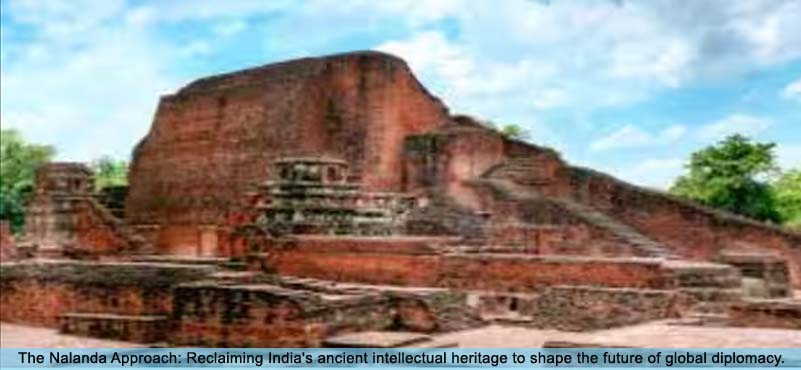
The Nalanda Approach must become part of India’s larger diplomatic and cultural imagination
India’s rise in the twenty-first century is often discussed through the frameworks of economics, technology, military capability and geopolitics. These are important markers of national power. Yet, one of the most enduring dimensions of India’s emergence lies elsewhere — in civilisation, culture and intellectual heritage. As the world enters an era increasingly shaped by competing narratives and strategic alignments, India possesses a unique advantage: the depth and continuity of its civilisational experience.
This is where the idea of the “Nalanda Approach” acquires significance.
 The revival of Nalanda is not merely the reconstruction of an ancient university. Nor should it be viewed only as a heritage initiative or a tourism project. Properly understood, it represents the re-emergence of an Indian civilisational framework through which India can engage the Global South, ASEAN, East Asia and large parts of the Indo-Pacific world.
Historically, Nalanda represented one of humanity’s earliest transnational knowledge ecosystems. Scholars travelled from across Asia to study philosophy, medicine, astronomy, linguistics, governance and ethics. Nalanda connected India to the world through ideas rather than conquest, scholarship rather than coercion, and dialogue rather than domination. That distinction remains profoundly relevant today.
Across centuries, India’s engagement with Asia travelled through monks, scholars, universities and intellectual exchange. Buddhism became the single most influential carrier of Indian civilisation across South Asia, Southeast Asia, East Asia and parts of Central Asia. Yet what travelled outward from India was not religion alone. It carried ethical frameworks, philosophical traditions, systems of debate, linguistic influence and modes of intellectual inquiry.
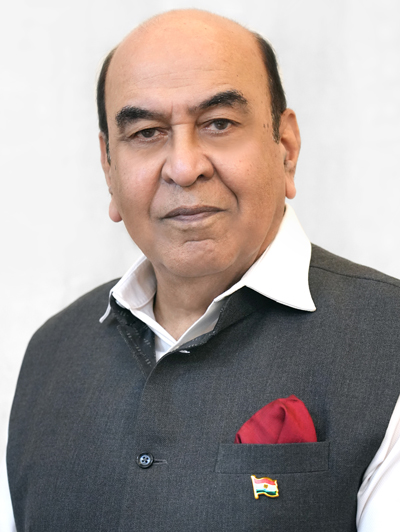
The geographical and spiritual core of much of this civilisational movement lies in Bihar — a state I have the privilege to serve as Governor, and one whose historical inheritance carries significance far beyond its boundaries.
Nalanda, Bodh Gaya, Rajgir, Vaishali and Vikramshila together form what may be described as a living civilisational geography — a “Nalanda Corridor”. This is not merely a collection of monuments or pilgrimage sites. It is an interconnected intellectual and cultural space linking India with large parts of Asia through shared historical memory. The strategic implications of this are substantial, although they are often insufficiently appreciated.
The modern world is witnessing an increasing contest over narratives, legitimacy and cultural influence. Nations are rediscovering heritage not only as a matter of identity, but also as a source of long-term geopolitical relevance. In such an environment, India possesses an extraordinary reservoir of credibility because it remains the original source of one of the world’s great ethical and philosophical traditions.
India’s soft power therefore does not arise from projection alone. It arises from authenticity. Countries across the Buddhist world continue to look towards Bodh Gaya and Nalanda with reverence and emotional connection. This creates opportunities for engagement that extend far beyond conventional diplomacy. Heritage circuits, academic partnerships, cultural exchanges, manuscript preservation projects, archaeological cooperation, youth interactions and spiritual tourism can collectively create durable people-to-people linkages across Asia and the Global South. The importance of all this cannot be overstated.
For many countries of Southeast Asia and the wider Indo-Pacific, India is not a distant external power entering the region for strategic convenience. India is already embedded within their civilisational memory. That gives India a uniquely natural and non-coercive basis for engagement.
Much of that historic outreach radiated from the ancient centres of Magadh and Pataliputra in present-day Bihar. It was from this region that some of India’s most influential political, intellectual and cultural impulses travelled across the seas. The Gupta era, often described as India’s Golden Age, helped shape a civilisational influence and enduring connect extending deep into Southeast Asia through trade, scholarship, language, art, architecture and systems of thought. What emerged was not political domination in any sense, but a broader cultural sphere often described by historians as “Greater India”.
The enduring relevance of this history lies in the fact that India’s engagement with Asia was built through attraction rather than coercion, and through shared cultural confidence rather than imposed authority.
The Nalanda Approach must, therefore, become part of India’s larger diplomatic and cultural imagination.
This does not imply revivalism in a narrow or ideological sense. Nor should it be seen as an attempt to romanticise the past. The real significance of Nalanda lies in its future orientation. It represents the possibility of combining ancient wisdom with contemporary relevance. This is where the role of Nalanda University becomes particularly important.
The new Nalanda University, established with strong international participation and support, has the potential to emerge as far more than an academic institution. It can become a centre for intercultural dialogue, climate studies, peace studies, ethics, sustainable development and Asian intellectual partnerships. In an era where universities increasingly shape narratives and leadership networks, institutions like Nalanda acquire strategic significance.
The fact that Nalanda University is a Net Zero campus is especially noteworthy. Located in an ecologically sensitive Bihar, it reflects the continuity between ancient Indian thought and modern sustainability concerns. Long before environmental consciousness became a global policy imperative, Indic traditions emphasised harmony between humanity and nature, moderation in consumption, and ethical restraint.
These ideas resonate deeply in a world grappling with climate stress, social fragmentation and mental anxiety despite material progress. The Nalanda Approach also has an important domestic dimension.
India possesses one of the youngest populations in the world, yet modern education often produces professional competence without civilisational rootedness. Reconnecting young Indians with the country’s intellectual traditions is therefore not a matter of nostalgia; it is a matter of national confidence.
For too long, Bihar itself has been viewed largely through the prism of developmental challenges, while its extraordinary civilisational inheritance remained underemphasised. Yet few places in the world possess such depth of intellectual and spiritual history. Bihar once illuminated Asia through knowledge and scholarship. The revival of Nalanda is, therefore, also the restoration of historical self-confidence.
This matters because nations that understand and articulate their civilisational strengths shape global conversations more effectively.
India today stands at an important inflection point. Economic growth, technological advancement and strategic confidence are increasingly being accompanied by a rediscovery of civilisational identity. The challenge is to ensure that this rediscovery remains inclusive, scholarly, outward-looking and globally relevant. The Nalanda Approach offers precisely such a pathway.
It allows India to engage the Global South not merely through development partnerships or strategic cooperation, but through shared cultural memory, intellectual exchange and ethical dialogue. It enables India to connect with ASEAN and the wider Asian world through authenticity rather than assertion.
Most importantly, it reminds the world that India’s greatest historical influence did not arise from imperial expansion. It arose from the power of ideas. The revival of Nalanda is therefore not a return to the past.
It is the rediscovery of India’s future role in Asia and the world.
ABOUT THE AUTHOR
 The writer is the Governor of Bihar and the former Commander of the Srinagar-based Chinar Corps. Views expressed in the above piece are personal and solely those of the author. This article first appeared in Firstpost. Reproduced here with permission of the author