
India’s growth story demands both clarity and context. No economy is ever complete, and no growth path is beyond improvement. Yet when measured against its own past and the realities of a slowing global economy, India’s current trajectory is distinctive not as a fleeting upswing, but as a structurally differentiated expansion.
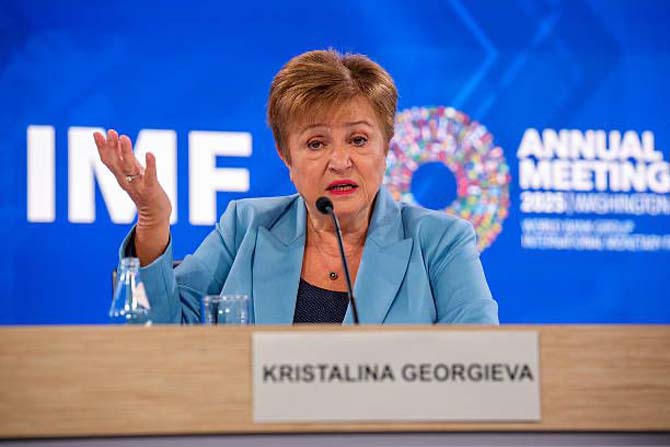
This is not rhetoric; this objective assessment is borne out by global institutional assessment. At the IMF Spring Meetings 2026, held on April 15, 2026, Ms. Kristalina Georgieva highlighted a striking reality: India’s growth rate is more than double the global average.
In a world where economic momentum has softened, this chasm, which is here to stay, is contextually significant. The hard numbers behind her comprehensive assessment and perspective tell a compelling story- a story of sustained economic growth, structural transformation, and resilience. In other words, India’s growth trajectory is neither incidental nor temporary and clearly reflects the robustness and resilience of the macroeconomy.
A Cross-cutting Growth Differential
Projections place India’s GDP growth at approximately 6.5% through 2026–27, while global growth hovers near 3.1%–3.2%.
As I have repeatedly held, this structural divergence – not merely a statistical gap – is not a quirk of fate; it is anchored in relatively stable macroeconomic fundamentals, resilient financial systems, and a large domestic market that continues to generate demand even when external conditions weaken. What sharpens the contrast is the disconcerting broader global backdrop of deceleration and in some cases, raising even the spectre of the dreaded phenomenon of “stagflation”.
A disaggregated examination of the global order reveals that the United States is expected to grow at roughly 2%, constrained by tighter financial conditions and maturing cycles.
China, long the engine of global expansion, is navigating a structural slowdown, with growth estimates in the 4–5% range amid property sector adjustments and demographic headwinds.
Europe faces even more subdued prospects, weighed down by energy transitions, geopolitical uncertainty, and aging populations.
Against this grim backdrop, India’s sustained outperformance, excluding the extraordinary disruption of the pandemic years, marks not just cyclical strength, but structural differentiation.
India’s Growth Engines
India’s growth is powered by a convergence of reinforcing factors:
Demographic Dividend: With one of the youngest populations among major economies, labor force expansion continues to provide a natural growth tailwind.
Digital Transformation at Scale: Platforms like Unified Payments Interface have revolutionized financial inclusion, lowering transaction costs and accelerating formalization. India now accounts for a significant share of the world’s real-time digital payments, a quiet but profound shift in economic infrastructure – a shift that has created a “silent revolution” across the country.
Infrastructure-Led Multiplier Effects: Sustained public capital expenditure—on roads, railways, logistics, and energy—has enhanced productivity and crowding-in of private investment.
Consumption Powerhouse: A rising middle class, projected to expand sharply over the next decade, continues to anchor domestic demand even as global trade softens.
Macroeconomic Stability: Compared to earlier decades marked by volatility, India today exhibits more stable inflation management, healthier banking balance sheets, and improved fiscal discipline.
These are not isolated variables; together, they constitute a reinforcing system, a virtuous cycle of growth and regeneration that enables growth to persist even amid external shocks.
Structural Strength—But Not Structural Completion
High growth, however, is not an endpoint; it is a platform for a higher, onward move. The next orbit of India’s economic evolution will be defined by how effectively it converts momentum into transformation.
Key challenges remain:
Manufacturing Scale: India’s share in global manufacturing remains below potential. Expanding initiatives like Make in India into globally competitive ecosystems will be critical.
Productivity Gains: Sustained growth requires improvements in total factor productivity across agriculture, industry, and services.
Employment Generation: Growth must translate into quality jobs at scale, especially for a young and increasingly skilled workforce.
Regional Balance: Bridging disparities between high-growth states and lagging regions is essential for inclusive development.
Where Do We Go from Here?
We need to straddle the growth path ahead not in a complacent or critical manner but by calibrating the process and pattern of economic growth.
India is outperforming most large economies at a time when global growth is fragmenting. That advantage is real, but it is also perishable if not deepened.
History rarely presents such windows twice. The writing on the wall is clear, the message of history is unmistakable: India is not merely keeping pace with the world; it is moving ahead of the curve.
To move to the next level, we need to accelerate growth, broaden inclusion, and embed structural change deeply enough to endure across cycles to define the next phase of global economic momentum. The way to go is full steam ahead to meet the challenges of the present and the expectations of the future and to consolidate India’s economic muscle and heft in the comity of nations. This is not easy but with hard work, sincerity of purpose and synchronised work by all stakeholders, this is by no means undoable. As the Panchtranta aptly stressed,
“उद्यमेन हि सिध्यन्ति कार्याणि न मनोरथैः। न हि सुप्तस्य सिंहस्य प्रविशन्ति मुखे मृगाः।।”
English translation: Great missions are achieved through determined effort, not mere wishes.
— Panchatantra, Mitra-bheda.
ABOUT THE AUTHOR
 Dr. Manoranjan Sharma is Chief Economist, Infomerics, India. With a brilliant academic record, he has over 250 publications and six books. His views have been cited in the Associated Press, New York; Dow Jones, New York; International Herald Tribune, New York; Wall Street Journal, New York.