36 Kilometres to the Divine: The Road That Leads Within
There are journeys that take you across landscapes, and then there are journeys that take you inward—into silence, into memory, into something older than history itself. The road from Gunji to Jollingkong, stretching roughly 36 kilometres across one of the most unforgiving Himalayan terrains, belongs unmistakably to the latter.
It is difficult to overstate what this road represents. For decades, this region existed at the edge of imagination—whispered about by trekkers, revered by pilgrims, and known intimately only to the hardy border communities who called it home. Today, that remoteness has been gently breached—not violated, but revealed—by a road that is as much an engineering feat as it is a civilizational bridge.
The story of its construction reads almost like a legend in itself. At altitudes where oxygen thins and weather turns without warning, building a road is not merely a logistical challenge—it is an act of persistence against nature’s will. Sections of this route required raw materials to be airlifted by helicopters, dropped with precision into narrow valleys and precarious ridgelines. Work advanced from multiple construction fronts—two primary operational axes—gradually stitching together a path where none had existed before.
And yet, no description can fully capture the experience of travelling this road. As one leaves Gunji—the quiet confluence settlement where rivers Kuthi Yankti and Kalapani meet and winds gather—and begins the gradual ascent, the landscape transforms almost imperceptibly. The air sharpens. The mountains close in. The road curves along cliffs that seem to drop endlessly into glacial streams. There are stretches where conversation naturally ceases, not out of fatigue, but out of reverence.
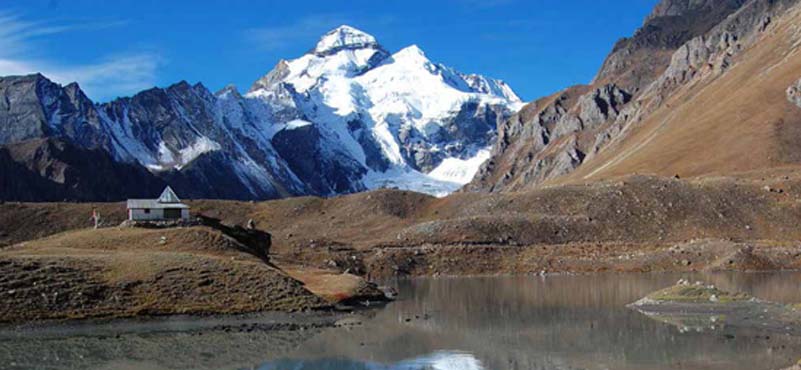
By the time one approaches Jollingkong, the journey has already done its work. There is a distinct, almost inexplicable sense of arrival—not just at a destination, but at a state of being. The sight of Adi Kailash, reflected in the still waters of Parvati Sarovar, does not surprise. It completes something. This is not just access. It is awakening.
Panch Kailash: The Sacred Order of the Himalaya
To understand the significance of this region, one must first understand the idea of Panch Kailash—the five sacred abodes of Lord Shiva, scattered across the Himalaya like points of a cosmic geometry.
These include:
- Mount Kailash in Tibet.
- Adi Kailash in Pithoragarh district, Uttarakhand.
- Kinnaur Kailash in Kinnaur district, Himachal Pradesh.
- Manimahesh Kailash in Chamba district. Himachal Pradesh.
- Shrikhand Mahadev in Kullu district, Himachal Pradesh.
Among these, Mount Kailash remains the most revered—the Axis Mundi, the Cosmic Centre. Yet, in spiritual narratives and local traditions, Adi Kailash occupies a deeply intimate position—second only to Kailash itself. It is often referred to not merely as a representation, but as a precursor—a beginning.
Unlike the distant, almost inaccessible grandeur of Mount Kailash, Adi Kailash feels closer, more human in scale, yet no less profound. It is a place where divinity seems to reside not in abstraction, but in presence—in the play of light on snow, in the stillness of the lake, in the quiet rhythm of the wind.
For the modern traveller, this transforms the journey. One is not just visiting a mountain. One is stepping into a sacred geography that has shaped belief for centuries.
Adi Kailash: Where Shiva First Dwelt
Local lore and ancient belief systems carry a compelling narrative—one that adds emotional depth to the physical journey. It is said that Lord Shiva and Goddess Parvati first chose Adi Kailash as their abode. In this quieter, gentler landscape, away from the cosmic responsibilities that later defined Mount Kailash, their presence was intimate, almost domestic. The region, with its serene lakes and protective mountains, symbolized a space of union, stillness, and early creation.
The waters of Gauri Kund (Parvati Sarovar) are believed to hold echoes of that presence. Crystal clear and impossibly calm, the lake reflects not just the towering peak of Adi Kailash, but also a sense of continuity—between myth and moment, between belief and experience.
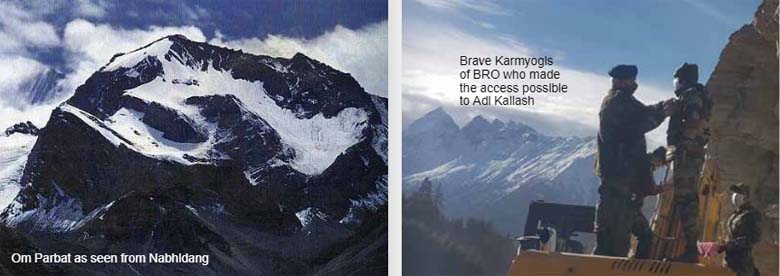
Nearby, Om Parvat stands as one of the most extraordinary natural formations in the Himalaya. The snow settles on its face in a pattern that unmistakably resembles the sacred syllable “ऊँ”. Unlike symbolic carvings or human-made shrines, this is nature itself participating in devotion.
Further along, Nabhidhang—often interpreted as the “navel” or centre—serves as a contemplative halt. It is a place where the vastness of the Himalaya becomes almost overwhelming, and yet deeply grounding.
Why then did Shiva shift from Adi Kailash to Mount Kailash?
The answer, perhaps, lies in the transition from the personal to the universal. From a space of intimate existence to one of cosmic responsibility. Adi Kailash remains, therefore, a beginning—a sacred prelude to the greater cosmic theatre of Kailash.
The Journey Through Living Landscapes
As the then Director General Border Roads, Project Hirak was the first field project I visited after taking over my appointment. That visit marked the beginning of a deep engagement with the region and a mission I took up with both strategic intent and personal commitment. In the months that followed, I undertook multiple on-ground visits to key locations—Munshiyari, Gunji, Jollingkong, and Lipulekh—to assess the terrain, oversee progress, and drive critical decision-making directly from the field. These were critical operational reviews in some of the toughest terrains, conducted to ensure that work progresses at the speed and quality such a mission demanded.
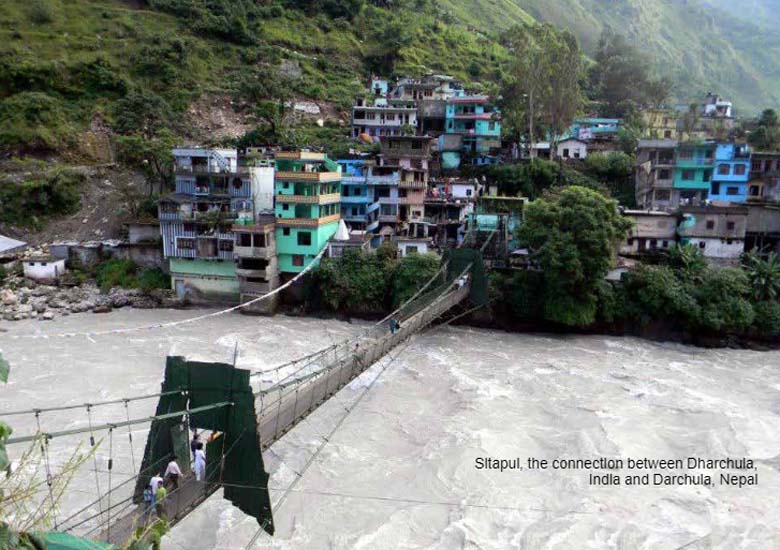
Every great destination is defined as much by the journey as by the arrival. The route from Dharchula to Jollingkong is not a mere transit corridor—it is a layered experience, unfolding through landscapes, cultures, and stories that enrich the traveller at every turn. The journey begins at Dharchula, a town uniquely poised along the banks of the Mahakali River. Here, India and Nepal exist not as distant political identities, but as lived realities—connected by bridges, shared markets, and centuries-old relationships often described simply as “roti-beti ka rishta”. In Dharchula, the India–Nepal connection continues to thrive as a living example of shared heritage, where boundaries blur and relationships endure.
As one moves ahead, the terrain begins to shift. Roads narrow, mountains rise, and the river—now a constant companion—cuts deeper into the valley. Gunji emerges as a crucial node. Located at the confluence of rivers, it serves as both a logistical base and a visual spectacle. The air here carries a different weight—lighter, thinner, yet somehow more alive.
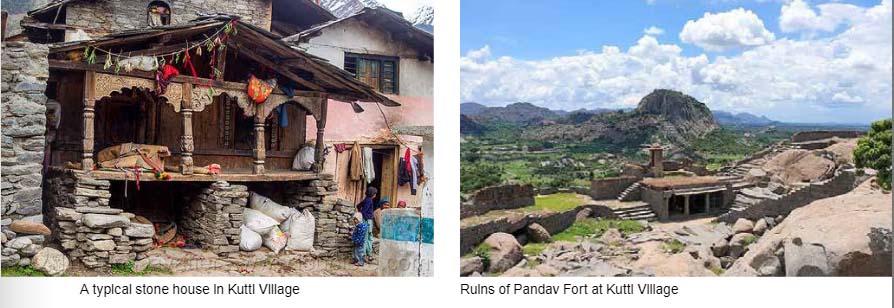
Beyond Gunji lie Kutti and Kalapani—villages and landscapes that seem suspended in time. Stone houses, prayer flags, grazing animals, and distant snowlines create a tableau that feels both ancient and immediate. At Kalapani, the origins of the Mahakali River are revered with quiet devotion. A small ancient temple marks the spot, but it is the surrounding stillness that defines the experience.
Pilgrimage Reimagined: The Lipulekh Transformation
One of the most profound changes in recent years has been the transformation of access. The Kailash Mansarovar Yatra, once considered one of the most physically demanding pilgrimages in the world, has been reimagined through the development of motorable routes up to Lipulekh Pass. For the first time, pilgrims have been able to undertake significant portions of this journey on wheels.
This shift has quietly democratized the pilgrimage. Where once only the physically resilient could attempt the route, today a wider cross-section of people—elderly devotees, families, and those previously constrained by physical limitations—can now aspire to experience the sacred Himalaya.
Importantly, this does not diminish the sanctity of the journey. If anything, it expands its reach.
For travellers exploring the Adi Kailash circuit, this connectivity adds another dimension—linking local pilgrimage with the broader spiritual geography of the Himalaya.
Adventure in Its Purest Form
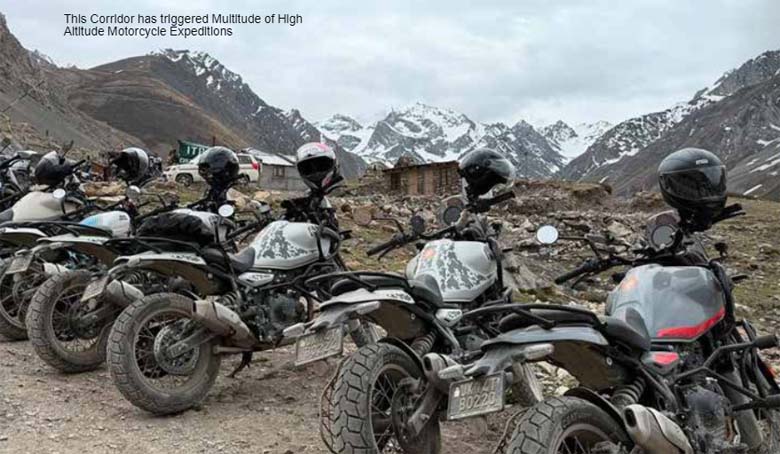
While the region is deeply spiritual, it is equally compelling as an adventure destination—perhaps one of the last in India where the experience still feels raw and unfiltered. The newly accessible roads have opened up possibilities for motorcycling expeditions, quickly emerging as one of the most thrilling ways to experience the terrain. Riding along cliff-edge roads, with glaciers in the distance and rivers roaring below, creates a sense of immersion that few routes can match.
For those seeking a slower, more deliberate engagement, high-altitude cycling presents a formidable challenge. The gradients are unforgiving, the air thin, and the rewards immeasurable. Traditional trekking routes continue to retain their charm. Trails between Gunji, Kutti, and Jollingkong offer opportunities to step off the road and into quieter, more intimate landscapes.
And then there is camping—perhaps the purest form of engagement. Nights at Jollingkong, under a sky unpolluted by artificial light, reveal a cosmos that feels almost within reach.
The Rang Community: Custodians of the Mountain Corridor
No journey through this region is complete without understanding its people. The Rang (Shauka) community, indigenous to this belt, has historically been engaged in trans-Himalayan trade with Tibet. Their lives were once defined by seasonal movement—ascending into higher altitudes during summer and descending as winter approached.
 Before the 1962 Indo-China conflict, they regularly traversed the Lipulekh Pass to trade wool, silk, grains, salt, rare medicinal herbs and traditional goods. Their connection to villages such as Gunji, Kutti, Nabi, and Garbyang is not just ancestral—it is spiritual and functional. These communities lived in synchronization with nature and the seasons. Their livelihoods revolved around trade, agriculture, and livestock rearing. The names of villages became part of surnames—Garbiyal from Garbyang, Kutiyal from Kutti, Napalchiyal from Napalchu—creating a deep identity rooted in geography. Even today, despite modern education and service in the Indian Administrative Services, the Rang people continue to support the Kailash Yatra. They serve as logistic coordinators, blending modernity with age-old mountain knowledge.
Today, while borders and changing economies have altered traditional patterns, the essence of their culture remains intact. For travellers, this opens up meaningful avenues for cultural tourism:
- Staying in local homestays.
- Experiencing traditional food and customs.
- Understanding a way of life shaped by altitude, resilience, and adaptation.
Echoes in Stone: The History Enlivened
Scattered across the region are reminders that this landscape has always been inhabited—not just physically, but culturally and spiritually. Near Kutti village lie the remains of what is often referred to as the Pandav Fort. According to local legends, the Pandavas and their mother Kunti resided in this fort during their 12-year Agyat Vaas (hidden exile), and it is a key site to visit in the region. Presence of such historical ruins adds a layer of intrigue—inviting travellers to imagine the passage of time across these mountains.
Ancient trade routes once connected these valleys to Tibet, carrying salt, wool, and stories across formidable passes. Today, these echoes remain—not as relics, but as quiet companions to the modern traveller.
Conclusion — The Quiet Transformation of a Sacred Frontier
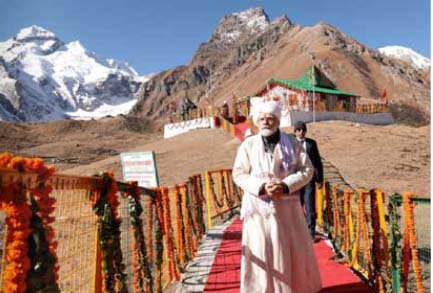
The visit of Prime Minister Narendra Modi to Adi Kailash in October 2023 brought unprecedented visibility to the region. Yet, beyond the symbolism, what it truly underscored was the arrival of this sacred geography into the national imagination. For tourism, this moment matters. It signals recognition, attention, and the possibility of thoughtful development.
The story of Adi Kailash is not one of sudden discovery, but of gradual revelation. A road has been built. Access has improved. Journeys that once demanded weeks now unfold in hours. And yet, the essence of the region remains intact—quiet, powerful, and deeply moving.
From Gunji to Jollingkong, the traveller does not merely traverse distance. One moves through layers—of history, landscapes, culture, and self. In a world increasingly defined by speed and spectacle, this corridor offers something rare: an experience that slows you down, lifts you up, and stays with you long after you have returned.
And perhaps that is its greatest promise—not just as a destination, but as a journey worth taking.
ABOUT THE AUTHOR

Lt Gen Rajeev Chaudhry (Retd) is a social observer and writes on contemporary national and international issues, strategic implications of infrastructure development towards national power, geo-moral dimension of international relations and leadership nuances in changing social construct.