Politico-Military Fusion for the Era of Multidomain Warfare
“A wise man should restrain his senses like the crane and accomplish his purpose with due knowledge of his place, time, and ability.”
– Chanakya
India’s defence ministry still retains an older institutional legacy model. The armed forces were kept at arm’s length from policymaking, thereby preserving civilian supremacy, and the ministry remained in the hands of generalist bureaucrats. This wider Indian political-military split is deeply historical. After Independence, political leaders made a deliberate effort to keep the armed forces apolitical and subservient. The instinct was understandable, but it also pushed the military out of the policy loop. In the end, that caution was compounded by bureaucratic dominance and political hesitancy, leaving India with a system that preserved civilian primacy but failed to foster strong politico-military fusion, at the cost of strategic coherence.
The 1962 debacle dispelled the illusion that India’s national interests could be safeguarded through diplomacy and political idealism alone. It exposed deep fault lines in politico-military relations and in the minimal military engagement within the wider national security strategy. After the wars of 1965 and 1971, suspicion gradually waned, but defence governance remained compartmentalised, with political authority exercised through a bureaucratic lens.
The succession of crises, from the Kargil crisis of 1999 to the Chinese incursions of 2020, reflected the persistent gaps in integrated politico-military thinking. Defence, diplomacy and development grew up in silos, rather than as mutually reinforcing pillars of statecraft. “Op Sindoor was a move in the right direction towards politico-military fusion, but it was sullied by a weak narrative and was used for political overtures. There are also thoughts on the politicisation of the military and the militarisation of the polity.”
The spectrum of threats confronting India today is sharper and more complex than at any time in recent history. China’s military modernisation, the unresolved Himalayan LAC, Pakistan’s enduring hostility, maritime competition in the Indo-Pacific, and the rise of cyber, space, drone, AI and electronic warfare have compressed the time available for policy response. These problems cannot be addressed by administrative generalists alone. Defence governance now requires people who understand operations, logistics, force employment and the real consequences of delay. The state is slower, less adaptive and less credible because those making the decisions lack military expertise.
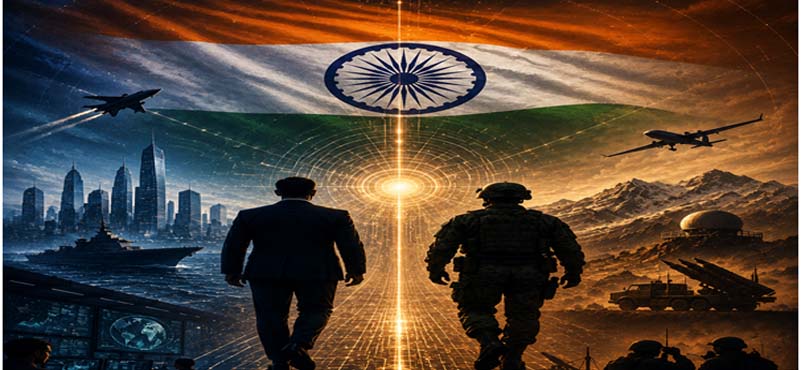
This is where politics and the military converge. Contemporary deterrence is not merely a military concept. It is a whole-of-nation, whole-of-society effort, with defence, diplomacy, development, technology and information power working together. The point isn’t to turn politicians into military philosophers. The point is to ensure that advice from both military and civilian institutions is deeply rooted, knowledge-based and professionally informed. Civilian leaders should be in charge, but they should exercise their authority through institutions that are structurally open to military expertise.
India’s current model, even as it evolves, as it has in recent years, still falls short of that standard. The establishment of the Department of Military Affairs has been a step forward, and the presence of uniformed officers in some ministry positions has improved coordination. But the change is not complete. Despite reforms, military officers are still not routinely embedded across the full range of policy, acquisition, planning, and technology functions. Much of the ministry remains mired in a bureaucratic culture that prizes process over operational relevance. The result is a system in which the armed forces are consulted but not always institutionally integrated.
The costs of that model are well understood. Procurement decisions tend to be slow because requirements do not closely match battlefield realities. Emergency procurement is not a primary source. It exposes gaps. Jointness may develop in principle, but interoperability does not necessarily follow in practice. Those moving files may not have seen the consequences of poor readiness or delayed modernisation, which undermine long-term planning. Defence is a specialist area, but all too often it is run like a standard government department. That strategy is no longer effective.
Worldwide experience points to a more viable way forward. The best democracies are not those with a permanent separation between soldiers and civilians. They are the ones that design systems in which civilians remain in charge, while military professionals are structurally embedded in decision-making.
In the American model, the defence system is firmly civilian-led but draws on military expertise in the policy process through the Pentagon, the Joint Staff, combatant commands, and multiple layers of oversight. Civilian leaders are in charge and have a good understanding of defence matters, either by experience or exposure, yet they govern with constant access to military judgement. The lesson is clear: civilian control is best when it is informed by, rather than insulated from, operational reality.
China gradually dismantled the line of demarcation between political authority, strategic planning and military transformation. Its leaders saw military modernisation not as a discrete defence activity but as an extension of national ambition, economic growth, technological progress and geopolitical influence. The People’s Liberation Army was reorganised to align with long-term national goals. Cyber, space, maritime and information warfare were consolidated into a single strategic vision under the Communist Party’s guidance. Despite economic constraints, Russia maintained a tightly woven state-security architecture in which political leadership, intelligence agencies, defence institutions and military power operated in close alignment. From Crimea to Syria and Ukraine, Moscow demonstrated how military force, information operations, diplomacy, energy leverage and nationalism could be synchronised as tools of statecraft. Despite their differences, both models underscore a central lesson: countries that couple political will with military capacity can pursue strategic aims with much greater coherence and resolve.
Japan is especially relevant for India because it began with a more restrictive, pacifist framework. For decades after the war, Japan’s political culture kept the Self-Defence Forces at arm’s length from high-level policymaking. Civilian bureaucrats were in charge, and the military was politically kept in check. But in the last decade, Japan has moved faster and further to tear down those barriers than India has. Faced with a more dangerous regional environment and a more assertive China, Tokyo realised that old administrative habits could no longer satisfy new strategic demands. It did not concede civilian supremacy. It polished it. The policy system became more responsive to strategic realities, coordination improved, and military expertise was brought closer to the ministry.
That is what India should internalise. Listening to its soldiers does not make democracy any less democratic. The story gets better. The trick is not to romanticise the military’s influence. The key is to institutionalise expertise under transparent civilian control.
India should thus transition from partial induction to structured integration. The first reform is to establish a fully integrated system. Military officers should not be posted to the Ministry of Defence except in rare cases or for symbolic purposes. They should be formally assigned to policy, planning, logistics, acquisition, and technology-related posts on a structured, merit-based basis. Their duties should be meaningful, not ritualistic. Rank and status must be preserved, and reporting should be through the services to avoid undue influence or pressure. The chosen officers must be among the best and have a high likelihood of career growth. At the same time, civilian officials should be posted to operational environments, joint commands, and field formations so that understanding is not one-way. “The governance of defence will be shallow, where one side will know the other only through paperwork.”
The second reform is structural. The Department of Military Affairs needs to evolve from a coordination layer into a genuine joint decision node. The office of the Chief of Defence Staff was a major step, but the broader ecosystem remains incomplete and underpowered. Integrated HQs, procurement boards and strategic planning cells need greater authority and tighter linkages with the ministry. India cannot deliver an effective transformation for future multidomain wars while preserving old departmental silos. If the services are to fight jointly, the ministry must also learn to think jointly.
The third is a cultural reform. The Indian defence establishment has long been marked by bureaucratic caution, compartmentalisation and an unspoken assumption that military knowledge can be consulted when necessary but should not be structurally embedded. That assumption is outdated. Artificial intelligence, autonomous systems, electromagnetic contestation, space assets, drones and cyber operations are shaping modern warfare. They are not peripheral issues to be addressed only through periodic consultation. They are at the heart of the future of state power. India needs to create specialist cells within the ministry, staffed by both civilians and uniformed professionals, to manage these domains with continuity and depth. Political messages and speeches must be grounded in realistic defence realities.
The fear most often raised against such reform is militarisation. That concern should not be ignored. The answer is not to cling to a bureaucratic monopoly. The answer is to build safeguards through law, procedure, parliamentary oversight, and a clear civilian authority. The goal is not to cede policy to the military. So the people who make policy are informed by those who do. Better-informed does not weaken civilian supremacy. It is getting stronger.
India’s strategic environment does not tolerate delay. Military change is persistent, and the costs of delayed reform are rising. In the absence of a National Security Strategy, a National Defence University and pragmatic defence reforms, much is lacking. Defence governance for an industrial age cannot meet the demands of a high-tech, multidomain age. There is no need for a militarised ministry in the country. It needs a pro one. That means a ministry where soldiers understand politics without being politicised, and civilians understand the military without pretending they can run defence by generic administration alone.
India’s challenge in defence reform is therefore not about choosing between civilian control and military expertise. It is about incorporating them into a more mature institutional system. That is the lesson of politico-military fusion, and it is the reform India needs now.
Countries that divorce military expertise from statecraft will be slower to respond, late to modernise, and less effective at deterring in future multidomain wars. India can’t afford that divide any more.
ABOUT THE AUTHOR
 Lieutenant General A B Shivane, is the former Strike Corps Commander and Director General of Mechanised Forces. As a scholar warrior, he has authored over 200 publications on national security and matters defence, besides four books and is an internationally renowned keynote speaker. The General was a Consultant to the Ministry of Defence (Ordnance Factory Board) post-superannuation. He was the Distinguished Fellow and held COAS Chair of Excellence at the Centre for Land Warfare Studies 2021 2022. He is also the Senior Advisor Board Member to several organisations and Think Tanks.