Nepal’s Drift and the Larger Strategic Question
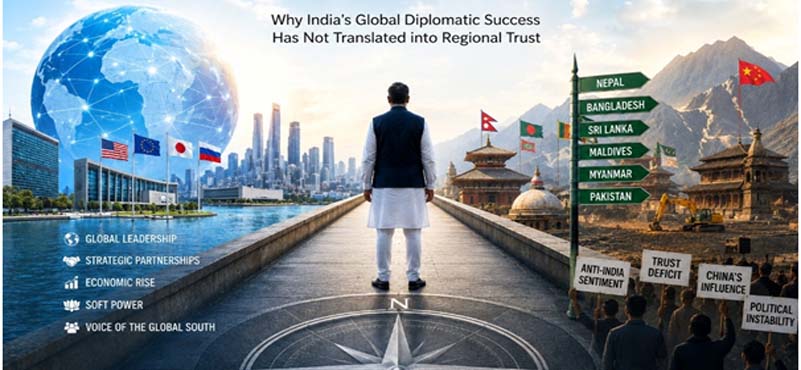
The recent deterioration in ties between India and Nepal is not merely a bilateral irritant. It reflects a deeper strategic paradox confronting India in South Asia. Political rhetoric in Kathmandu has become increasingly nationalist and occasionally anti-India. Chinese economic and political influence has expanded steadily in Nepal’s infrastructure, communications and political discourse. Similar patterns are visible, in varying degrees, in Bangladesh, Sri Lanka, Maldives and Myanmar.
Ironically, this regional unease has emerged during a period when India’s global profile has risen dramatically. India today participates confidently in major global platforms, shapes conversations on technology and climate, deepens strategic partnerships with the West while retaining ties with Russia, and increasingly presents itself as the voice of the Global South. Yet the same India struggles to maintain stable goodwill within its immediate neighbourhood.
This contradiction raises a difficult but necessary question:
How did India become more influential globally while simultaneously becoming less trusted regionally?
The answer lies not in one diplomatic failure, but in the intersection of geopolitics, institutional weaknesses, regional asymmetry and changing power equations in Asia.
India’s Diplomatic Rise on the Global Stage
Over the past decade, India’s external engagement has undergone a remarkable transformation.
India successfully pursued a policy of multi-alignment rather than rigid alliance politics. It strengthened strategic cooperation with the United States through defence agreements and technology partnerships while simultaneously preserving defence ties with Russia. It expanded maritime cooperation with Japan and France, deepened engagement in West Asia, and emerged as a major actor in forums such as the Quadrilateral Security Dialogue, BRICS and G20.
India’s successful hosting of the G20 summit symbolized this diplomatic confidence. Simultaneously, India projected soft power through digital public infrastructure, pharmaceuticals, vaccines, space achievements and diaspora influence. Several factors contributed to this success:
- Rapid economic growth and market potential.
- Strategic importance in balancing China.
- Political stability and leadership continuity.
- Expanding defence and technological capabilities.
- Effective projection of India as a civilizational and democratic power.
Globally, India increasingly came to be viewed as an indispensable balancing power in an uncertain world order. Yet diplomatic success at the global level did not automatically translate into regional harmony.
India’s Failure at the Regional Level
In South Asia, India’s diplomatic record appears considerably more uneven.
Relations with Pakistan remain adversarial. Nepal periodically witnesses anti-India political mobilization. Bangladesh, despite strong cooperation, still experiences undercurrents of mistrust linked to water-sharing, migration and political sensitivities. Sri Lanka oscillates between India and China. Maldives repeatedly swings politically between “India First” and “India Out” narratives. Myanmar remains unstable and strategically contested.
Most significantly, China has expanded its footprint across nearly every neighbouring state through infrastructure financing, connectivity projects and elite-level influence. This has created a perception that India, despite being the natural regional power, failed to consolidate its own strategic backyard. The stagnation of South Asian Association for Regional Cooperation further symbolizes the failure of South Asia to evolve into an integrated regional community.
India’s neighbourhood challenge is therefore not merely diplomatic; it is psychological and structural. Many smaller neighbours increasingly seek to balance India rather than align naturally with it.
Reasons Behind the Regional Failure
1. The Burden of Asymmetry. India’s overwhelming size creates unavoidable anxieties among smaller neighbours. What India considers legitimate security concerns are often perceived as interference by neighbouring states. Geography magnifies this asymmetry. Unlike distant powers, India’s influence is immediate and unavoidable. This creates a persistent “big brother” perception.
2. The Shadow of Partition and the Geography of Distrust. The roots of South Asia’s regional distrust also lie deeper in history. In Shattered Lands, Sam Dalrymple argues that the hurried partitions and boundary-making processes accompanying the end of the British Empire fractured long-standing civilisational, cultural and economic linkages across the subcontinent. The Partition of 1947 not only created India and Pakistan as rival security states, but also transformed borders across South Asia into zones of suspicion, militarisation and political anxiety.
The continuing reality that India maintains heavily fenced and guarded borders with Pakistan and Bangladesh, while now constructing an extensive smart fencing system along parts of the Myanmar frontier, reflects how deeply security concerns have come to dominate regional interaction. This persistent atmosphere of mistrust prevented South Asia from evolving into an integrated regional community and created strategic spaces that were later exploited by China to expand its influence across the neighbourhood.
3. China’s Strategic Entry into South Asia. China recognised South Asia as India’s vulnerable strategic flank. Through ports, highways, energy projects and loans under the Belt and Road Initiative, Beijing provided smaller countries with an alternative strategic partner. China’s diplomacy was fast, transactional, infrastructure-driven, and politically non-judgmental. India often underestimated the geopolitical consequences of this expansion.
4. Reactive Rather than Anticipatory Diplomacy. India frequently appeared reactive to developments rather than ahead of them. The 2015 Nepal blockade perception severely damaged India’s image among ordinary Nepalis. Political changes in Maldives and Sri Lanka often caught Indian policymakers unprepared. Neighbourhood diplomacy requires continuous engagement not only with governments but also with opposition parties, media, universities, youth and civil society. India often remained excessively state-centric.
5. Slow Delivery and Bureaucratic Delays. One of India’s biggest diplomatic weaknesses has been implementation failure. Projects announced enthusiastically often moved slowly due to bureaucratic procedures, inter-ministerial coordination failures, funding delays, and administrative caution. China, in contrast, delivered visible infrastructure rapidly, creating immediate political capital. In modern diplomacy, speed itself is strategic power.
6. Security-Heavy Approach. India’s neighbourhood policy is heavily influenced by security concerns to include terrorism, migration, insurgency, Chinese influence, and maritime vulnerabilities. While legitimate, this security-first mind-set sometimes overshadowed emotional diplomacy and developmental engagement. Neighbours often felt India spoke more as a security manager than as a regional partner.
Weaknesses Within the Indian Diplomatic System
Criticism of the Indian Foreign Service should neither be exaggerated nor ignored. India’s diplomats are highly capable, but institutional weaknesses remain visible.
1. Limited Size of the Diplomatic Corps. India manages global ambitions with a surprisingly small diplomatic cadre compared to major powers. This limits regional specialization, outreach capacity, language expertise, and sustained local engagement.
2. Elite-Centric Diplomacy. Indian diplomacy has historically remained formal and establishment-oriented. Embassies often engage effectively with ruling elites but insufficiently with local media, universities, opposition leaders, youth organisations, and grassroots opinion makers. This creates vulnerabilities during political transitions.
3. Weak Strategic Communication. India has not mastered modern narrative warfare. Anti-India misinformation spreads rapidly through social media ecosystems in neighbouring countries. India’s responses are frequently delayed, fragmented or defensive. Diplomacy today is fought not only in ministries but also in digital perception spaces.
4. Inadequate Accountability and Policy Feedback. Long-term diplomatic assessment mechanisms remain weak. There is insufficient institutional scrutiny regarding failed regional projects, deteriorating public perceptions, intelligence gaps, and policy miscalculations. Strategic cultures improve only when systems absorb criticism honestly.
Measures to Reclaim Lost Ground
India cannot reclaim regional trust through rhetoric alone. It requires a recalibrated neighbourhood doctrine rooted in humility, efficiency and delivery.
1. Become the Region’s Most Reliable First Responder. India should institutionalize rapid humanitarian assistance. Whether earthquakes, financial crises or health emergencies, India must consistently remain the first country neighbours turn to instinctively. Humanitarian credibility builds durable trust.
2. Deliver Projects Faster. India’s greatest diplomatic reform may simply be administrative efficiency. A dedicated regional infrastructure authority with financial and operational autonomy could fast-track strategic projects. Even modest projects completed on time create more goodwill than grand announcements delayed indefinitely.
3. Build People-Centric Diplomacy. India must engage societies, not merely governments. Measures include scholarships, medical cooperation, youth exchanges, digital partnerships, tourism connectivity, regional educational networks. India possesses immense civilisational soft power but has not institutionalised it strategically.
4. Create a Specialized Neighbourhood Cadre. The IFS requires deeper regional specialization. Officers dealing with South Asia should receive language training, longer tenures, political sociology exposure, economic negotiation expertise, and media engagement skills. South Asia cannot be managed through routine diplomatic rotation alone.
5. Separate Domestic Politics from Regional Diplomacy. Statements aimed at domestic political audiences sometimes create regional anxieties. A mature regional power must practice calibrated communication. Quiet diplomacy often produces stronger outcomes than public signalling.
6. Compete with China Intelligently. India cannot and need not match China financially. Instead, India should focus on areas where it enjoys natural comparative advantages like healthcare, democratic institutions, education, digital public infrastructure, affordable technology, and cultural familiarity. India’s strength lies in trust-based integration, not debt-driven expansion.
Way Ahead: From Regional Power to Trusted Power
India’s rise in the twenty-first century will ultimately depend not only on economic growth, military capability or global recognition, but also on the confidence and comfort its neighbours feel in India’s presence. No major power can sustain global influence while remaining regionally distrusted. The growing unease visible across South Asia — whether in Nepal’s increasingly assertive nationalism, political fluctuations in Maldives, strategic anxieties in Sri Lanka, or China’s rise in South Asia should therefore be viewed as a strategic wake-up call rather than a temporary diplomatic setback.
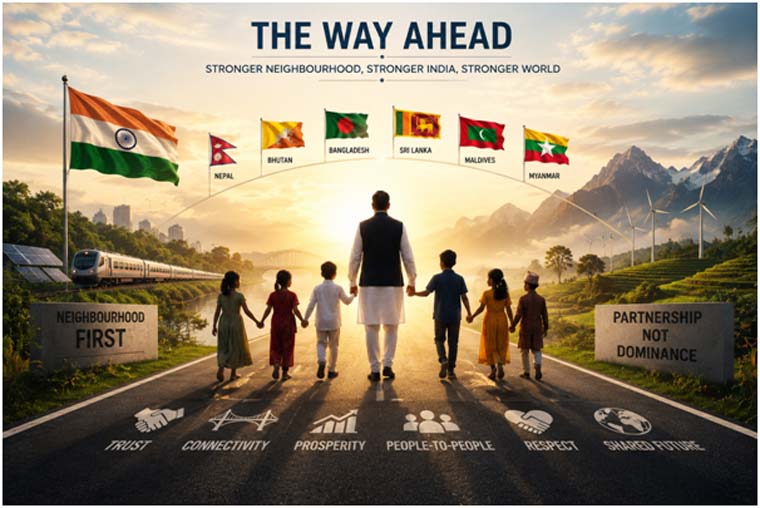
The challenge before India is not merely to counter China, but to redefine the nature of its own regional leadership. India must move from being perceived as a dominant power to becoming a dependable partner. This requires faster delivery of projects, deeper people-to-people engagement, more sensitive diplomacy, institutional reforms within the Indian Foreign Service and a neighbourhood policy rooted in trust rather than strategic anxiety alone.
India already possesses enduring advantages — geography, civilizational familiarity, markets, democratic legitimacy and human connectivity. However, these strengths must now be supported by efficient statecraft and sustained regional sensitivity.
A nation seeking leadership beyond its borders must first inspire confidence within them. India cannot truly emerge as a Vishwa Guru to the world unless it first becomes a trusted Prativeshi Guru in its own neighbourhood.
ABOUT THE AUTHOR

Lt Gen Rajeev Chaudhry (Retd) is a social observer and writes on contemporary national and international issues, strategic implications of infrastructure development towards national power, geo-moral dimension of international relations and leadership nuances in changing social construct.