
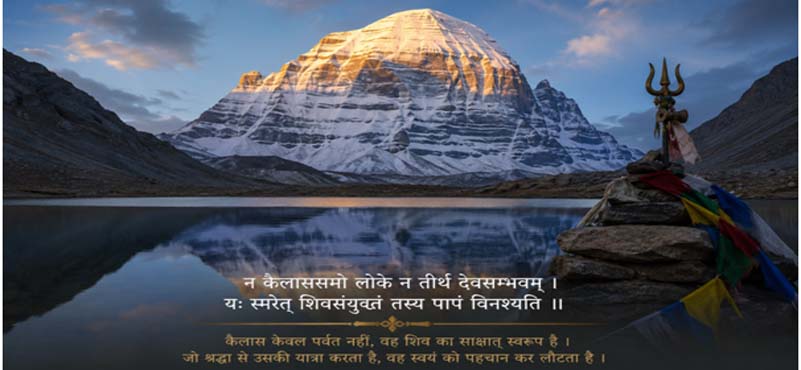
The Mountain Beyond Mountains
There are mountains that challenge the body. There are mountains that inspire the mind. Then there is Mount Kailash—a mountain that calls to the soul.
For countless devotees of Lord Shiva, Kailash is not merely a destination on a map. It is the cosmic abode of Mahadev, where time stands still, silence acquires a voice, and the eternal dance of creation and destruction continues beyond human perception. One does not “visit” Kailash in the conventional sense; one answers its call. It is perhaps the only pilgrimage where the mountain itself is the deity. There is no shrine to enter, no idol to worship, no elaborate rituals to perform. The snow-clad peak is the temple, the vast blue sky its dome, and the whispering winds its eternal hymns.
For centuries, sages, ascetics, kings and ordinary pilgrims have braved inhospitable terrain, freezing temperatures and rarefied air to catch a fleeting glimpse of this sacred mountain. Many believe that no one truly decides to undertake the Kailash Mansarovar Yatra; rather, it is Lord Shiva who extends the invitation. The familiar saying among pilgrims is, “Only those whom Shiva calls can reach Kailash.”
The journey is demanding. It tests physical endurance, mental resilience and spiritual resolve. Yet every year, thousands willingly embrace these hardships. They do not measure the pilgrimage in kilometres walked or passes crossed. They measure it in faith, surrender and grace.
Why Kailash Matters
In Hindu tradition, Mount Kailash is revered as the celestial abode of Lord Shiva and Goddess Parvati. The Shiva Purana describes Shiva as the supreme yogi, immersed in eternal meditation atop the silver mountain of Kailash, detached from worldly desires yet deeply connected with the universe. It is here that Shiva is believed to have revealed profound truths to Parvati, where the sacred rhythm of the damaru first resonated, and where the mighty Ganga descended from the heavens into his matted locks before flowing to the plains to nourish civilisation.
At the foot of the mountain lies the serene Lake Mansarovar. According to tradition, it was first conceived in the mind (manas) of Lord Brahma before manifesting on earth, giving the lake its name. Its crystal-clear waters are regarded as symbols of purity, wisdom and spiritual awakening. Nearby lies Rakshastal, stark and mysterious, reminding pilgrims that light and darkness, serenity and turbulence, coexist in nature just as they do within every human heart.
The revered Kailash Parikrama, a circumambulation of approximately fifty-two kilometres around the mountain, is the spiritual climax of the pilgrimage. Crossing the formidable Dolma La Pass, standing at over 18,000 feet, pilgrims experience not merely a physical ascent but an inner transformation. Every step becomes a prayer; every breath becomes an offering.
Remarkably, Kailash is sacred not only to Hindus. Buddhists venerate it as the abode of Demchok and identify it with Mount Meru, the cosmic axis of the universe. Jains believe it is where the first Tirthankara, Rishabhdev, attained liberation. Followers of the ancient Bon faith also consider it their holiest mountain. Few places on Earth command such universal reverence across diverse spiritual traditions.
Perhaps this explains why, unlike many of the world’s highest peaks, Mount Kailash has never been climbed. It is not because it is unconquerable, but because humanity has collectively accepted that some summits are meant to be revered, not conquered.
Three Gateways to Kailash
Today, pilgrims can undertake the Kailash Mansarovar Yatra through three principal routes, each offering a distinct experience while leading to the same sacred destination.
- Lipulekh Pass Route. Beginning in Uttarakhand, it is the oldest and most traditional path. For centuries, saints, traders and pilgrims traversed this route. Even today, many devotees regard this route as the most spiritually authentic because it preserves the continuity of an ancient pilgrimage.
- Nathu La Route. This route through Sikkim offers a comparatively easier journey. Improved road connectivity has made this route more comfortable while retaining the spiritual essence of the yatra.
- Nepal Route. This goes via Kathmandu and the Kerung border. Operated largely through private tour agencies, it has become popular among international pilgrims and those seeking greater flexibility in planning their journey.
Yet among these three, the Lipulekh route occupies a special place in the hearts of devotees. It is not merely a road to Kailash; it is a path sanctified by centuries of faith.
In many ways, the story of Kailash is also the story of this ancient Himalayan corridor—a path where geography, civilisation and spirituality have travelled together for centuries.
Lipulekh: Where Roads Serve Faith
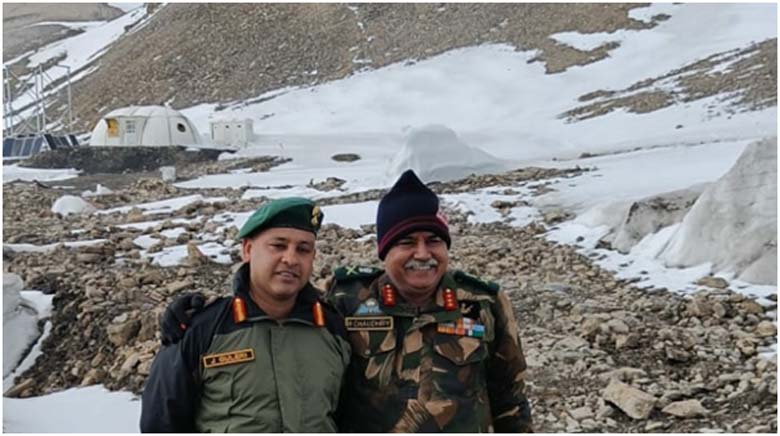
Among the three routes to Kailash, the ancient trail through Lipulekh Pass occupies a place of special reverence. Long before maps were drawn and borders demarcated, this was the pathway of pilgrims, traders and wandering ascetics. The Bhotia communities of the Kumaon Himalayas carried salt, wool and grain across these mountains, while saints and seekers carried little more than a staff, a blanket and an unwavering faith in Lord Shiva.
The Himalayas, however, have never yielded easily. Landslides, avalanches, swollen streams, fragile mountain slopes and unpredictable weather have tested every traveller who has attempted this journey. For generations, reaching Kailash demanded not only devotion but extraordinary courage.
It was my privilege to witness another chapter being written in the history of this pilgrimage.
During my years with the Border Roads Organisation, I came to understand that roads in the Himalayas are far more than engineering projects. Some connect villages. Some strengthen national security. But a few carry the weight of civilisation itself. The road to Lipulekh is one such road.
Building this route was unlike constructing highways across the plains. Every kilometre demanded patience. Mountains had to be persuaded rather than conquered. Men and machines worked at dizzying altitudes where oxygen was scarce, weather changed without warning and every blasting operation had to respect the fragile balance of nature. Often, a day’s hard work could disappear overnight under a fresh landslide or snowfall.
Yet no one complained.
Every member of the BRO team understood that we were not merely building a road. We were helping restore one of India’s oldest pilgrim routes. We were making it possible for elderly devotees, women and ordinary citizens to undertake a journey that had once remained beyond the reach of many.
I have often believed that engineering, at its highest, becomes an act of service. A bridge across a turbulent stream is not merely steel and concrete; it is hope. A mountain road is not merely asphalt carved into rock; it is an opportunity. On the Lipulekh route, that opportunity is deeply spiritual. Today, pilgrims traverse stretches on wheels that once took weeks to negotiate.
The Lipulekh road is therefore much more than an infrastructure project. It is a bridge between India’s ancient spiritual traditions and modern nation-building. It is a reminder that development and devotion can walk together.
The Panch Kailash: Five Manifestations of the Divine
While Mount Kailash in Tibet remains the supreme abode of Lord Shiva, Hindu tradition also speaks of the Panch Kailash—five sacred Himalayan shrines that together represent different manifestations of Mahadev.
- At the heart of this sacred geography stands Mount Kailash, the eternal seat of Shiva, rising in majestic isolation above the Tibetan plateau. Its near-perfect pyramidal form has inspired awe for millennia. To behold it is considered a blessing; to circumambulate it, a lifetime’s spiritual achievement.
- Closer to India’s borders lies Adi Kailash, often called Chhota Kailash. Nestled amidst the Kumaon Himalayas, it resembles the great Kailash in form and serenity. The nearby Parvati Sarovar enhances its tranquil beauty. Adi Kailash is considered the earthly home where Lord Shiva and Goddess Parvati lived before shifting to Mount Kailash in Tibet. For many devotees unable to undertake the arduous journey into Tibet, Adi Kailash offers a deeply moving experience of Shiva’s presence. Before road to Lipulekh, the road to Jollingkong was constructed to facilitate devotees to visit this sacred mountain.
- Not far away rises Om Parvat, one of nature’s most astonishing creations. Every winter, snow settles upon its dark rock face in the unmistakable shape of the sacred syllable “Om”. No sculptor has chiselled it, no artist has painted it. Nature herself seems to have inscribed the primordial sound upon the mountain, leaving pilgrims humbled by its mystery.
- In Himachal Pradesh stands Kinnaur Kailash, dominated by a towering rock pillar that appears to touch the heavens. The steep trek to this sacred peak tests the endurance of every pilgrim, yet the breath-taking panorama and profound silence make every step worthwhile.
- Further West is Shrikhand Mahadev, perhaps the most physically demanding of the Panch Kailash pilgrimages. The final ascent to its lofty rock pinnacle is steep, rugged and unforgiving. Those who complete it often speak less of reaching the summit than of discovering their own inner strength.
Each of these five Kailash shrines possesses its own personality. Together they reveal the many dimensions of Shiva—the ascetic, the protector, the cosmic dancer, the compassionate father and the eternal source of creation. They remind us that while God may be one, the paths leading to Him are wonderfully diverse.
Faith Above 18,000 Feet
The Himalayas are impartial. They make no distinction between the rich and the poor, the scholar and the labourer, the young and the old. At altitudes above 18,000 feet, every traveller breathes the same thin air. Every step is slow. Every heartbeat is louder. Every ascent demands humility.
It is here that one begins to understand the true meaning of pilgrimage.
The body protests. Muscles ache. Breathing becomes laboured. A few steps often require a pause. Yet, remarkably, despair rarely overtakes the pilgrims. Instead, chants of “Om Namah Shivaya” echo across barren valleys, encouraging strangers who become companions on the same sacred path.
Faith performs a quiet miracle. It does not remove hardship; it transforms its meaning.
The burden on the shoulders becomes lighter because the heart is full. Fatigue gives way to determination. Anxiety is replaced by surrender. In those rarefied heights, one realises that oxygen may become scarce, but faith grows abundant.
Perhaps that is the greatest gift of Kailash. Pilgrims begin the journey believing they are travelling towards God. Somewhere along the way, they discover that God has been travelling beside them all along.
The Highest Summit Lies Within
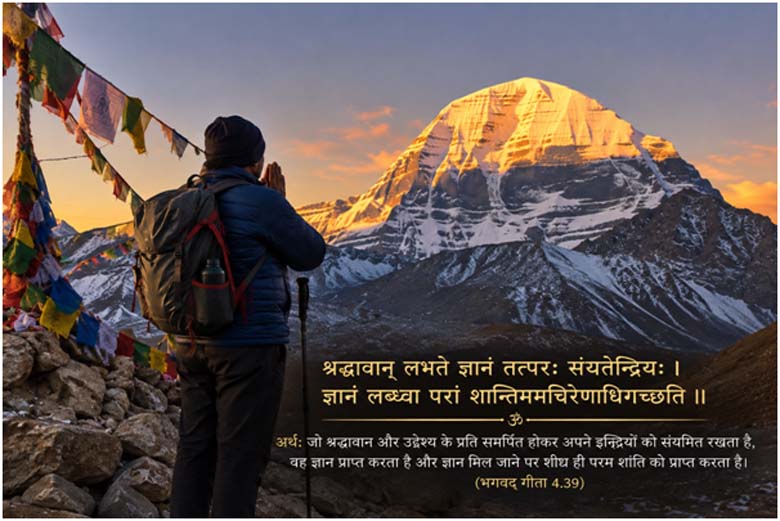
Every civilisation preserves certain journeys because they teach lessons that no classroom can impart. The Kailash Mansarovar Yatra is one such journey.
People return with photographs of snow-covered peaks and the shimmering waters of Mansarovar. Yet these are merely memories. The true pilgrimage leaves no visible souvenir. It leaves behind a quieter mind, a humbler heart and a renewed appreciation for life’s simple blessings.
Roads will continue to improve. Bridges will become stronger. Communication networks will reach ever deeper into the Himalayas. These are welcome achievements, making the pilgrimage safer and more accessible for future generations. Yet no engineering marvel can replace the one thing that has sustained this yatra for thousands of years—faith.
Kailash teaches that the greatest victories are not won over mountains but over one’s own ego. It reminds us that silence often speaks louder than words, that simplicity is a form of wisdom, and that surrender is not weakness but strength.
Those who return from Kailash rarely claim that they conquered the mountain. Instead, they speak softly of how the mountain transformed them.
For in the end, Mount Kailash is not merely a destination in the Himalayas. It is a destination within ourselves.
ABOUT THE AUTHOR

Lt Gen Rajeev Chaudhry (Retd) is a social observer and writes on contemporary national and international issues, strategic implications of infrastructure development towards national power, geo-moral dimension of international relations and leadership nuances in changing social construct.