
The Long Walk Beyond Revenge
Some lives become larger than history because they answer questions that every generation continues to ask. Nelson Mandela’s life poses perhaps the most difficult question of all: How does a man spend twenty-seven years in prison and emerge without hatred? Most of us struggle to forgive an insult that lasts a day, a betrayal that lingers for a year, or a disappointment that refuses to fade. Mandela endured nearly three decades behind bars under a system designed not merely to imprison his body but to diminish his dignity. Yet when freedom finally arrived, he chose reconciliation over revenge, hope over bitterness and nation-building over score-settling. That choice transformed him from a political leader into one of humanity’s enduring moral giants.
The Prison That Could Not Imprison the Mind
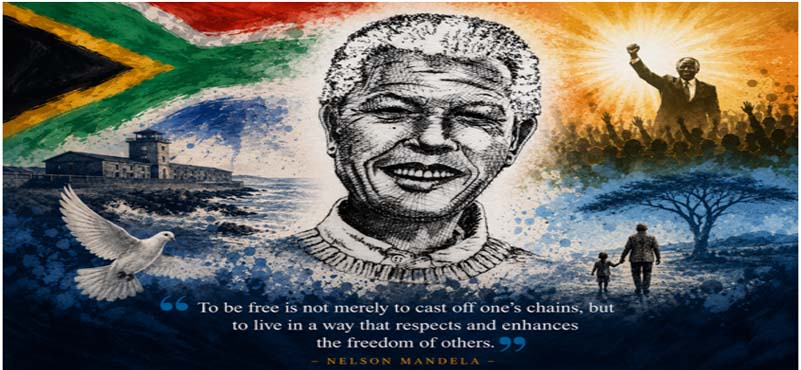
Prisons are built to confine the body, but they often reveal the true freedom of the human spirit. Robben Island was intended to silence Nelson Mandela, isolate him from his people and slowly erode his resolve through hard labour, humiliation and loneliness. Instead, it became the unlikely place where his character acquired extraordinary depth. Breaking limestone under the blazing African sun exhausted his body, but it never diminished his conviction. Deprived of ordinary comforts, he discovered extraordinary discipline. Every day became an exercise in patience, self-control and quiet leadership.
Mandela understood that every prison presents two choices. One can allow suffering to become a permanent companion, or one can transform suffering into a teacher. He chose the latter. He studied relentlessly, debated ideas with fellow prisoners and encouraged younger inmates to educate themselves. Robben Island gradually became known as the “University of Robben Island” because the prisoners refused to surrender their minds even when their freedom had been taken away.
Those years also taught Mandela an uncomfortable truth about leadership. A leader who cannot govern his own emotions will never govern a divided nation. Long before he became South Africa’s President, he had already learnt the art of mastering anger, disciplining ego and replacing resentment with purpose.
Chains can restrain the body; only bitterness imprisons the soul.
Forgiveness Is Not Weakness. It Is Strategy.
History often glorifies revenge because it appears decisive. Forgiveness, by contrast, is frequently mistaken for softness. Nelson Mandela demonstrated that it can be one of the most powerful instruments of statecraft.
When apartheid ended, South Africa stood on the edge of a dangerous future. The wounds of racial injustice ran deep, and retaliation seemed almost inevitable. Many expected the new government to repay decades of oppression with humiliation of the former rulers. Mandela recognised that such a path might satisfy emotions for a moment but would condemn the nation to generations of conflict.
Instead, he chose reconciliation. The Truth and Reconciliation Commission did not erase painful memories or excuse injustice. It acknowledged the truth while allowing the nation to move forward without becoming hostage to its past. Mandela understood that countries, like individuals, cannot build tomorrow while constantly reliving yesterday.
Forgiveness, in his vision, was neither surrender nor forgetfulness. It was a conscious decision to deny hatred the power to shape the future. He was not asking victims to forget their suffering; he was asking an entire nation to refuse becoming prisoners of it.
Forgiveness does not rewrite yesterday. It protects tomorrow.
Power Reveals Character More Than It Creates It
Many revolutionaries become generous while seeking power but unforgiving once they possess it. Mandela travelled the opposite path. The years of hardship had stripped away every illusion except one—that leadership exists to unite rather than divide.
As President, he resisted the temptation to replace one form of domination with another. He retained institutions, reassured minorities and repeatedly reminded South Africans that democracy could not survive if large sections of society lived in fear. His famous appearance wearing the Springbok rugby jersey during the 1995 Rugby World Cup was far more than a sporting gesture. It symbolised his determination to reclaim a symbol of division and transform it into one of national unity.
Mandela understood something that many leaders forget. Elections can produce governments, but only trust produces nations. True authority is measured not by the number of opponents one defeats but by the number of former opponents willing to build the future together.
His greatest victory was therefore not political. It was psychological. He persuaded millions of people that reconciliation was not only morally desirable but strategically indispensable.
Power is greatest when it heals more wounds than it creates.
Freedom Demands Responsibility
Freedom is among the most celebrated words in human history, yet Mandela constantly reminded the world that freedom is never an end in itself. It carries obligations that are often more demanding than the struggle to obtain it.
Political liberation gave South Africans the right to vote, but Mandela believed genuine freedom also required education, opportunity, justice and mutual respect. He repeatedly argued that dignity cannot flourish where ignorance, poverty and inequality continue to dominate everyday life. His famous observation that education is the most powerful weapon for changing the world reflected this belief. Real revolutions are sustained not merely by ballots but by classrooms.
Mandela also insisted that individual liberty must never undermine the freedom of others. A society becomes truly free only when citizens willingly accept responsibility for one another. Rights and duties are not opposing ideas; they are partners in building a healthy democracy.
This message feels remarkably contemporary. Around the world, societies often celebrate rights while neglecting responsibilities. Mandela’s life reminds us that freedom without discipline eventually loses both direction and purpose.
Freedom reaches its highest meaning when it becomes responsibility in action.
Five Lessons That Belong to Every Generation
The greatest leaders leave behind more than memories; they leave behind principles that outlive their own age. Mandela’s life continues to offer guidance because the challenges he confronted—division, injustice, anger and inequality—remain part of the human condition. His five lessons would always guide the future generations in making this world a better place to live.
- Suffering should shape character rather than harden it. Adversity can either shrink a person or deepen them. Mandela chose depth.
- Forgiveness requires greater courage than revenge. Revenge satisfies emotion, while forgiveness demands vision.
- Power exists to restore dignity, not to humiliate opponents. Leadership is measured by the confidence it inspires, not the fear it creates.
- Education remains society’s most enduring investment. Nations rise when ordinary citizens are empowered to think, learn and contribute.
- No victory is complete if it leaves half the nation feeling defeated. The finest triumphs are those in which former adversaries become partners in a common future.
The strongest nations are built not by victorious leaders, but by healing ones.
The Long Walk Beyond Revenge
Every generation searches for heroes, but only a few individuals become moral compasses for humanity. Nelson Mandela earned that place not because he suffered more than others, but because he transformed suffering into wisdom. His extraordinary achievement was not merely dismantling apartheid or becoming South Africa’s first Black President. It was demonstrating that forgiveness is not the absence of strength but its highest expression.
Today, as the world marks Nelson Mandela International Day, millions will devote sixty-seven minutes to acts of service in honour of the sixty-seven years he dedicated to public life. That tradition is meaningful, but perhaps the greatest tribute lies elsewhere. It lies in resisting the temptation to answer hatred with hatred, division with division and anger with anger. Mandela showed that the hardest battles are fought not on streets or in parliaments but within the human heart.
History remembers conquerors for the territories they captured and empires they built. Humanity remembers Nelson Mandela because he conquered something infinitely more difficult—his own resentment. That is why his long walk never truly ended. It continues wherever courage overcomes fear, wherever forgiveness defeats revenge and wherever hope proves stronger than hatred.
Nelson Mandela did not simply free a nation. He taught the world that the longest walk towards justice begins by walking beyond revenge.
ABOUT THE AUTHOR

Lt Gen Rajeev Chaudhry (Retd) is a social observer and writes on contemporary national and international issues, strategic implications of infrastructure development towards national power, geo-moral dimension of international relations and leadership nuances in changing social construct.