
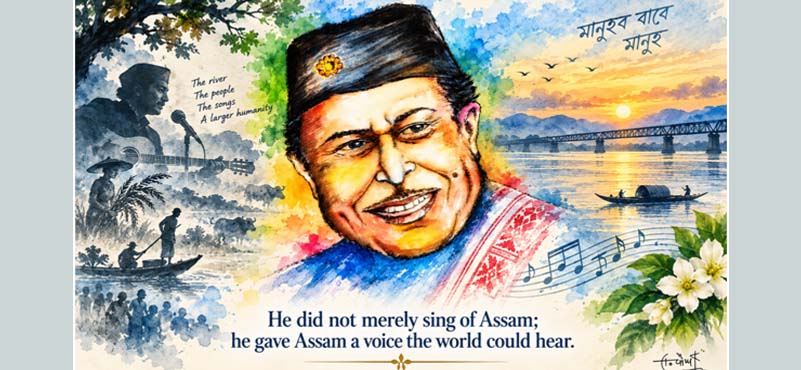
There are singers who entertain us, singers who move us, and singers whose voices become so inseparable from a people that, after they are gone, the people continue to hear themselves in their songs. Bhupen Hazarika belonged to the rarest category. He did not merely sing about Assam; he seemed to carry Assam inside his voice. And if Assam had to choose one sound to represent its soul, it might well be the deep, resonant, almost elemental voice of the man whom it lovingly called Sudhakantha—the pure-throated one.
On 8 September 2026, Assam marks the 100th birth anniversary of the man who became far more than a singer, composer, lyricist, filmmaker or cultural icon. He became a bridge—between Assam and India, between the Northeast and the rest of the country, between folk and modernity, between music and social conscience, and above all, between one human being and another.
Perhaps the best way to understand Bhupen Hazarika is not through the honours he received, though there were many, culminating in the Bharat Ratna. It is through a river.
He was born on 8 September 1926 in Sadiya, in the vast Assam of that time, close to the Brahmaputra. He was the eldest of ten children. His mother sang lullabies to him; the folk traditions and tribal music surrounding his childhood entered his consciousness almost naturally. Long before he understood music as an art, he experienced it as a way of life.
Then, at the age of ten, something extraordinary happened.
At a public event in Tezpur, the young Bhupen sang. Among those listening were two towering figures of Assamese culture—Jyotiprasad Agarwala and Bishnu Prasad Rabha. They recognised something in the boy that perhaps even he could not yet see in himself. Agarwala, one of the pioneers of Assamese cinema, took the young singer with him to Kolkata. Rabha became another important influence. By the time most children were still discovering their voices, Bhupen Hazarika had already begun discovering the enormous possibilities of his own.
But his genius was never confined to music.
He studied political science at Banaras Hindu University. In Banaras, he encountered another India—the India of classical music, spirituality, debate and tradition. He was fascinated by Ustad Bismillah Khan and sought to understand the nuances of Hindustani music. Then came America. In 1948, he went to Columbia University in New York for a PhD in Mass Communication.
It was there that his imagination widened without his roots loosening.
America exposed him to folk music as an instrument of protest, to the African-American struggle and to the extraordinary power of music to speak when politics failed. He met Paul Robeson. Robeson’s rendition of Ol’ Man River, with its sorrowful meditation on the suffering of African-Americans, stayed with him. Hazarika would eventually transform that emotional experience into one of the defining songs of his own life—Bistirno Parore, the Brahmaputra speaking through the cadence of a borrowed river.
That transformation tells us almost everything about Bhupen Hazarika. He could travel across the world without becoming a stranger to home. He could hear the Mississippi and find the Brahmaputra. He could encounter the pain of another people and recognise his own people’s pain in it. He could take an American experience, pass it through an Assamese imagination and return it to India as something entirely his own.
That was his magic.
The Brahmaputra was not merely a geographical presence in his life. It became a metaphor for everything he believed about humanity. It could be beautiful and terrifying, nourishing and destructive, ancient and restless. It connected villages, communities and cultures, but it also carried away lives, memories and dreams. Hazarika’s songs captured precisely that contradiction. His music could sound like celebration one moment and lament the next. His river could be a mother, witness, companion and accuser.
The Indian Express has described the Brahmaputra as an enduring metaphor in his work and noted how his songs, deeply rooted in Assam, became links between the Northeast and the rest of India. Their themes—solidarity, dignity, humanity and resistance—were never merely regional.
This is why reducing Bhupen Hazarika to a regional icon would be an injustice to the man. He was intensely Assamese, but never narrowly regional. He was deeply Indian, but never culturally homogenised. He was a nationalist without needing nationalism to silence diversity. His Assam was not an island separated from India. It was a doorway into India.
After returning from America, he joined the Indian People’s Theatre Association, where art was understood not simply as entertainment but as a means of awakening society. His songs increasingly became the voices of people who rarely found themselves represented in polished public narratives—the boatman, the worker, the poor, the marginalised, the lonely and the angry.
And that perhaps explains why Assam revered him so deeply. People did not merely listen to Bhupen Hazarika. They recognised themselves in him. In times of political turbulence, when Assam felt neglected and culturally threatened, his songs acquired another meaning. He did not stand outside the anguish of his people and comment upon it. He entered it. He sang their anxieties, their aspirations and their wounds. Yet even when his music became a vehicle for protest, he resisted allowing anger to become hatred.
That distinction matters enormously.
In the turbulent years of the Assam movement and the violence that followed, his voice remained a voice for peace. In 1998, while speaking at an event marking fifty years of All India Radio Guwahati, he spoke about peace and later offered to mediate between the Union government and ULFA. He once recalled how young men had challenged him to abandon songs and pick up a gun. His answer was unforgettable: his song was his gun.
He believed that music could confront injustice without surrendering humanity. He believed that identity could be fiercely protected without another identity being hated. He believed that the wounds of a society could be acknowledged without allowing those wounds to become its permanent destiny.
His canvas therefore became enormous.
He sang of Assam, but also of Bengal. He composed for Hindi cinema. He wrote, directed and gave music to films. His work travelled across languages. His songs entered the consciousness of people who did not understand Assamese, because the deepest language of his music was not Assamese, Bengali or Hindi.
And that is why, even a century after his birth, his songs refuse to become merely archival recordings.
There is something else about Bhupen Hazarika that deserves remembering in an age obsessed with celebrity: he made himself larger by remaining close to ordinary people. He could stand before thousands, yet sing as if he were speaking to one lonely listener. That intimacy was the secret of his greatness.
India has always been a civilisation of many voices. The danger of a large nation is not only political fragmentation; it is cultural flattening—the possibility that the smaller voices become inaudible beneath the louder national chorus. Bhupen Hazarika showed that the opposite is possible. A region does not become less Indian by celebrating its distinctiveness. India becomes richer when every river is allowed to reach the sea without losing its name.
Bhupen Hazarika was never really owned by a stage, a language, a state or even a nation. He belonged to the great human tradition of artists who hear suffering and turn it into song; who encounter beauty and refuse to keep it to themselves; who inherit a culture and then enlarge it so that the world can enter.
He took the lullaby of his mother, the folk music of Assam, the wisdom of Banaras, the protest of America, the pain of ordinary people and the restless soul of the Brahmaputra—and made them flow into one human voice. That is why Assam does not merely remember him. Assam hears him.
A hundred years after Bhupen Hazarika was born, the Brahmaputra still flows—and somewhere within its eternal music, Bhupenda is still singing.
ABOUT THE AUTHOR

Lt Gen Rajeev Chaudhry (Retd) is a social observer and writes on contemporary national and international issues, strategic implications of infrastructure development towards national power, geo-moral dimension of international relations and leadership nuances in changing social construct.