
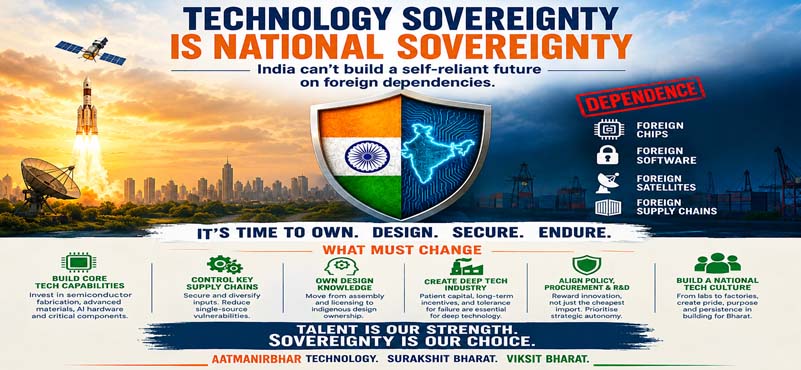
India claims to be a rising technological power. It builds rockets, runs the world’s largest digital payments system, and trains more engineers every year than most countries have working professionals. Yet ask one simple question. If every foreign chip, foreign software licence and foreign satellite link were withdrawn tomorrow, would India’s economy, military and government still function without interruption? The honest answer is no. That single fact captures the gap between using technology and owning it, and India has spent three decades mastering the first while quietly avoiding the second.
Technology sovereignty does not mean building everything at home. No country does that anymore, not even the United States or China. It is narrower and harder. It means owning the design knowledge behind the systems a nation depends on, controlling enough of the supply chain to survive a shock, and having the industrial depth to repair, modify and improve what is already in service without waiting for permission from elsewhere. Measured against that standard, India is sovereign in very few areas that actually matter.
Start with the chip that sits inside almost everything built today. India supplies a large share of the world’s semiconductor design talent, as many global chipmakers run their design centres from Indian offices. But that design work happens on foreign payrolls for foreign companies, and the actual fabrication happens almost entirely outside India. A country that cannot fabricate its own semiconductors at scale does not control the brains of its defence systems, banking network or telecom grid. The recent push to build fabrication plants at home is welcome and overdue. A single plant, however, does not undo a supply chain that took the rest of the world forty years to build elsewhere.
Telecom tells a similar story. India has built 4G and 5G networks that reach over a billion phones, and it deserves real credit for developing an indigenous stack in recent years. Yet look inside the base stations, the core routing equipment, and the undersea cables that carry the country’s data abroad, and the origin of the critical components is rarely Indian. A telecom network is now as strategic as a border post. Depending on someone else for its inner workings is a vulnerability wearing the mask of connectivity.
Defence shows the same pattern, but in sharper relief. India assembles fighter jets, missiles and radar systems under licence and calls this indigenisation. Assembly is not design ownership. When a system needs rapid modification under wartime pressure, that ability depends on understanding why an engineer elsewhere made a particular design choice years earlier, not on the ability to bolt imported parts together. The same problem now applies to artificial intelligence. India has excellent software talent, but the computing hardware that trains large models, the processors every serious laboratory now needs, comes almost entirely from one or two foreign suppliers. A country that cannot make or reliably secure the machines that train its own algorithms does not control its own intelligence infrastructure, however good its programmers are.
This dependence is no longer merely an economic inconvenience. Recent years have shown that technology has become a tool of pressure between states, deliberately used to reward partners and constrain rivals through export controls and licensing restrictions. A nation that depends on others for its critical technology does not simply pay a premium. It accepts a standing vulnerability to decisions made in boardrooms and ministries it does not control, decisions that can arrive without warning and leave very little room for negotiation.
How did a country with this much talent end up here? Part of the answer lies in decades of procurement habits that rewarded the cheapest working import over the slower, harder path of building domestic design capacity. It was always faster to buy a finished system from abroad than to fund fifteen years of research that might fail twice before it succeeds. Governments elected every five years rarely have patience for a fifteen-year bet, and industry simply follows the incentives it is given.
A second reason lies in the shape of Indian industry itself. Deep technology needs patient capital, long testing cycles, and a tolerance for failure that most Indian investors have not been willing to provide. Venture capital chases software applications that can scale within two years, not fabrication plants that take a decade to turn a profit. Public research bodies built genuine capability in a few areas, most visibly in space and missiles, but that capability rarely spread to a private industrial base able to compete on cost and speed with the rest of the world.
A third reason is harder to admit openly. India trains world-class engineers and then exports most of them. The best minds working on chip design, machine learning research and advanced materials often do so for a company headquartered elsewhere, in facilities located elsewhere, and file patents owned by someone else entirely. Talent without a domestic industry to absorb it quietly becomes another country’s sovereignty, not India’s own. Fixing this is not only a research policy question. It is also a schooling and skilling question, since a talent pipeline that rewards rote learning over original design work will keep producing engineers who are excellent at implementing someone else’s blueprint and less practised at drawing their own.
None of this is fixed by fate, and none of it needs slogans to fix it. It needs choices that will look expensive and slow for the next decade before they look wise. Government funding for research has to shift from grants that end when a paper is published to sustained programmes that follow a technology from the laboratory bench to the factory floor, with the same team and the same funding line for ten years, not one. Defence and civilian procurement should give real, measurable credit to whoever transfers the most design knowledge, not simply to the lowest bidder or the fastest delivery date.
Capital needs a push as well. A sovereign technology fund, patient by design and willing to lose money on nine attempts to win big on the tenth, would do more for chip fabrication and advanced materials than another subsidy scheme announced with fanfare and forgotten by the next budget cycle. Universities and public laboratories need contracts that require them to offer their research to an Indian company first, before anyone abroad gets a look at it. And the engineers India trains need a genuine reason to stay home, which means well-funded Indian laboratories and Indian companies able to pay what the rest of the world already offers.
Technology sovereignty is not a badge a country earns once and keeps forever. It is a muscle that must be exercised continuously, over long years when nobody is watching and success is never guaranteed. India has the people, the market and the ambition needed to build this muscle. What it has lacked is the patience to fund it properly and the honesty to admit how far it still has to go. The world will not wait for India to decide this matters. Neither will the next crisis, which will expose exactly how much of the country’s technology base lies outside its own control.
ABOUT THE AUTHOR
 Lieutenant General A B Shivane, is the former Strike Corps Commander and Director General of Mechanised Forces. As a scholar warrior, he has authored over 200 publications on national security and matters defence, besides four books and is an internationally renowned keynote speaker. The General was a Consultant to the Ministry of Defence (Ordnance Factory Board) post-superannuation. He was the Distinguished Fellow and held COAS Chair of Excellence at the Centre for Land Warfare Studies 2021 2022. He is also the Senior Advisor Board Member to several organisations and Think Tanks.