
The World Takes to the Streets
When crowds gather in distant cities, carrying different flags but expressing remarkably familiar frustrations, the coincidence invites a strategic question. From France, Spain, Italy, Belgium and Portugal to Serbia, Albania, Tunisia, Chile and Argentina, reports of demonstrations have drawn attention to the recurring themes of economic insecurity, political alienation, unaffordable housing and declining confidence in institutions. In South Asia, the upheavals in Sri Lanka in 2022, Bangladesh in 2024 and Nepal in 2025 demonstrated how quickly accumulated grievances can become movements capable of transforming political realities. India, with its distinctive democratic institutions and diverse traditions of public mobilisation, belongs in this comparative inquiry.
The temptation is to search immediately for an invisible hand directing these events. Yet simultaneous unrest does not establish common command, just as similar slogans do not prove common sponsorship. The strategic task is more demanding: to distinguish the pressures that independently produce dissent, the networks through which movements learn from one another, and the evidence that might establish deliberate coordination across borders. The European Partnership for Democracy has documented the continuing internationalisation of protest tactics and youth mobilisation, while research published in the Journal of Public Economics has demonstrated how online social connections can facilitate the geographical spread of protest. These findings establish plausible mechanisms, not a universal conspiracy.
The central question, therefore, is not whether the world’s protests look alike, but whether their similarities reveal a changing architecture of political mobilisation. The appearance of a global pattern is the beginning of the investigation, not its conclusion.
Convergence: Different Grievances, Familiar Anger
The first explanatory lens is convergence: societies confronting comparable pressures may generate similar political reactions without communicating with one another. Inflation, insecure employment, unaffordable accommodation, strained public services and perceptions of elite privilege can erode the social contract across very different political systems. Young people, particularly those who see education failing to deliver economic mobility, may feel that the promises made to their generation have been withdrawn before their working lives have properly begun.
The immediate triggers, however, differ. Demonstrations over living costs in European countries cannot automatically be equated with protests against corruption, restrictions on expression or alleged institutional failures elsewhere. In one country, a disputed policy may ignite discontent; in another, the same public anger may accumulate over years before a triggering event provides a focal point. The comparison must therefore distinguish underlying grievances from immediate catalysts and subsequent political consequences.
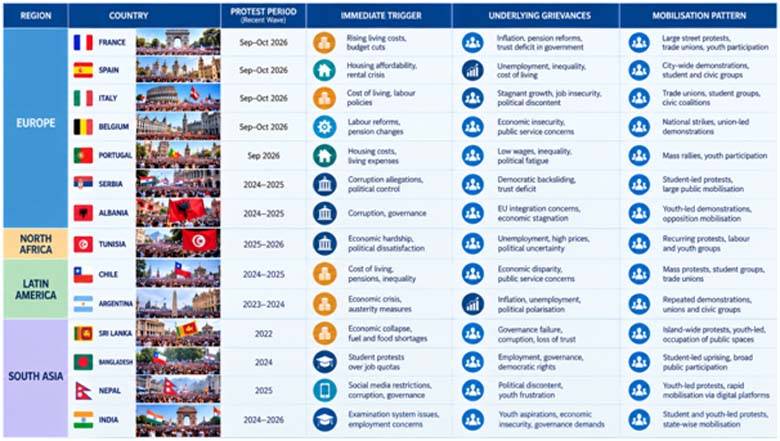
This distinction matters for India. Farmers’ protests, demonstrations concerning citizenship legislation, student movements and protests over examination-related grievances have emerged from different circumstances, constituencies and demands. Treating them as manifestations of one externally directed campaign would erase the very differences that a strategic assessment must understand. Their significance lies instead in revealing how democratic societies negotiate competing claims, institutional accountability and the boundaries of legitimate dissent.
Convergence also explains why protest language travels so readily. Words such as dignity, fairness, accountability and opportunity possess universal emotional resonance, even when their political meanings differ. Similar demands may reflect common human expectations rather than common organisers.
When grievances converge, the resulting crowds may resemble one another because the pressures beneath them are similar, not because their instructions originate from the same source.
Contagion: How Protest Travels Without Borders
Convergence explains resemblance; contagion helps explain transmission. Contemporary movements observe one another in near real time, borrowing symbols, slogans, organisational methods and forms of digital communication. A dramatic image of a government building surrounded by demonstrators can become an international reference point within hours. A tactic that appears effective in one capital may inspire activists elsewhere, who adapt it to their own circumstances without seeking permission from the original organisers.
Social media has transformed the speed and reach of this process. Research by Jost and colleagues in Political Psychology describes how digital platforms facilitate the exchange of practical information, emotional appeals and motivational messages that support collective action. A 2025 study of Black Lives Matter demonstrations, published in the Journal of Public Economics, found that stronger online social connections between American counties increased the likelihood of protest spillover. Neither study establishes that platforms manufacture grievances; both illuminate how existing grievances can travel through connected networks.
The implications are substantial. Digital communication can reduce the cost of mobilisation, allow loosely connected individuals to discover common concerns and weaken the traditional gatekeeping role of established organisations. Humour, memes, short videos and personal testimonies can create a shared identity before a movement develops formal leadership. Yet these same features can magnify misinformation, circulate misleading footage or make isolated incidents appear representative of an entire country.
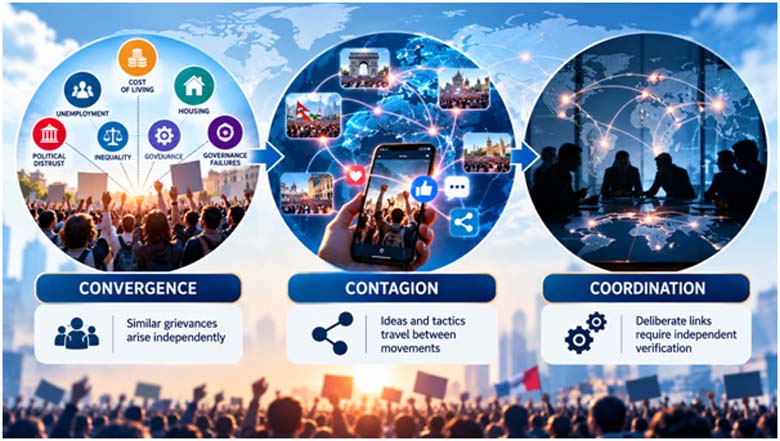
Contagion is not necessarily ideological. Protesters may borrow techniques while rejecting another movement’s political programme. They may learn how to organise a march, communicate during a communications blackout or sustain public attention without sharing objectives or external sponsors. Diffusion can therefore produce coordination at the level of tactics while leaving strategy entirely local.
In the networked age, protest no longer needs a central architect to acquire a common vocabulary, a familiar rhythm and extraordinary momentum.
South Asia: A Regional Laboratory of Dissent
South Asia offers an especially revealing comparison because three major movements unfolded within a relatively short period, producing consequences that extended far beyond the immediate demonstrations. Sri Lanka’s Aragalaya movement in 2022 emerged amid economic collapse, shortages and widespread anger at political leadership. Bangladesh’s 2024 uprising developed from student opposition to public-sector employment quotas and expanded into a broader confrontation with the government. Nepal’s youth-led protests in 2025 followed anger over restrictions on social media and wider concerns about governance, corruption and political accountability. Each movement possessed its own history, grievances and organisational dynamics.
These cases demonstrate the interaction between accumulated discontent and triggering events. Economic hardship weakened confidence in Sri Lanka’s government; a specific policy dispute became the catalyst in Bangladesh; and a digital restriction helped ignite mobilisation in Nepal. Young people, connected through digital platforms but operating within distinct national environments, helped turn individual frustrations into collective action. The outcomes also depended on factors beyond social media, including the conduct of political elites, the cohesion of security institutions and the government’s response to public anger.
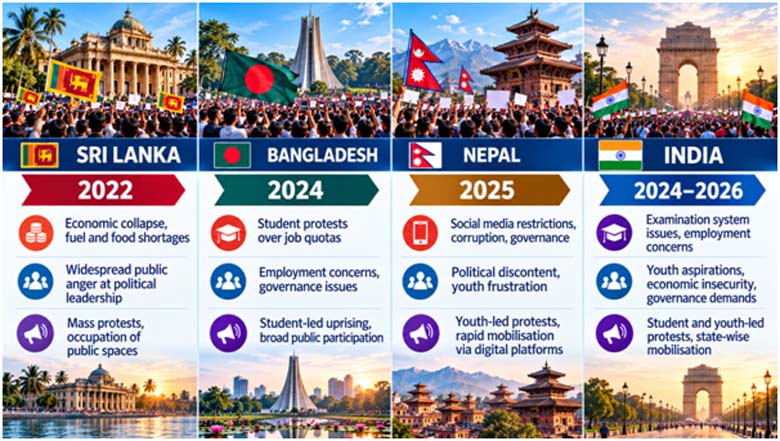
The sequence invites an important question: did later movements learn from earlier successes, failures and tactics? The chronology makes such diffusion plausible, and comparative scholarship has begun examining connections between these movements. But temporal succession alone cannot establish direct transmission, still less common direction. Evidence of shared symbols, acknowledged inspiration, communications between organisers or replicated tactics would strengthen the case for contagion. Evidence of shared planning would be needed to advance the argument towards coordination.
India provides a necessary contrast. Its vast political arena accommodates demonstrations ranging from local campaigns to nationwide movements, within a constitutional framework that provides channels for electoral competition, public assembly and judicial review. Its protest history cannot be reduced to the South Asian pattern of governments falling under pressure. Institutional resilience, political diversity and the scale of the federation shape outcomes differently.
South Asia reveals a regional pattern of digitally accelerated dissent, but regional resemblance is not proof of regional command.
Coordination: Following the Invisible Threads
Coordination is the most consequential—and most demanding—of the three lenses. It asks whether connections between movements extend beyond imitation and shared grievances into deliberate joint activity. Transnational activist networks, trade unions, advocacy organisations and civil-society groups sometimes exchange expertise, coordinate solidarity campaigns and provide logistical support. Such activity is neither inherently clandestine nor necessarily illegitimate. Foreign governments and other actors may also attempt to influence public debate, amplify divisions or exploit unrest for strategic advantage. The question is what can be demonstrated in each case.
A rigorous investigation would examine four categories of evidence.
- Organisational. Do identifiable individuals or groups maintain demonstrable links across countries?
- Financial. Are there traceable funding flows, grants or material transfers connected to specific protest activities?
- Communicative. Do authenticated messages reveal common planning, operational instructions or coordinated dissemination?
- Behavioural. Do movements exhibit independently verified patterns of synchronisation that are difficult to explain through public information and ordinary imitation alone?
No single indicator is conclusive. Shared hashtags may reflect common news coverage; similar posters may originate from publicly available templates; international grants may support civic work without directing demonstrations. Even coordinated messaging does not establish control over participants or outcomes. Investigators must establish provenance, chronology, intent and the relationship between the alleged sponsor and the action being examined.
Attribution also demands consideration of competing explanations. A claim that foreign actors organised a protest should be tested against evidence of domestic organisation, independently documented grievances and the possibility that the supposed coordination arose after a movement had already begun. Selective evidence can turn legitimate suspicion into political accusation.
The invisible hand becomes a defensible finding only when evidence identifies the hand, traces its actions and establishes what it actually controlled.
Information Battlefield
The distinction between influence and control becomes particularly important when dissent enters the information domain. Governments, political organisations, commercial influence networks and foreign actors may attempt to shape how events are perceived. Amplifying an authentic grievance can be more effective than inventing one, because the underlying anger already exists and audiences may recognise their own experiences in the message. A genuine incident can be selectively presented, emotionally amplified or detached from its original context until it acquires a meaning beyond the event itself.
This possibility warrants serious attention, but it must not become a universal explanation. Digital platforms host authentic reporting, activist communication, political propaganda, automated accounts and ordinary citizens expressing genuine convictions. Their coexistence complicates attribution. Researchers must distinguish organic engagement from coordinated inauthentic behaviour, and demonstrable manipulation from the ordinary circulation of controversial ideas.
For strategic analysts, three questions are essential. Who created the content? Through which networks did it spread? What evidence connects its dissemination to a deliberate political objective? Platform transparency reports, independent digital investigations, authenticated communications and documented financial relationships may help answer these questions. Yet even a proven influence operation does not establish that its sponsor initiated the underlying grievance or directed the people who subsequently protested.
India faces the same analytical challenge as other democracies: protecting the information environment without treating criticism of government as evidence of hostile interference. Excessive suspicion can weaken public trust, while complacency can leave institutions vulnerable to manipulation. The appropriate response combines transparency, credible public communication, independent verification and accountability for demonstrable wrongdoing.
Influence can shape the direction of public anger, but only evidence can establish who sought to shape it and with what effect.
Strategic Implications
For governments, the convergence-contagion-coordination framework offers a practical method of early warning. Convergence indicators include worsening economic insecurity, declining institutional trust and unresolved grievances. Contagion indicators include the rapid adoption of protest tactics, cross-border amplification and demonstrable exchanges between activist networks. Coordination indicators require stronger evidence: authenticated instructions, traceable operational support, common planning or independently established links between organisers and external sponsors.
These indicators should not be collapsed into a single threat assessment. A country experiencing high levels of public frustration may be vulnerable to unrest without facing foreign orchestration. A digitally connected movement may spread quickly without possessing a central leadership. An external actor may exploit an existing crisis without having created it. Each situation requires a different policy response.
For India, the implications extend beyond internal security. Its neighbourhood provides a continuing lesson in how economic distress, generational expectations, institutional credibility and digital mobilisation can interact. Regional diplomacy must recognise the domestic origins of neighbouring societies’ political crises while assessing any substantiated external involvement. Indian institutions, meanwhile, benefit from addressing grievances early, communicating transparently and maintaining public confidence in lawful avenues for redress.
A strategically mature state must avoid two opposite failures. The first is underestimating organised interference because the grievances being exploited are genuine. The second is attributing domestic dissent to foreign manipulation without adequate evidence. The former invites exploitation; the latter deepens alienation and can undermine the legitimacy that security policy is intended to protect.
The most effective defence is therefore not merely surveillance or suppression. It is institutional credibility, responsive governance, reliable information and proportionate law enforcement, supported by professional investigative capabilities.
A resilient state does not fear every crowd; it understands the grievance, investigates the evidence and responds without surrendering either security or legitimacy.
Verdict of Evidence
The protests examined here do not yet establish a single global command structure. They reveal something more complex: a world in which economic and political grievances can converge across societies, protest techniques can travel through digital networks, and organised actors may sometimes seek to influence or coordinate events. The relative importance of these mechanisms differs across countries and must be demonstrated through comparative research rather than inferred from visual similarity or timing.
Sri Lanka, Bangladesh and Nepal illustrate how domestic crises can interact with networked mobilisation to produce profound political consequences. India demonstrates why national institutions and political context matter when assessing the trajectory of dissent. European and Latin American cases widen the inquiry, but they must be examined through verified event chronologies and reliable country-level evidence. The objective is not to force every movement into one explanatory model; it is to identify where the models fit, where they fail and what remains unknown.
The next stage of investigation should therefore build a country-by-country evidence matrix covering triggers, organisers, timelines, digital links, financial relationships, verified external involvement and political outcomes. It should distinguish confirmed findings from plausible hypotheses and unresolved allegations. Such discipline will make the resulting paper more persuasive than any predetermined claim of orchestration.
Ultimately, convergence explains why anger can arise in many places; contagion explains how movements can learn from one another; coordination explains how deliberate connections may organise collective action. These mechanisms can coexist, but none should be mistaken for the others.
The strategic question is no longer simply who fills the streets, but how dissent travels, who seeks to influence its course, and what evidence separates a global pattern from a centrally directed operation.
ABOUT THE AUTHOR

Lt Gen Rajeev Chaudhry (Retd) is a social observer and writes on contemporary national and international issues, strategic implications of infrastructure development towards national power, geo-moral dimension of international relations and leadership nuances in changing social construct.