
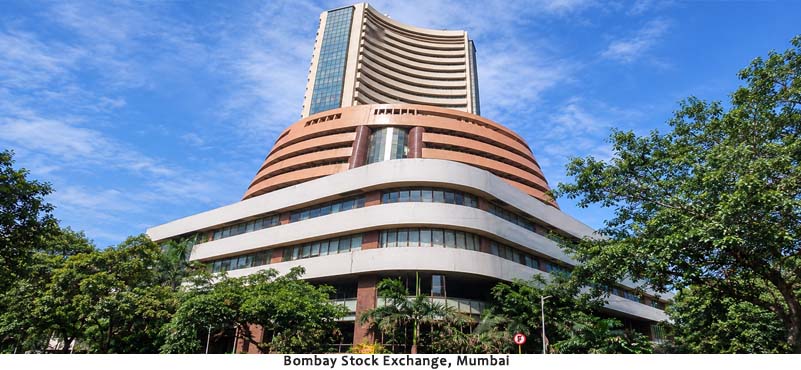
Global Perspective
Indian equities face a difficult external environment. Rising oil prices, uncertainty over US interest rates, foreign investor selling and geopolitical tensions are weighing on sentiment. Together, these pressures exacerbate domestic pressures.
Brent crude approached $106 a barrel on 14 October amid tensions around the Strait of Hormuz. For India, which depends heavily on imported oil, a prolonged price surge would widen the import bill, strain the current account and put pressure on the rupee. It could also push up inflation. Airlines, paint manufacturers and other oil-intensive businesses face an immediate squeeze on margins.
US inflation has added to the uncertainty. September’s headline rate of 3.7% and core rate of 2.6% exceeded expectations, potentially limiting the Federal Reserve’s scope to cut interest rates. Higher Treasury yields and a stronger dollar can pull capital away from emerging markets, raise financing costs and make equity valuations harder to sustain.
Foreign selling is already substantial. Figures reported on 11 October showed withdrawals of approximately ₹44,166 crore from Indian equities during the month. Domestic institutions have cushioned the market but cannot be expected to absorb foreign outflows indefinitely. Large-cap shares and the rupee remain exposed.
Corporate earnings now become critical. Weak global markets, trade uncertainty and shifting technology valuations have unsettled investors, although resilient US demand could help Indian IT exporters. The forthcoming quarterly results will show which companies can protect earnings against rising costs and weaker confidence. They will also test whether current share prices rest on credible earnings expectations or hopes that are becoming increasingly difficult to fulfil.
Caution need not mean abandoning equities. It means choosing financially sound businesses at sensible prices rather than betting on a broad recovery. Cheaper oil, steadier US bond yields and renewed foreign buying would help, but lasting gains require earnings that justify valuations.
The consequences extend beyond the trading screen. A conflict thousands of miles away can raise India’s fuel costs, weaken its currency and reduce household purchasing power. The fighting abroad is visible. Meanwhile, the challenge on the ground is far less dramatic, but no less critical: keeping prices down, protecting household budgets, and making sure ordinary families don’t get left behind.
Domestic Landscape
Share prices reflect corporate expectations and investor sentiment, but they are hardly a measure of national prosperity. The stock market captures the fortunes of listed companies; the wider economy depends on production, employment, wages and public services. A market correction, therefore, should not become an automatic pretext for tax concessions presented as an economic rescue measure.
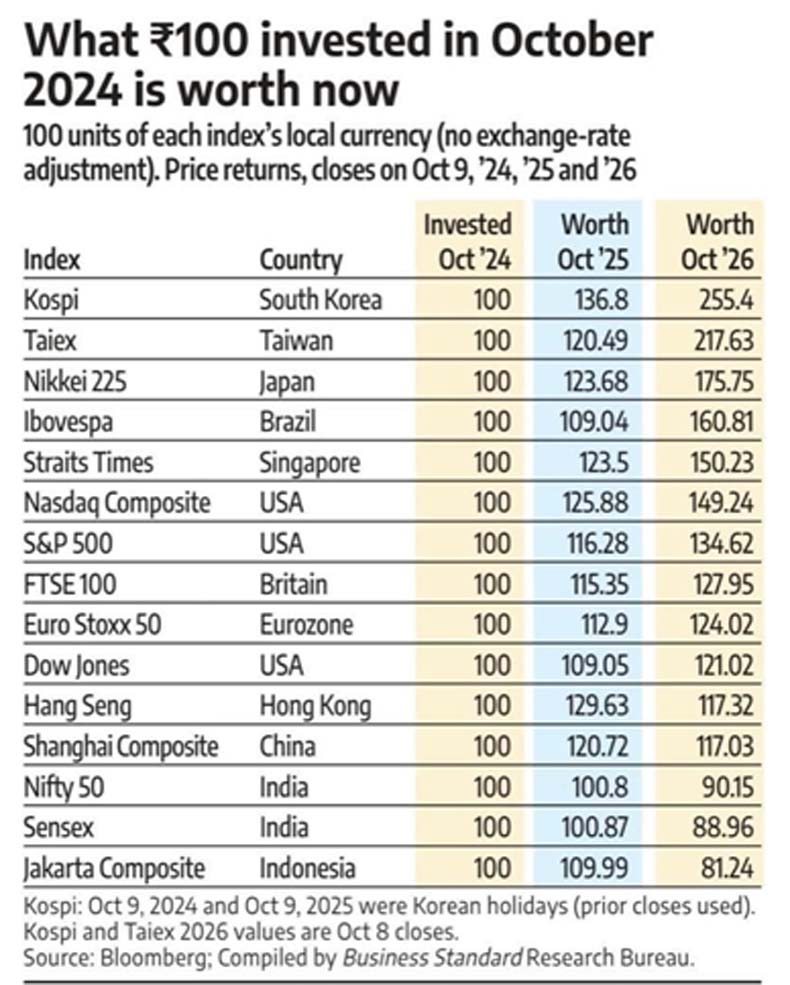
Recent data illustrate this disconnect. India’s real GDP grew by 7.8% in April–June 2026, compared with 6.9% a year earlier. Yet the Nifty’s September-end factsheet recorded a negative one-year total return of 7.09%. Although these figures cover different periods and measure different outcomes, the broader point is clear: economic growth does not necessarily translate into shareholder returns. The stock market is no miniature version of the Indian economy.
The renewed debate over long-term capital gains (LTCG) tax must, therefore, be judged on two counts. Is the existing framework efficient and internationally competitive? More importantly, would tax concessions stimulate fresh investment, enhance productivity and spread the benefits of growth more widely—or merely increase investors’ post-tax returns? These questions deserve rigorous scrutiny, particularly when external turmoil is aggravated by domestic economic pressures. There may be a war outside, but the battle within—for jobs, purchasing power and inclusive prosperity—is equally consequential.
The 2008 crisis exposed “moral hazard”: expectations of rescue weakened creditor discipline and encouraged excessive risk-taking. Yet disorderly failure can disrupt payments, credit and employment. Policy must therefore preserve essential financial functions without insulating shareholders and managers from consequences.
I examined these tensions in my two-volume book, Global Financial Meltdown, published by Atlantic Publishers in 2011. They remain unresolved: the Financial Stability Board’s 2026 agenda identified funding during resolution and cross-border bail-in execution as continuing challenges. IMF research likewise warns that support for nonbanks can weaken market discipline and encourage regulatory arbitrage. Rather than focusing on whether an equity market decline is justified, the central question is how losses are distributed when downside risks materialise.
Regulators should enforce disclosure, punish misconduct and contain contagion—not underwrite rising indices. Investors must bear investment risk; intermediaries must answer for mis-selling; and emergency assistance must preserve accountability. Credible markets require enforceable rules and fair responsibility, not permanent optimism or official price guarantees.
A Benchmark, Not A Miniature Economy
The Nifty 50 comprises 50 companies weighted by free-float market capitalisation, not their contributions to employment, household income or national output. Financial services accounted for 37.45% of its weight on September 30, 2026. HDFC Bank and ICICI Bank alone represented 19.43%. Consequently, developments affecting a handful of financial institutions can materially influence what people casually call “the market”. This concentration is not necessarily a defect in an investable benchmark. Large, liquid companies deserve prominence in an index designed for trading and portfolio comparison. The mistake lies in expecting that benchmark to represent economic activities it was never designed to measure.
The latest Annual Survey of Unincorporated Sector Enterprises (ASUSE) makes the mismatch clearer. ASUSE 2025 estimated 7.92 crore establishments employing 12.81 crore workers, updating the earlier figures of 7.34 crore establishments and 12.06 crore workers for 2023–24. Its coverage includes unincorporated non-agricultural manufacturing, trade and services, but excludes construction. The comparison also involves different reference periods: January–December 2025 and October 2023–September 2024. These enterprises are not directly represented by listed share prices. Neither are agricultural livelihoods adequately captured. Their circumstances must be investigated through employment, earnings, credit and enterprise surveys—not inferred from a bank-led rally.
No Direct Correlation between Growth and a Market Rally
Share prices are shaped by expectations of future earnings, discounted to their present value. They respond not only to economic output but also to interest rates, financing costs, risk perceptions and the valuations at which investors enter the market. Strong GDP growth can still disappoint shareholders if share prices already reflect even better prospects. Conversely, equities can rise amid slower growth if borrowing costs fall or companies deliver earnings above subdued expectations. The fundamental question is not simply the divergence between strong economic growth and weak equity markets, but how real-world outcomes measure up against expectations already priced into the market.
GDP captures value added across the economy; shareholders, by contrast, earn returns from the profits of the companies they own. There is no guarantee that the two will move in tandem. Rising wages and lower prices may improve household purchasing power even as corporate margins come under pressure. Similarly, large listed companies can boost profits by gaining market share at the expense of smaller enterprises, without necessarily creating commensurate gains in employment or household welfare. Neither rising corporate profits nor falling share prices, taken in isolation, reveals how widely the benefits of economic growth are distributed. A meaningful assessment of prosperity must look beyond market performance to production, employment and the growth of household incomes.
Capital Flows -Not A Verdict on India
The broader picture is further complicated by foreign portfolio shifts. Highlighting approximately $13 billion in FY27 equity outflows, the SBI Research Report proposed abolishing long-term capital gains tax while stretching the requisite holding period to two or three years. Although persistent foreign selling poses a credible threat to market stability, assigning blame to the prevailing tax regime overlooks the multifaceted drivers of capital flight. Foreign institutional investors weigh post-tax yields alongside growth prospects, relative valuations, foreign exchange dynamics, and broader asset-allocation mandates. Tax relief modifies only one dimension of this framework; it cannot mechanically lock in capital. Ultimately, a longer qualification period acts merely as a conditional incentive rather than a structural anchor.
This “poly-crisis” (a situation where interconnected risks amplify one another within the broader trajectory of transition) reminds us of Muin Ahsan Jazbi’s famous Urdu couplet
“जब कश्ती साबित–ओ–सालिम थी साहिल की तमन्ना किस को थी
अब ऐसी शिकस्ता कश्ती पर साहिल की तमन्ना कौन करे”
This means when the boat was intact (i.e., when the going was good), there was no wish to reach the shore; now when the boat is dilapidated (i.e., when things are in a mess), it’s futile to expect to reach the shore.
A Budget Suggestion- Not a Commitment
On October 13, 2026, the Finance Minister Nirmala Sitharaman acknowledged the LTCG and securities transaction tax debate, expressed willingness to hear suggestions and declined to commit to changes ahead of the Budget. Her remarks opened a consultation space; they did not announce abolition or establish that relief would become a Budget proposal. This distinction assumes significance because policy speculation can rapidly acquire the appearance of official intent. Rather than asking if Budget concessions will satisfy financial markets, we should evaluate whether their economic value justifies their fiscal impact and distributional trade-offs.
The government should assess additional investment attributable to relief, rather than treating a possible rise in share prices as sufficient justification. Secondary-market trading provides liquidity and supports price discovery. Nevertheless, purchasing an existing share is not equivalent to financing a new factory. Any claimed connection between tax relief and productive investment must identify the intermediate steps.
Revenue Foregone: Substantial, But Uncertain
The strongest available historical benchmark is ₹1,29,158 crore of equity LTCG-tax revenue in assessment year 2025–26, compared with ₹72,249 crore in assessment year 2024–25, according to Finance Ministry figures reported from Parliament. These are assessment-year figures; describing them simply as FY25 and FY24 receipts obscures an important distinction.
The larger amount equals approximately 2.9% of FY2026–27 budgeted gross tax revenue of ₹44.04 lakh crore. This establishes scale, not a reliable current-year estimate of abolition’s cost. Realised gains vary with market conditions, investor behaviour and the applicable tax framework. The reported equity category also should not automatically be treated as listed-shares-only revenue.
The Centre’s retained revenue loss would differ from the combined public-sector loss because of tax devolution. States’ lost receipts, however, do not cease to be a fiscal cost merely because they fall outside the Union government’s net accounts. Calling abolition “manageable” without specifying the financing adjustment is therefore premature.
Why Calibrated Relief Is More Defensible?
Budget 2026–27 targets a fiscal deficit of 4.3% of GDP and central government debt of 55.6% of GDP. These are Union government measures, not consolidated Centre-and-states figures. Within that framework, a substantial permanent concession must compete with infrastructure, health, education and other expenditure priorities.
Existing rules impose a 12.5% tax on qualifying gains under Section 112A exceeding the annual ₹1.25 lakh threshold. Raising that threshold would concentrate relief on smaller amounts of realised gains; cutting the rate would deliver larger absolute benefits to taxpayers realising larger taxable gains. Neither design automatically targets low-income households. Someone with substantial wealth can also realise modest gains in a particular year. Distributional assessment therefore requires taxpayer-level evidence, not labels such as “retail-friendly”. Capped relief for longer holdings could be examined, but longer lock-in incentives also discourage portfolio rebalancing. The design must reward patient investment without trapping investors in unsuitable assets.
Review STT And LTCG Together—But Distinguish Them
The interplay between Securities Transaction Tax (STT) and Long-Term Capital Gains (LTCG) tax adds layer to transaction costs, yet it avoids strict double taxation: STT is a levy on transaction value—incurred even on loss-making trades—whereas LTCG tax is levied solely on realized income.
Against budgeted STT collections of ₹73,700 crore, a baseline 10% reduction implies an immediate revenue foregone of ₹7,370 crore. While secondary volume expansion could mitigate this shortfall, anticipating total dynamic recovery is a policy miscalculation.
Crucially, any reform framework must decouple delivery-based asset ownership from high-frequency derivatives trading. As proposed in Budget 2026–27 through elevated STT rates on futures and options, incentives aimed at fostering patient capital should not inadvertently subsidise speculative activity. The hazards of retail derivative exposure are well-documented: SEBI’s August 2026 findings indicated that 87.7% of retail derivative traders suffered net losses totaling ₹91,685 crore in FY2025–26. These data points do not impair the case for long-term equity participation, but they decisively refute frequent trading as a viable vehicle for wealth generation.
Canons of Taxation: Measuring Economic Success Beyond Revenue
A credible reform package would publish revenue estimates, identify beneficiaries, distinguish investment from turnover and evaluate whether concessions generate additional productive capital. Higher exemptions or capped longer-holding concessions merit comparison with simpler reporting, clearer rules and lower compliance burdens. Both predictability and generosity are important.
Repeatedly redesigning taxation in response to market weakness risks making fiscal policy a support mechanism for asset prices. India should have competitive capital markets. But the policy objective must remain a more productive economy with stronger employment, rising real incomes and resilient enterprises. India needs strong equity markets, but a rising index is not an economic objective. Any tax concession must demonstrate that it delivers something more than higher post-tax returns for investors.
ABOUT THE AUTHOR
 Dr. Manoranjan Sharma has been the Chief Economist for 25 years with Canara Bank and Infomerics Ratings.
Globally recognised as an expert in global economy, Indian economy, banking, finance, MSMEs, sustainable development and financial inclusion, he has chaired sessions at national and international conferences and is recognised as one of the 30 global experts by the UN Virtual University (UNVU) for SDGs.
He has been on over a dozen Advisory Councils in seven states, viz. Member, Rajasthan Governor’s Advisory Council; Governor’s Senate Nominee on Rajasthan University; Governor’s Senate Nominee on SNDT University, Mumbai; and Expert on selection panels for IIMs, Vijay Patil School of Management, SAIL, IDBI Bank, Canara Bank, Bank of India, Union Bank of India.
He has been published widely and quoted extensively in major Indian and international media and publications.