
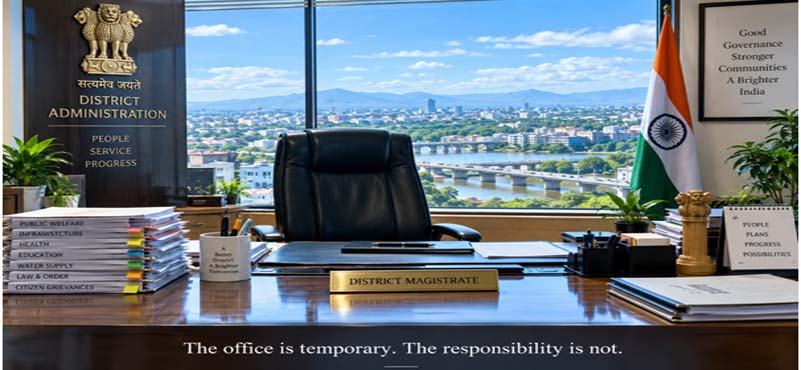
Rethinking the compact between politics, administration and the citizen
When an honest and effective civil servant leaves government, the first question should not be, “Why did she resign?” It should be, “What does her departure make us think about the system she leaves behind?”
The recent resignation of IAS officer Divya Mittal offers precisely that moment for reflection. A 2013-batch Uttar Pradesh officer, she served as District Magistrate in Mirzapur, Deoria and Sant Kabir Nagar and became particularly well known for her hands-on approach to administration. Her work in Mirzapur brought piped water to Lahuria Dah, a remote hill village whose residents had depended on springs and tankers for decades. When she left Mirzapur in 2023, the public farewell she received was striking.
Yet Mittal herself has been clear that her recent decision to resign was considered and driven by personal priorities, family and interests. Her resignation should therefore not be simplistically presented as a protest against the system.
But perhaps the larger question is even more important.
Can our administrative system retain, encourage and empower officers who genuinely want to make a difference?
India’s democracy rests on an important compact. The political executive derives its authority from the people and provides direction. The permanent civil service provides institutional continuity, professional expertise and impartial execution. Neither can substitute for the other. A politician understands the aspirations and compulsions of the electorate; an administrator understands the machinery through which those aspirations can become outcomes.
The relationship works best when there is mutual respect. The problem begins when accountability becomes selective.
A politician may rightly take credit for a successful government programme because elected leadership sets priorities and provides resources. But the same principle should apply when something goes wrong. If a city floods every monsoon, roads collapse, projects overrun their deadlines or public services fail, the answer cannot always be that “the babus” were responsible.
The photograph of an inauguration and the photograph of a flooded city are part of the same governance story.
This is where the distinction between political authority and administrative autonomy becomes important.
An officer must remain accountable to the elected government. But accountability cannot mean perpetual vulnerability. An administrator who knows that an unpopular but lawful decision can result in an arbitrary transfer, stalled career or loss of meaningful responsibility may eventually learn a dangerous lesson: it is safer to manage expectations than to solve problems.
That is when bureaucracy becomes cautious rather than courageous. And cautious bureaucracy is rarely transformative bureaucracy.
There is another side to this story. Bureaucrats too must look into the mirror. Not every transfer is political victimisation. Not every officer who disagrees with a politician is necessarily right. Bureaucratic arrogance, procedural delays, excessive file-pushing, risk aversion and an obsession with hierarchy can be as damaging to governance as political interference.
The answer, therefore, is not to make bureaucrats more powerful than elected representatives. The answer is to make the system stronger than personalities.
A good administrator should have enough space to implement lawful decisions professionally. A good politician should have enough confidence to allow an honest officer to disagree without treating disagreement as disloyalty. And both should remember that neither office belongs to them permanently.
The ultimate stakeholder is the citizen.
This becomes particularly important because India is entering an era in which young civil servants have unprecedented alternatives. The most capable officer who once saw the IAS as the ultimate platform for public service can today choose academia, public policy, international institutions, entrepreneurship, social enterprise or other forms of public engagement.
The State cannot retain talent merely through status and job security. It must offer purpose, professional dignity and the freedom to deliver.
Divya Mittal’s story, therefore, need not become an indictment of politicians or bureaucracy. It can become an opportunity to rethink governance. There are several practical reforms that could strengthen this compact:
- Assured minimum tenure for key field assignments, except for clearly recorded administrative reasons.
- Transparent transfer and posting policies, reducing the scope for arbitrary intervention.
- Objective performance assessment, based substantially on measurable public outcomes rather than perceptions and personal equations.
- Protection for bona fide decisions, provided they are lawful, documented and taken in public interest.
- Independent grievance mechanisms for officers facing improper pressure.
- Greater delegation of authority, accompanied by clear accountability for results.
- 360-degree accountability, where political leadership, bureaucracy and implementing agencies are all answerable for outcomes.
- Recognition of innovation and courage, rather than rewarding only procedural compliance.
- Stronger citizen feedback systems, because the ultimate test of administration is not the number of files cleared but the difference made to people’s lives.
- A culture of respectful disagreement, where an officer can tell a political superior that a proposal may not work without that professional advice becoming a personal confrontation.
None of this diminishes democratic supremacy. On the contrary, it strengthens it.
A confident political leadership does not need compliant officers. It needs competent ones. And a confident bureaucracy does not need political power. It needs the professional space to discharge its constitutional responsibilities.
Perhaps that is the real lesson from the affection Divya Mittal received in Mirzapur. People did not celebrate her because she was an IAS officer. They remembered her because something changed in their lives. A tap began to flow where generations had waited for water.
That is what good governance ultimately means.
The greatest danger is not that an individual good officer leaves the system. The greater danger would be if the system gradually teaches the next generation of good officers that keeping one’s head down is safer than raising one’s hand to solve a problem.
India does not need a weaker bureaucracy or a stronger bureaucracy.
It needs a braver, more accountable and more professionally protected bureaucracy—working in partnership with an equally accountable political leadership.
Because in a democracy, the real contest should never be between the politician and the bureaucrat. It should be between good governance and bad governance. And the citizen must always win.
ABOUT THE AUTHOR
Lt Gen Rajeev Chaudhry (Retd) is a social observer and writes on contemporary national and international issues, strategic implications of infrastructure development towards national power, geo-moral dimension of international relations and leadership nuances in changing social construct.