Map is Changing Again
For most of the post-Cold War era, we persuaded ourselves that geography was losing its power. Globalisation dissolved borders into supply chains, finance ignored frontiers, technology compressed distance and cyberspace appeared to create a world where physical territory mattered less than connectivity. Then came Donald Trump, and suddenly the map is back.
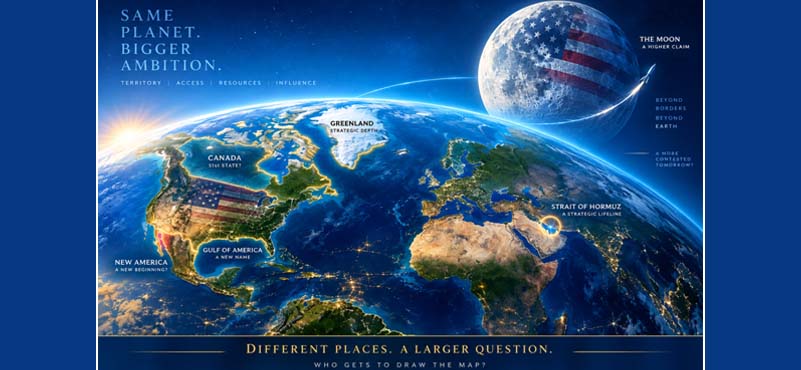
Greenland should be American. Canada could become the 51st state. The Gulf of Mexico became the “Gulf of America” in official U.S. federal usage. New Mexico, in a recent social-media campaign, was recast as “New America”. The Strait of Hormuz was described by Trump as American territory, while the White House subsequently declared that the United States controls the strategic waterway. And now comes the most audacious claim of all: “The Moon is ours.”
Taken individually, these statements can be dismissed as provocation, political theatre or the idiosyncratic vocabulary of an unconventional president. Taken together, however, they reveal something more consequential. They place territory, strategic chokepoints, geographical nomenclature and even the global commons back at the centre of great-power politics.
The question, therefore, is not whether Donald Trump is serious about owning the Moon. He cannot. Nor is it whether Canada is about to become an American state. It will not. The deeper question is more uncomfortable: are we witnessing the return of a world in which geography once again becomes an explicit instrument of power?
Perhaps geography never ceased to matter. Perhaps it was only temporarily obscured by globalisation.
Rhetoric is Not Policy
The first discipline required in analysing Trump is to separate rhetoric from policy, aspiration from capability, and symbolism from law.
A presidential post is not a treaty. A provocative declaration is not sovereignty. A map on social media does not redraw an international boundary. And a president of the United States cannot unilaterally rename an American state. Trump’s “New America” proposal for New Mexico has precisely that limitation: it is political theatre, not an executable presidential power.
The same distinction applies to the Moon. Article II of the 1967 Outer Space Treaty is unequivocal: outer space, including the Moon, is not subject to national appropriation through claims of sovereignty, occupation or any other means. Article I further establishes that space is to be explored and used by all states on a basis of equality.
So calling Trump’s lunar declaration a legal claim to sovereignty would be inaccurate. But dismissing it as meaningless would also be a mistake.
Rhetoric matters in international politics because rhetoric can change what becomes thinkable.
Repeated assertions can shift the boundaries of political debate. They can turn yesterday’s taboo into today’s negotiating position and tomorrow’s policy option. Trump’s territorial rhetoric may therefore be less important for what it accomplishes immediately than for what it normalises.
The serious analytical question is not, “Will Trump annex the world?”
It is: What happens when the world’s most powerful state increasingly speaks the language of possession, control and strategic entitlement?
That takes us beyond Trump the personality and into the geography of power.
New Geography of Strategic Power
- Greenland — Geography of Strategic Depth. Greenland is perhaps the clearest example of where Trump’s rhetoric intersects with genuine strategy. Its location between North America and Europe gives it enormous importance for the Arctic and North Atlantic. It matters for missile warning, military surveillance, emerging Arctic routes, critical minerals and the evolving strategic competition involving the United States, Russia and China. Therefore, there is nothing irrational about Washington wanting greater strategic access to Greenland.
The problem begins when strategic access is translated into territorial entitlement. That distinction is fundamental. Great powers have always sought bases, ports, surveillance facilities and logistical access. The modern international system permits such arrangements when sovereign states consent. What it was designed to prevent was the conversion of military superiority into an automatic right to acquire territory.
Greenland therefore presents the first principle of the new geography: Strategic interest does not automatically create a right of possession. The Arctic is becoming strategically valuable precisely because geography is becoming valuable again.
- Canada — When Allies Become Geography. Canada presents an even more unsettling case because it is not an adversary. It is America’s neighbour, economic partner, NATO ally and one of Washington’s closest strategic relationships. Yet Trump has repeatedly described Canada as the potential “51st state”. The significance is not that Canada is likely to surrender its sovereignty. It is not.
The significance lies in the erosion of a post-1945 assumption: that sovereign borders, particularly among democratic allies, are not bargaining chips. The language of annexation, even when deployed provocatively, challenges that taboo. And once sovereignty becomes negotiable in political rhetoric, the question inevitably follows: if the strongest power has the capacity to absorb, coerce or redefine geography, what restrains it? International order ultimately depends not only on treaties and armies, but also on norms about what legitimate states do not do.
- Gulf and New Mexico — Power to Rename. At first sight, geographical renaming appears almost trivial beside warships and territorial claims. It is not. In January 2025, Trump ordered the federal renaming of the Gulf of Mexico as the “Gulf of America”, and the U.S. Department of the Interior implemented the change for federal usage. More recently came the proposal to transform New Mexico into “New America”.
A name does not alter physical geography. But names carry memory, identity and psychological ownership. Maps are not merely technical documents; they are instruments through which nations imagine themselves. Yet there is an important distinction: Naming is not owning.
The United States can change the terminology used by its own government. It cannot compel Mexico, international organisations or every other country to accept its nomenclature. Still, the symbolism is significant. Before geography is contested physically, it can sometimes be contested linguistically. The map begins in the mind before it is redrawn on the ground.
- Hormuz — From Territory to Chokepoint. The Strait of Hormuz takes the argument from symbolism to hard power. In August, Trump said he viewed Hormuz as “American territory”; the White House later went further, declaring that the United States controls the Strait and highlighting American military protection of commercial shipping.
Legally, control of a waterway through military power is not equivalent to sovereignty over it. Strategically, however, the distinction can become blurred. Hormuz is one of the world’s great economic chokepoints. Whoever can control access to it can influence the movement of energy and therefore the economic security of countries thousands of kilometres away. That produces one of the most important lessons of contemporary geopolitics: Control can sometimes matter more than ownership.
A state does not necessarily need to possess a piece of geography to exercise enormous power over it. It can dominate the infrastructure, command the surrounding military space, control access or make passage dependent upon its consent. This is a far more sophisticated form of power than traditional territorial annexation. And it may be the form of power that defines this century.
- Moon — Geography Beyond Sovereignty. Then comes the Moon. Trump’s declaration that “The Moon is ours”, accompanied by imagery featuring the American flag, might invite ridicule. But the strategic reality behind the theatre deserves much greater attention. The Moon cannot legally become American territory. The Outer Space Treaty prohibits national appropriation and establishes the principle of free access and exploration.
But sovereignty is not the only form of power. The future lunar contest may involve landing sites, water ice, energy, communications, scientific installations, logistics, resource extraction and permanent human presence. Nobody may legally own the Moon. Yet somebody could become dominant in accessing, servicing and operating on the Moon.
That distinction could prove decisive. And therefore the emergence of the U.S. Space Force is strategically more significant than the uniforms themselves. The uniform is symbolism; the institution represents something much larger—the recognition that space is becoming a domain of national competition. The question for the future may not be: Who owns the Moon? It may be: Who controls the infrastructure that makes the Moon accessible?
From Pax Americana to a World of Strategic Primacy
- Return of Great-Power Geography. This is where the individual pieces form a larger picture. The post-Cold War world was built on the assumption that interdependence would moderate geopolitical rivalry. Trade would restrain conflict. Global institutions would regulate competition. Technology would make geography progressively less important.
That assumption is weakening. Ukraine has demonstrated the enduring importance of land. The South China Sea has demonstrated the importance of maritime geography. The Arctic has become a new arena of competition. Critical minerals have transformed remote deposits into strategic assets. Semiconductors have made industrial geography a matter of national security. Chokepoints such as Hormuz, Suez and Malacca have acquired renewed importance.
The world is therefore moving from globalisation without geography towards globalisation constrained by geography. Trump may be an unusually loud expression of this transformation, but he is not its sole cause. The deeper transition is from a world in which great powers primarily sought influence to one in which they increasingly seek access, leverage and control. That is the real strategic story.
- What Does an Equal Global Order Mean? For countries such as India, the answer cannot be reflexive anti-Americanism. America remains indispensable to the international balance. Its technological power, naval reach, economic weight and alliance network provide stability in many regions. Nor should every assertion of American interest be interpreted as imperialism.
But an equal global order requires one fundamental principle: Power may determine capability; it must not automatically determine legitimacy. Equality between nations never meant equality of military strength. It meant equality before the basic rules governing sovereignty, navigation, territory and the global commons. For India and the Global South, the strategic objective should therefore be neither confrontation with America nor accommodation of every American demand.
It should be strategic autonomy within a rules-based order. The seas must remain open. Sovereignty must remain meaningful. International waterways cannot become private possessions of powerful states. Outer space must remain accessible. Resources beyond Earth must be governed by rules that prevent their transformation into exclusive monopolies.
The principle is simple: The powerful must have more responsibility, not more rights. If capability itself becomes the source of legitimacy, international law will gradually become little more than the legal vocabulary of the powerful. And that would be the beginning of a very different world.
Who Gets to Draw the Map?
For centuries, great powers drew maps. They drew them after wars. They drew them after conquest. They drew them in imperial capitals, often without asking the people whose lands were being divided.
The post-1945 international order attempted something revolutionary: it sought to make sovereignty a right rather than a privilege of the powerful. Trump’s rhetoric challenges that principle—not necessarily because America is about to annex Canada, seize Greenland or claim the Moon, but because it makes the language of possession and control politically thinkable again.
That is why dismissing the phenomenon as lunacy would be intellectually lazy. The statements may be theatrical. The strategic questions are not. Greenland asks who controls strategic depth. Canada asks whether sovereignty remains sacred among allies. The Gulf asks whether names can become instruments of identity. Hormuz asks whether military control can substitute for legal ownership. The Moon asks whether humanity will reproduce terrestrial geopolitics beyond Earth.
The real issue, therefore, is not whether Trump owns Greenland, Canada, Hormuz or the Moon. It is whether the 21st century will be governed by those who respect the map—or by those powerful enough to redraw it.
And perhaps that is the final irony of our age: humanity spent centuries fighting over the geography of Earth, created an international order to restrain that struggle, and now—just as it prepares to reach the Moon—risks carrying the old politics of possession into the new geography of space.
ABOUT THE AUTHOR

Lt Gen Rajeev Chaudhry (Retd) is a social observer and writes on contemporary national and international issues, strategic implications of infrastructure development towards national power, geo-moral dimension of international relations and leadership nuances in changing social construct.