Introduction
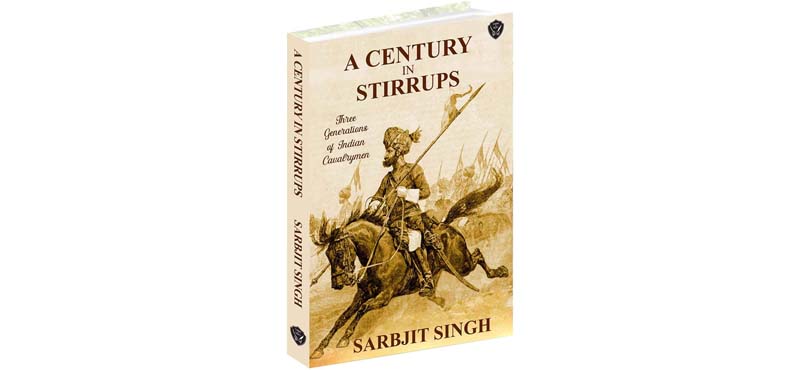
A Century in Stirrups: Three Generations of Indian Cavalrymen is a historical non-fiction book written by Sarbjit Singh and published by Sabre and Quill which explores the military heritage, legacy, and accounts of three generations of the same family who served with distinction from 1877 to 1968.
Their story that begins in Kahuta now Pakistan’s nuclear centre extends across various parts of India and also Egypt, China, France, Belgium, Afghanistan, Japan and Congo.
The book brings to the fore not only the traditions of the Army the motivation for young men to be willing to serve in this organistaion but also what they endured and the atmosphere that existed which includes the relationship with British officers. What stands out is how they always put the honour of their Regiment above all else.
About The Book
The book unfolds in two parts, the first covers their lives and times and the second delves into the history of the honours they won and aspects of Army life. The journey takes the reader from Rawalpindi District to the blood-soaked trenches of Belgium and France, the scorching desert of Egypt, dense jungles of North East India, inhospitable terrain of Waziristan, war torn Japan and includes the Boxer rebellion in China and the uprising in Congo. The enduring sprit is that of nationalism which threads through each one’s experiences. Indeed, a fascinating tale of heroism, sacrifice and dedication to the nation.
Chanda Singh
It started with Chanda Singh, who at the age of eighteen after having been married at thirteen joined the 16th Regiment of the Bengal Cavalry in Allahabad in 1877. A skilled horseman he joined as a Sillidar, which meant bringing his own horse, saddlery and accoutrements except weaponry. This system was discontinued in World War I as the sillidars could not match the quality of horses provided by the Army. Little did Chanda Singh realise that from a small village he would traverse half the globe and that his son and grandson would follow in his footsteps.
The author writes that the opportunities for employment of Sikh youth had diminished after the Anglo Sikh War and subsequent defeat of the Sikh Empire. But the ‘aftermath of the 1857, bought a tectonic shift in British policy ending the monopoly of the higher castes’. This opened up avenues for recruitment of martial races such as Sikhs amongst others.
Training ensured the transformation of a peace-loving men into fearless professional soldiers. The values of discipline, honour and loyalty were instilled. They also understood that the true respect of subordinates was earned through honesty, fairness and transparency and that courage was a quality required both on and off the battlefield. The Regiment’s izzat or honour was paramount and upholding this was their ‘dharma’ or duty.
Following the disbandment of his Regiment he was sent to 6 Bengal Cavalry as they embarked for Egypt in 1882 as part of an Indian Division which had amongst it 2 Bengal Cavalry (Gardner’s Horse), 6 King Own Cavalry and 13 Bengal Lancers (Watson’s Horse). Their voyage with horses suffering below the deck due to the stifling heat and humidity is described in great detail. After participating in the famous battle of Tel el Kabir, he returned to India rejoining his original Regiment in September 1885 which was re-raised in Ambala. Jaswant, his first son was born in 1888.
May 1900 saw him deployed to quell the Boxer rebellion in China as part of his Regiment. The Indian troops once again excelled themselves but did not find their due in the historical records.
As per military historian Ashok Nath; 16 Bengal Lancers (now 6 Lancers in Pakistan) was’ dismounted to support the infantry and was the first to reach the American Legation.’ But the role of the Indian soldier ‘remains overlooked, a bitter truth of colonial subjugation.’
Chanda went on to retire as Risaldar Major in 1907, the highest rank an Indian could attain. While in 1906, Chanda’s son Jaswant Singh was enlisted into the Regiment. Chanda returned to his village and fondly recounted tales of his battles as well as grandeur when he was part of Queen Victoria’s Diamond Jubilee procession in London in June 1897.
Jaswant
Jaswant ‘s path to the Army seemed inevitable, little had changed in Kahuta and only one in six out of every hundred men in Punjab could read and write.
Joining the Regiment in June 1906 at Dera Ismail Khan , young soldiers trained in distant combat with rifles and close combat with swords and lances. The prevailing policy being that Indian soldiers were provided with older weaponry till World War I necessitated the use of modern rifles.
The outbreak of the First World War in 1914 saw Jaswant Singh being seconded to 6 King Edwards’s Own Cavalry, the same Regiment his father fought with in Egypt but now the battleground was France. The character of war had changed and the battlefields were filled with untold horror. This is where he was awarded the Belgian Croix de Guerre, a prestigious medal awarded to very few Indians. The Indian soldiers fought in the trenches of France shivering with foul water standing up to their knees.
At the wars outset the Indian Army was focused on the volatile North West Frontier Province (NWFP) and was earmarked to replace British troops in Egypt to enable them to move the Western Front. However, the decision was reversed and the Indians moved to France. One million one hundred thousand Indians served there, over 60, 000 died, yet their contribution finds little mention in Eurocentric histories of the war.
Indian Cavalry units had little idea as to what awaited them and most were employed in a dismounted role as broken ground had made Cavalry charges irrelevant. This was also the time tanks were inducted into the battlefields of France. The stench of decaying bodies, burnt shells and large rats feeding on corpses spreading disease was far different to the battles in the NWFP. They had crossed the seas unaware of the impending horrors and soon realised the horse and lance were outdated.
On returning to India, he was posted back to his original Regiment and was deployed in Afghanistan in 1920 when his father passed away. He was awarded a jagir of 100 acres in Gujrat District (now in Pakistan) where he dreamed of setting up a Polo Pony Breeding farm after retirement but he suddenly passed away at forty while in Bannu where he was the Woordie Major of 6 Lancers the successor of 16 Bengal Cavalry.
His wife Thakuri was subsequently displaced by the horrors of partition in August 1947 moved to Dehra Dun. She passed away in 1964 in Ahmed Nagar.
Harmander
The story of Brigadier Harmander Singh is equally fascinating. Born in August 1920, he was educated King George Royal Indian Military College in Jullundur which he joined in 1928 just before his father passed away. Thereafter in 1936 he secured a place in Kitchener College which provided an ideal foundation for the Indian Military Academy which he joined in December 1939. The Academy selected only forty cadets every six months including ten from the State Forces.
In June 1941 he was commissioned into 45 Cavalry as the sole Indian officer. The author states that the British officers were unaccustomed to treating Indians as equals and many held deep set prejudices. He also writes about ‘the formalities at Dinner Nights which exceeded those on the parade ground.’
May 1944 saw him fighting the Japanese at Kohima, which was the site of one of World War II’s fiercest battles involving ‘sustained artillery fire, point blank tank firing, incessant infantry attacks including brutal hand to hand conflicts coupled with aerial attacks. Despite being outnumbered with scarce supplies the defenders held on for two weeks and under Slim the tide of the Burma campaign was turned. A brutal battle was fought at the Tennis Courts where the Stuart tanks from 45 Cavalry supported the infantry.
On his return from Kohima he was posted to 7 Cavalry with whom he went to Japan and then in Jammu & Kashmir in 1947. Initially supporting 50 Parachute Brigade commanded by Brigadier Usman in Naushera and thereafter in Handwara- Kupwara Sector and was finally involved in the reopening of the route to Dras and Kargil.
In December 1949 he took over command of 8 Cavalry. Subsequently he was selected to raise 63 Cavalry in Alwar in January 1957 and is credited with laying the foundations for Regiment which has excelled itself over the years. To quote Lieutenant Colonel KG Jalnawala who served in the Regiment;’ he showed us the way by setting a personal example with his soldierly qualities, of professional competence, fair play, firmness and warmhearted friendliness’.
Amongst his other important assignments post command were Indian Contingent Commander of the UN Peace Keeping Operations in Congo in 1961, Commandant of Armoured Corps Centre of School at Ahmed Nagar and finally commanded 43 Armoured Brigade.
He retired in 1968 and settled in Ambala where he became one of India’s pioneering mushroom cultivators and passed away in 2013 aged 93.
Conclusion
The book has been researched in great depth and matched by wonderful illustrations provides a window into an era that must be remembered.
Sarbjit has exposed the reader to a rare into a part of military history that is mainly contained in Regimental accounts as well as the relationship between the Indian soldier and the British officer.
As General SS Mehta writes; “the Indian soldier has never been forged by conquest or coin, He is a product of a civilisational legacy, older than empire, deeper than doctrine and immune to mercenary logic. “The soldier brought to the battlefield the inheritance of unlimited liability in the form of Naam (honour). Namak (duty and loyalty) and Nishan (the flag). To serve the flag he reveres, the service that shaped him and the unit which is his home and his fellow soldiers for whom all he willingly lays down his life when the occasion demands.
This book must be read as a tribute to those who served and journeyed through a fascinating period of Indian military history and shaped the values, traditions and ethos whichch remain the foundational blocks of the present Indian Army.
ABOUT THE AUTHOR
 Major General Jagatbir Singh VSM, (Retd), has held various command, staff and instructional appointments and served in varied terrains in the country. He has served in a United Nations Peace Keeping Mission as a Military Observer in Iraq and Kuwait. He has been an instructor to Indian Military Academy and the Defence Services Staff College, Wellington. He has commanded the prestigious 1 Armoured Division. He is a prolific writer in defence& national security and is a Distinguished Fellow at USI.