Some writers belong to their age. A few manage to escape it. Amrita Pritam belongs to the second category. Born on 31 August 1919 in Gujranwala, then in undivided Punjab, she grew up in Lahore and began writing poetry while still very young. She would go on to become one of the most important voices of modern Punjabi literature, writing poetry, fiction, essays and autobiography across more than six decades. Yet the awards—the Sahitya Akademi recognition, the Jnanpith and eventually the Padma Vibhushan—do not fully explain her enduring place in Indian literature. Her real distinction lies elsewhere: she turned private pain into public language, and in doing so gave generations of readers words for emotions they had struggled to name.
Her early poetry carried the romantic and idealistic sensibility of a young writer, but the world around her was changing rapidly. Social upheaval, political ferment and the influence of progressive thought widened the horizon of her writing. The poet of love gradually became a poet of society. She began to look beyond the self towards injustice, inequality and the fragile dignity of ordinary human beings. Sahitya Akademi’s account of her literary journey describes this movement—from early poetry towards a more modern, socially responsive and humanist voice. After Partition, when she moved to Delhi, she also wrote in Hindi, extending her readership without abandoning the emotional soil of Punjab.
Then came 1947.
For millions, Partition was a political event. For Amrita Pritam, it became an intimate wound. Punjab, the landscape of her childhood and imagination, was suddenly divided by a border. Families disappeared, trains arrived carrying corpses, women became targets of violence, and neighbours who had shared streets and memories became enemies. It was not merely a country that had been partitioned; a civilisation of shared lives had been torn apart.
Out of that devastation came the poem that would become inseparable from her name: “Ajj Aakhaan Waris Shah Nu.” She addressed the eighteenth-century Punjabi poet Waris Shah, author of the epic Heer, asking him to rise from his grave and witness the suffering of Punjab. Amrita did not write as a statistician of Partition or as a political commentator. She wrote as a daughter of Punjab. Through the voice of one woman, the pain of countless women became audible; through the memory of one poet, a wounded civilisation found its witness. The poem became one of the defining literary responses to Partition and remains among the works for which she is most remembered.
Her novel Pinjar carried that moral imagination into fiction. Through Puro, a young Hindu woman abducted during Partition, Amrita explored what happens when a woman’s body becomes a battlefield for communal honour. Puro’s tragedy is not reduced to a simple contest between victim and villain. Instead, the novel asks harder questions about identity, belonging, memory and the meaning of home. What happens to a woman whose community rejects her because violence has altered her identity? What does freedom mean when every available choice carries a wound? In Pinjar, Partition is not merely a story about two nations. It becomes a story about human beings trapped inside the brutal logic of collective hatred. The novel’s continuing prominence is itself testimony to the power of Amrita’s treatment of Partition and its human consequences.
That ability to make the personal universal was perhaps Amrita’s greatest literary gift. She wrote about women not as symbols but as individuals with desires, contradictions and inner lives. At a time when social expectations often prescribed how a woman should love, behave and even imagine herself, Amrita insisted on the right to possess an inner world of her own. Her life, too, refused easy conventions. Her relationships with Sahir Ludhianvi and later Imroz have often attracted more attention than her writing, but to reduce her to a romantic story would be to miss the larger significance of her choices. What mattered was not simply whom she loved, but her insistence that a woman’s emotional and creative life belonged to her.
That insistence found its most candid expression in Raseedi Ticket, her celebrated autobiography. The book is remarkable because Amrita does not hide behind the respectable distance of biography. She allows the reader into the uncertainties, loves, wounds and contradictions of her life. Penguin describes it as an account shaped by her trauma of Partition, her relationship with Sahir and her deep friendship with Imroz. But it is also an assertion of the writer’s right to tell her own story in her own voice. She understood that a life does not become less dignified because it contains contradictions. Sometimes truth becomes more powerful precisely when it refuses to be sanitised.
This is what makes Amrita Pritam’s feminism, if we choose to call it that, more enduring than a slogan. She did not spend her life writing manifestos about women’s freedom. She lived the difficult proposition that freedom begins with the right to hear one’s own voice. Her women suffer, love, resist, compromise, remember and sometimes choose the impossible. They are not always victorious, but they are rarely voiceless. And that distinction matters. Literature does not have to give its characters perfect lives to give them dignity.
Her writing also reminds us that love need not be separated from courage. Amrita could write of love with tenderness without making it sentimental, and of suffering without turning it into self-pity. Even her loneliness became a literary space. As the years passed, her work increasingly acquired a contemplative quality, moving towards questions of existence, memory, spirituality and the strange solitude of being human. The turbulence of youth gradually gave way to a quieter wisdom, but the essential voice remained: intimate, questioning and unwilling to surrender to convention.
It is tempting, especially on an anniversary, to place Amrita Pritam inside a frame of honours. She deserves every one of them. But awards are ultimately footnotes to a writer’s life. The more meaningful measure is whether the work continues to disturb, comfort, challenge and illuminate. On that measure, Amrita remains remarkably alive. Her words cross the India-Pakistan border that history drew. They speak to women negotiating autonomy, to families carrying memories of displacement, to lovers discovering that love does not always obey social rules, and to readers trying to understand how private grief becomes part of collective memory.
That is perhaps why her 107th birth anniversary is worth remembering not merely as a literary occasion but as an invitation to read her again. We may discover that the questions she asked have not aged as quickly as the world that produced them. What is home when history takes it away? What does a woman owe society—and what does she owe herself? Can love survive without possession? Can memory heal what politics has broken? And can literature preserve a human truth that history, with its borders and dates, cannot?
Amrita Pritam did not simply write about her times. She absorbed them. She carried the fragrance of Punjab, the violence of Partition, the ache of love, the loneliness of independence and the hunger for freedom into her poetry and prose. She turned wounds into words and words into memory. At 107, therefore, she is not merely a writer we commemorate. She is a voice we continue to hear. And perhaps that is the highest tribute literature can receive: not that a writer is remembered, but that, decades after her departure, we still find ourselves using her words to understand our own lives.
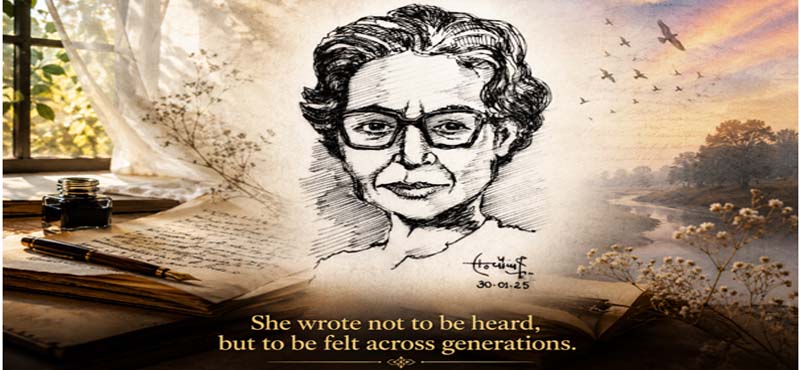
(A face drawn in ink, a life remembered in words–the opening portrait is author’s own pen sketch.)
ABOUT THE AUTHOR

Lt Gen Rajeev Chaudhry (Retd) is a social observer and writes on contemporary national and international issues, strategic implications of infrastructure development towards national power, geo-moral dimension of international relations and leadership nuances in changing social construct.