The Diesel Paradox
On 9 October 2026, President Donald Trump announced that Russia would supply more than 300,000 tonnes of diesel immediately, followed by 500,000 tonnes in November, another million tonnes thereafter, and potentially three million additional tonnes, subject to refinery capacity. The US Treasury subsequently authorised specified transactions involving Russian-origin diesel until 7 April 2027. The announcement, made against the backdrop of fuel-price pressures and the November midterm elections, presented a striking contradiction: Washington was prepared to facilitate Russian energy supplies when American interests demanded it, even as it sought to penalise countries purchasing Russian oil.
The immediate explanation is domestic economics. Expensive fuel hurts consumers, raises transportation costs and threatens political support. Yet the episode raises a larger strategic question: if Russian energy can become acceptable when American consumers need relief, why should India’s purchase of Russian crude be treated as an offence deserving economic punishment? The answer may lie beyond the oil itself. Beneath the language of sanctions, national security and market stability sits a deeper contest over financial influence, monetary power and the ability to shape the terms of global energy commerce. The petrodollar deserves scrutiny as part of that contest, although it would be simplistic to treat it as the sole explanation.
Oil is Power; Currency is Leverage
The petrodollar is not a formal global treaty compelling every oil transaction to be settled in American currency. It describes the dominant role of the US dollar in international petroleum trade and the recycling of oil-export earnings into dollar-denominated financial assets. Its foundations lie in the dollar’s convertibility into gold until 1971, America’s financial depth, the security relationships it developed with Gulf producers, and the expanding use of dollar-based markets. The arrangements between Washington and Saudi Arabia during the 1970s strengthened this relationship, but the popular claim that a single agreement legally forced the entire world to buy oil exclusively in dollars is misleading.
The advantage to America is nevertheless substantial. Oil-importing countries need foreign exchange; exporters accumulate revenues; international banks facilitate payments; and investors seek liquid, trusted assets. Because the dollar occupies a central position in this ecosystem, global demand for it supports American financial influence and helps the United States finance deficits on comparatively favourable terms. Dollar-based transactions also create channels through which Washington can apply sanctions, restrict access to financial institutions and raise the cost of doing business with targeted states.
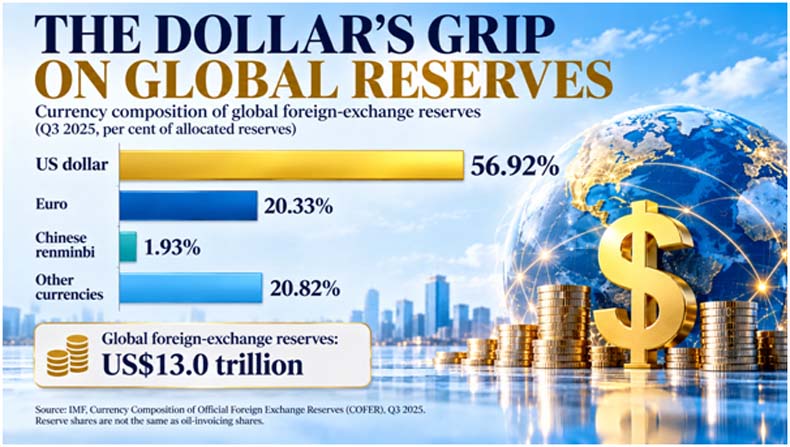
The scale remains formidable. The International Monetary Fund reported that the dollar represented 56.92 per cent of allocated global foreign-exchange reserves in the third quarter of 2025, against 20.33 per cent for the euro and 1.93 per cent for the Chinese renminbi. These figures measure reserves, not the share of oil invoiced in dollars, but they illustrate the monetary infrastructure behind American influence. Protecting that advantage is a plausible strategic interest; proving that every American energy decision is designed to defend it is another matter.
Chokepoints, Sanctions and Selective Pragmatism
Energy power is exercised not only at oilfields but also across shipping lanes, insurance markets, payment systems and export terminals. The Strait of Hormuz, through which roughly one-fifth of global petroleum liquids consumption normally passes, demonstrates how a narrow maritime passage can influence prices far beyond the Gulf. Conflict affecting Iranian exports or shipping through the strait can disrupt supplies, increase freight and insurance costs, and make alternative sources commercially indispensable.
Venezuela presents a different case: American sanctions and licensing decisions have influenced its access to markets, investment and oil revenues, but Washington does not simply own or control Venezuelan petroleum. Russia, meanwhile, retains enormous production capacity and has redirected much of its energy trade towards Asian buyers since the invasion of Ukraine. These distinctions matter because influence, coercion and ownership are not interchangeable.
The Russian diesel announcement exposes the transactional character of sanctions policy. The Treasury’s temporary authorisation permits specified diesel-related transactions, subject to restrictions; it does not amount to the wholesale removal of sanctions on Russia. Nevertheless, the reversal illustrates that sanctions can be adjusted when domestic prices or strategic calculations change. Washington’s willingness to make exceptions for itself, while pressing other states to curtail Russian purchases, creates an obvious credibility problem. A policy justified as a universal defence of international order becomes harder to defend when its application appears dependent on who is buying, who is selling and whose consumers are paying.
India: Cost of Strategic Autonomy
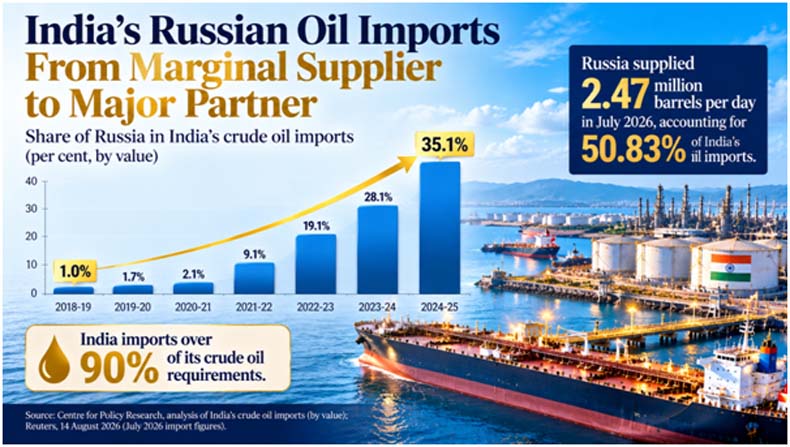
For India, this debate is not theoretical. The country imports more than 90 per cent of its crude-oil requirements, leaving its economy exposed to international prices, shipping disruptions and currency fluctuations. Russian supplies became especially attractive after 2022 because discounted crude offered Indian refiners a commercial advantage. Russia’s share of India’s crude imports rose from approximately 1 per cent by value in 2018–19 to 35.1 per cent in 2024–25. In July 2026, Russia reportedly supplied 2.47 million barrels per day, equivalent to 50.83 per cent of India’s crude imports, as disruptions in the Middle East intensified.
These purchases cannot be understood merely as a diplomatic gesture towards Moscow. They reflect refinery economics, availability, pricing and the imperative of securing affordable energy for a population and economy of continental scale. Nor does buying Russian crude automatically mean endorsing Russia’s war against Ukraine. Commercial decisions and political alignment are related, but they are not identical.
Washington’s response has raised the stakes. US legislation enacted in September 2026 provides authority for tariffs of up to 100 per cent on goods from major purchasers of Russian energy, subject to statutory conditions and presidential discretion. This is not an automatic blanket tariff on every Indian export, but the threat is consequential. India must therefore weigh the savings from Russian crude against possible trade penalties, disruption to exports and wider diplomatic costs. Strategic autonomy cannot mean ignoring these risks; equally, partnership with America cannot require India to surrender the freedom to diversify its energy sources.
Is Petrodollar Under Threat?
The strongest version of the argument is that Washington wants to preserve a system in which energy commerce reinforces American monetary primacy. If producers increasingly accepted alternative currencies, built payment networks outside Western influence, or invested revenues in non-dollar assets, the United States could lose some financial leverage. Russia’s search for alternative settlement mechanisms, China’s promotion of the renminbi and interest among other countries in local-currency trade all form part of this wider movement.
Yet a dollar decline should not be confused with an imminent collapse. Currency dominance rests on much more than oil invoicing: the size of American capital markets, the availability of Treasury securities, institutional credibility, liquidity and the relative scarcity of equally attractive alternatives all matter. The dollar’s 56.92 per cent share of reserves in 2025 demonstrates continuing dominance, even as diversification proceeds. Neither BRICS cooperation nor isolated bilateral oil transactions automatically displace that foundation.
There is also a paradox in using sanctions to defend monetary influence. Financial restrictions can demonstrate the reach of the dollar system, but excessive use may encourage states to reduce their exposure to it. The more access to finance becomes conditional on political alignment, the stronger the incentive to build alternatives. America’s immediate leverage can therefore generate long-term resistance. The petrodollar is best understood not as a conspiracy explaining every policy, but as one pillar of a larger structure of American power that Washington has reasons to preserve.
India’s Answer: Independence without Illusions
India should neither accept American pressure uncritically nor romanticise a multipolar world in which alternative powers are automatically more benign. Its interests require diversified suppliers, resilient shipping arrangements, adequate strategic petroleum reserves, competitive refining, greater domestic production where economically viable, and accelerated investment in renewables, electrification and energy efficiency. Payment flexibility can help, but it must remain commercially practical, legally compliant and supported by willing trading partners.
Diplomatically, New Delhi should insist that energy decisions be assessed through transparent rules rather than selective coercion. It should engage Washington on the legitimate question of Russian war financing while explaining the economic consequences of forcing a major importer to abandon viable supplies. India must also recognise that exposure to any single supplier creates vulnerability, whether the supplier is Russia, the Gulf or the United States.
The central issue, therefore, is not whether America seeks to own every oilfield. It is whether it seeks to retain disproportionate influence over the channels through which energy is financed, traded and monetised. The petrodollar is central to that influence, but it is neither its only source nor a sufficient explanation for every sanction or exemption. India’s task is to protect its room for manoeuvre without confusing independence with isolation.
Oil may fuel the world’s economies, but the power to dictate the terms of its exchange can shape the world’s politics. India’s energy sovereignty will depend on ensuring that no capital, however powerful, acquires the final word over its choices.
ABOUT THE AUTHOR

Lt Gen Rajeev Chaudhry (Retd) is a social observer and writes on contemporary national and international issues, strategic implications of infrastructure development towards national power, geo-moral dimension of international relations and leadership nuances in changing social construct.