
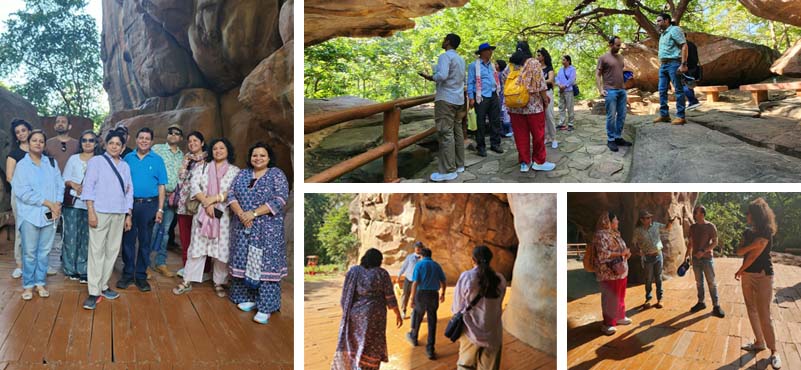
When the Voyagers announced their next outstation trip, the destination was Bhopal.
The reaction from quite a few people was immediate.
“Bhopal? Why Bhopal? What is there to see in Bhopal?”
It was asked with genuine bewilderment.
And, in a way, that question became the beginning of the trip.
The St. Stephen’s Voyagers and FMS Voyagers are Delhi NCR based alumni groups whose members regularly get together for history and heritage walks, both within Delhi and outside it. The outstation trips are an extension of that interest, a chance to take the conversations, the curiosity and, inevitably, the arguments about history somewhere else.
Bhopal was next.
So began the slightly mischievous exercise of answering the question: Why Bhopal?
There was plenty to tell.
There was Bhopal itself, with its lakes, mosques, old quarters, palaces and food.
And then there was what lay beyond Bhopal.
Bhimbetka.
The prehistoric rock shelters, with paintings that take you astonishingly far back into human history.
Sanchi.
The great Buddhist stupa and its extraordinary carved gateways.
And Udayagiri, with its magnificent Gupta period rock cut sculptures.
Suddenly, the answer to “Why Bhopal?” became rather easy.
The destination was not really just Bhopal.
It was Bhopal and everything that could be reached from it.
Information began circulating. Photographs were shared. Places were discussed. The itinerary took shape. And somewhere along the way, the people who had initially wondered what there was to see in Bhopal began to understand why it was worth going.
Eventually, thirteen Voyagers landed in Bhopal.
And the answer to “Why Bhopal?” was about to become much more interesting.
THE MUSEUM THAT CHANGED A FEW MINDS
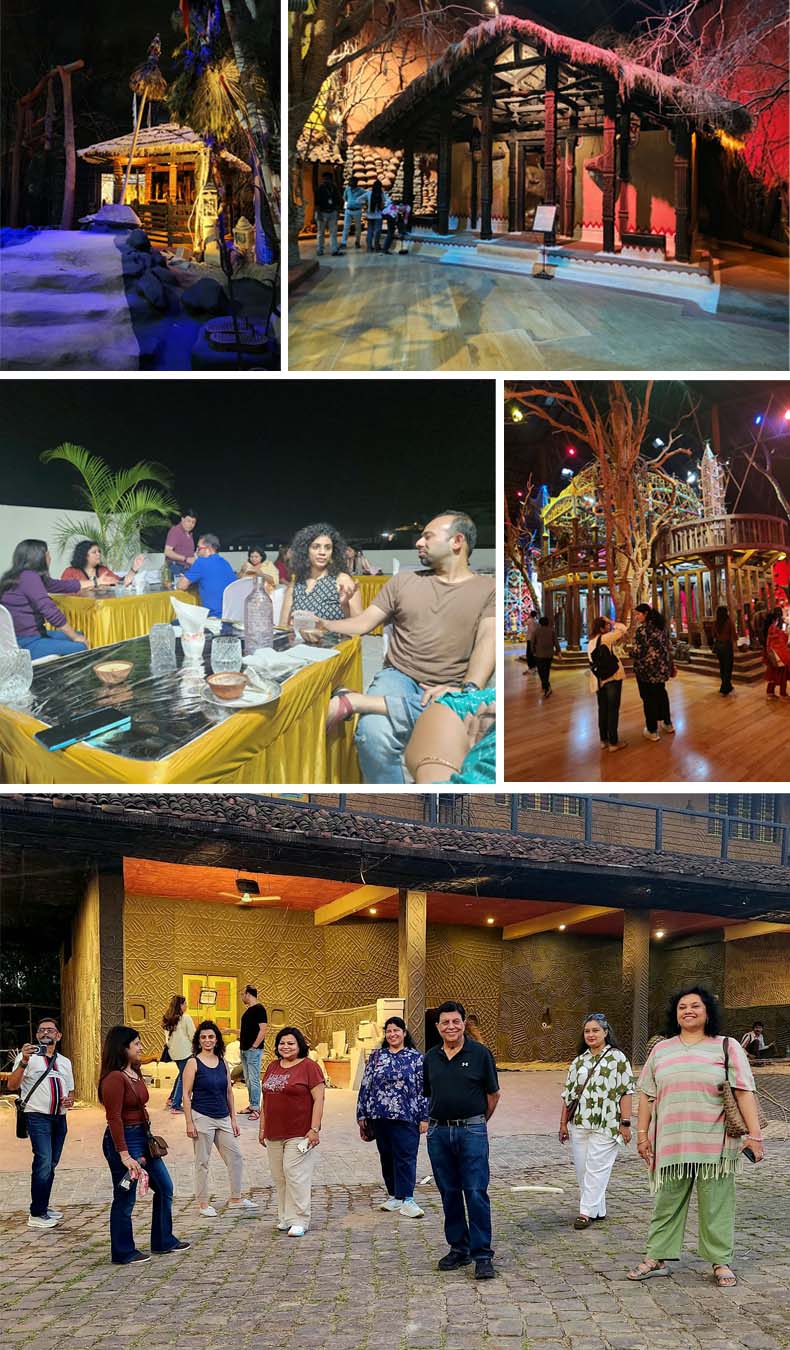
Our first stop, almost immediately after landing, was the Madhya Pradesh Tribal Museum.
This was perhaps the first pleasant surprise of the trip.
Some members of the group, having travelled extensively abroad and visited some of the world’s celebrated museums, had arrived with a slightly dismissive assumption: surely there could not be anything particularly extraordinary to see in an Indian museum.
The Tribal Museum settled that argument rather quickly.
It is not the sort of museum where you walk past rows of objects accompanied by small labels and move on to the next display. The galleries recreate the environments, homes, traditions and visual worlds of Madhya Pradesh’s tribal communities. Large scale installations, sculptures, paintings, architectural elements, everyday objects and extraordinary examples of indigenous art are brought together to tell the story of communities rather than simply display their possessions.
The result is immersive.
The museum gives space to the Gond, Bhil, Baiga, Korku, Sahariya and other communities, allowing visitors to see how their homes, rituals, beliefs, relationship with nature, agriculture and artistic traditions are interconnected.
There was something particularly satisfying about beginning the trip here.
The first lesson of Bhopal was that you do not have to leave India to find an extraordinary museum.
And the people who had been sceptical were among the most pleasantly surprised.
35,000 YEARS BACK AT BHIMBETKA
The following day took us out of Bhopal and much further back in time.
Bhimbetka is one of those places where the phrase “ancient history” suddenly becomes inadequate.
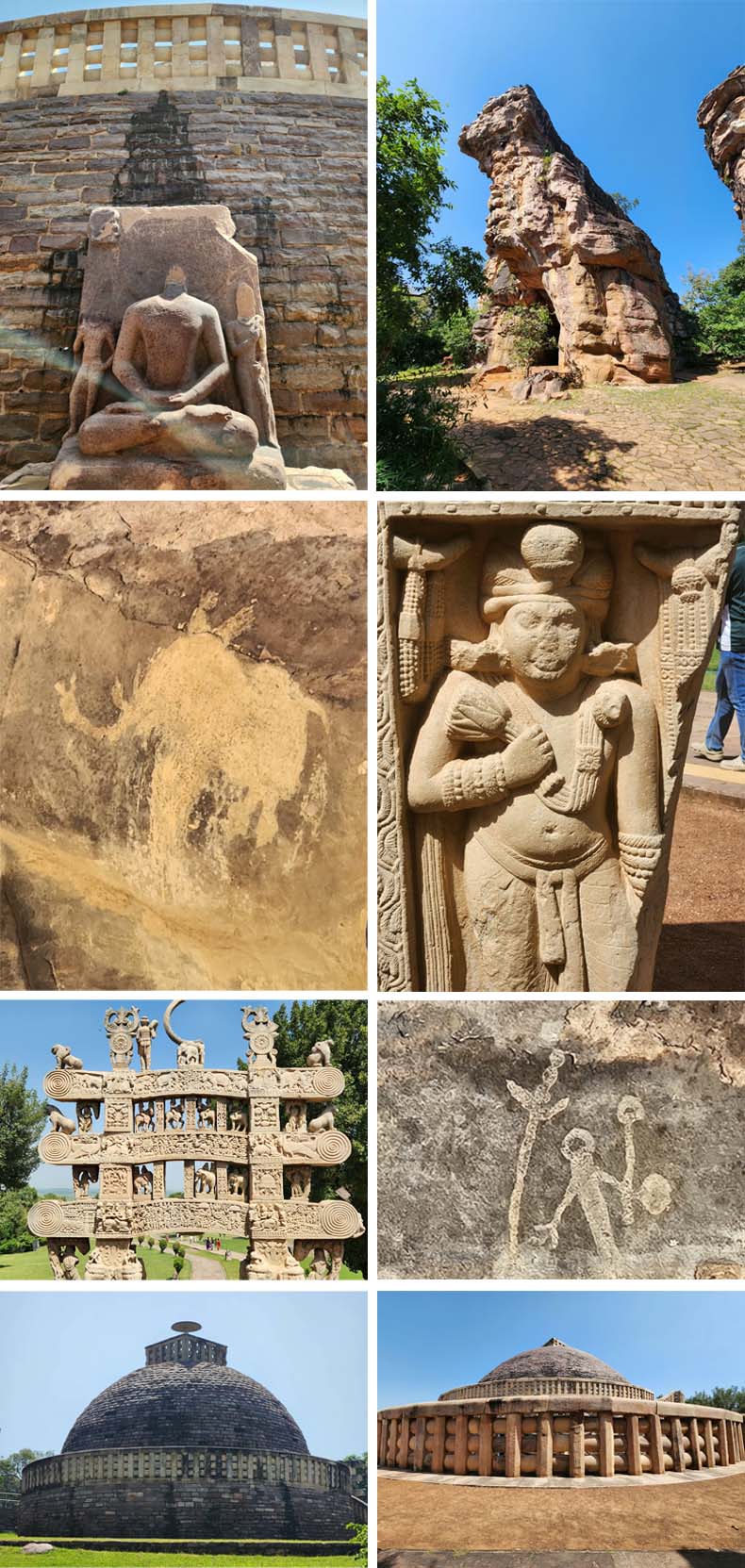
The rock shelters here were inhabited by early Homo sapiens, and their walls carry paintings depicting animals, hunting, dancing, daily life and scenes from the world inhabited by the people who made them.
Some of the earliest paintings are estimated to be around 35,000 years old.
Think about that for a moment.
Thirty five thousand years.
The people who made these drawings had no written language as we know it, no cameras, no books and no museums. Yet they left behind images of their lives on the walls of the shelters in which they lived.
And those images have survived.
Bhimbetka is spread across a remarkable landscape of sandstone rock formations and hundreds of rock shelters. Walking through them, one is struck by the intimacy of the experience. These are not grand monuments built to proclaim the power of a king or an empire. They are traces of ordinary human beings, what they saw, hunted, feared, celebrated and perhaps simply found beautiful enough to reproduce.
For a group that enjoys history, Bhimbetka was less a sightseeing excursion and more a confrontation with the sheer depth of human existence.
SANCHI AND WHY YOU SHOULD GET A GUIDE
The next major excursion was to Sanchi, about two hours from Bhopal.
The Great Stupa at Sanchi is one of those monuments that can be deceptively easy to look at.
You see the massive hemispherical stupa, the stone railings and the four elaborately carved gateways, and you understand that you are looking at something important.
But without knowing what you are looking at, you can miss a great deal of what makes Sanchi extraordinary.
The four toranas are covered with detailed carvings depicting scenes from the life of the Buddha, Jataka stories, symbols, animals, devotees and episodes from the Buddhist tradition. The Buddha himself is generally represented symbolically rather than in human form, through images such as the Bodhi tree, the empty throne, the wheel and footprints.
There is an astonishing amount happening on those pillars and crossbars.
Which is why a guide is strongly recommended.
Without one, it is very easy to admire the carvings, take photographs and walk away without understanding the stories unfolding in front of you. With a knowledgeable guide, the gateways become almost like an illustrated book, with each panel revealing another story.
Sanchi is also remarkable because what survives is not simply the Great Stupa. The hill contains a wider complex of stupas, monasteries, pillars and other structures that allow visitors to understand how this developed as an important Buddhist centre over centuries.
For the Voyagers, this was exactly the sort of excursion that makes these trips worthwhile. You do not simply see a monument. You begin to understand it.
UDAYAGIRI, HISTORY CARVED INTO THE HILL
If Bhimbetka took us back to prehistoric human life and Sanchi into the world of Buddhism, Udayagiri brought us into the Gupta period.
The Udayagiri caves, dating largely to the 4th and 5th centuries CE, are cut directly into the sandstone hills. What makes them particularly fascinating is the sheer physicality of the sculptures. These are not statues placed inside a temple. The mountain itself has been carved away to reveal the gods.
The most spectacular is the colossal Varaha, the boar incarnation of Vishnu, shown rescuing the earth from the cosmic waters. Even after centuries, the scale and power of the sculpture are striking.
There are Shiva sculptures, Vishnu imagery and other carvings associated with the religious world of the Gupta period. And, as at Sanchi, having someone explain what one is looking at makes a considerable difference. A collection of ancient carvings becomes a story of mythology, patronage, religion and the imagination of the time.
By this point, the trip had acquired a rather satisfying chronological sweep.
From prehistoric humans at Bhimbetka, to Buddhist India at Sanchi, to Gupta India at Udayagiri, all within excursions from Bhopal.
AND THEN THERE WAS FOOD
History may have been the stated purpose of the trip, but no Voyagers trip is going to pretend food is incidental.
Bhopal is particularly rewarding for anyone who enjoys meat and kebabs. The non vegetarians in the group made their priorities very clear.
There were kebabs, of course.
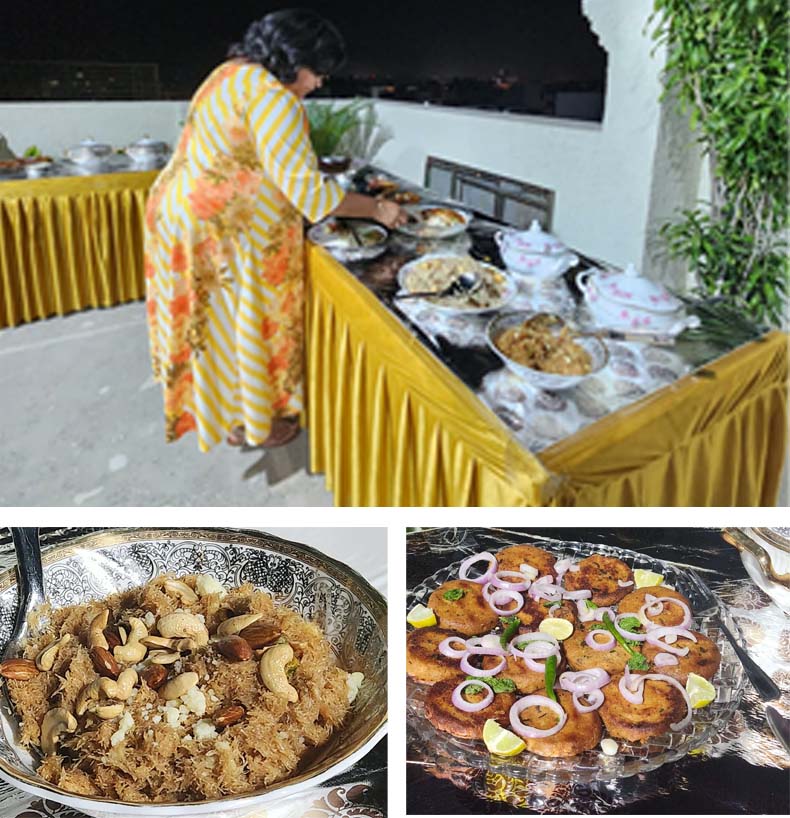
But the undisputed culinary high point was a meal at a home chef’s home, served on the terrace.
And what a meal it was.
Mutton mutthi kebabs. Chicken shami kebabs. Dahi bada. Dahi ke sholey. Paneer cutlets. Mutton pasande. Murg rezala. Shahi vegetable korma. Hyderabadi baingan. Angara mutton biryani. A vegetarian biryani with dry fruits and paneer. Parathas, raita, chutneys and salad.
There was shikanji to drink.
And then came Kimami sevai.
The sort of dessert that makes sensible portion control temporarily irrelevant.
It was not merely an elaborate meal. It was the warmth of being fed in someone’s home, with the food carrying a sense of hospitality that is difficult to reproduce in a restaurant.
The other memorable dinner was at Jehan Numa Palace in Bhopal.
Here, the experience was completely different. An elegant heritage setting, beautiful ambience, music and the feeling of being transported into another version of Bhopal altogether.
Between the home cooked feast and the palace dinner, the group was beginning to understand that Bhopal’s history does not stop at its monuments.
It is also present in the way the city eats, entertains and welcomes.
BACK TO BHOPAL
Bhopal itself deserved its share of attention.
We visited Taj ul Masajid, one of India’s largest mosques and one of Bhopal’s most recognisable landmarks. Unfortunately, a function was taking place during our visit and women were not permitted inside for those three days, so we had to admire the mosque from outside.
It was one of those small travel disappointments that becomes part of the story rather than spoiling it.
Not every door opens when you arrive.
Sometimes you simply look from the outside, take the photographs and move on.
There was also Bhojpur and the Bhojeshwar Temple on the itinerary. Some members of the group made the excursion to see the enormous unfinished Shiva temple. I stayed back because I had an upset stomach and was not up to the excursion that morning.
And that, too, is the reality of group travel. Thirteen people can travel together and still have thirteen slightly different experiences of the same destination.
A LITTLE BHOPAL BETWEEN THE MONUMENTS
One of the pleasures of the trip was discovering the city between the major historical sites.
There was a food walk, naturally.
There were mangodas, khoya jalebi and bun maska, with tea appearing at regular intervals because apparently no historical investigation can proceed properly without it.
And there were the ordinary details that never make it into an itinerary: streets, conversations, photographs, the inevitable searching for the next cup of tea, and the particular pleasure of wandering around a city with a group of people who are just as interested in asking “But what exactly is that?” as they are in taking a picture of it.
That, perhaps, is the real character of a Voyagers trip.
The destination provides the material.
The people provide the curiosity.
SO, WHY BHOPAL?
By the time the thirteen Voyagers were preparing to leave, the question that had greeted the announcement of the trip seemed almost funny.
“Why Bhopal? What is there to see?”
Well.
There are prehistoric rock paintings that take you back 35,000 years.
There is a Buddhist complex whose stone gateways can keep you occupied for hours if you know how to read them.
There are Gupta sculptures carved into hillsides.
There are tribal traditions brought alive through one of the most remarkable museums in the country.
There are mosques, palaces, lakes and old neighbourhoods.
There is food that can occupy an entire evening.
And there is the unexpected pleasure of discovering that a place you thought you knew little about can turn out to contain several thousand years of history within easy reach.
Perhaps the best destinations are not always the ones that immediately announce themselves.
Sometimes, someone simply says “Bhopal”, and everyone asks, “Why?”
And then thirteen people go and find out.
ABOUT THE AUTHOR
 Purva Rakesh is a media and communication professional with an MBA and a Master’s in Filmmaking. An alumni of St. Stephen’s College and FMS, she has a keen interest in history, heritage, culture and travel, and enjoys discovering the stories behind the places she visits.


