
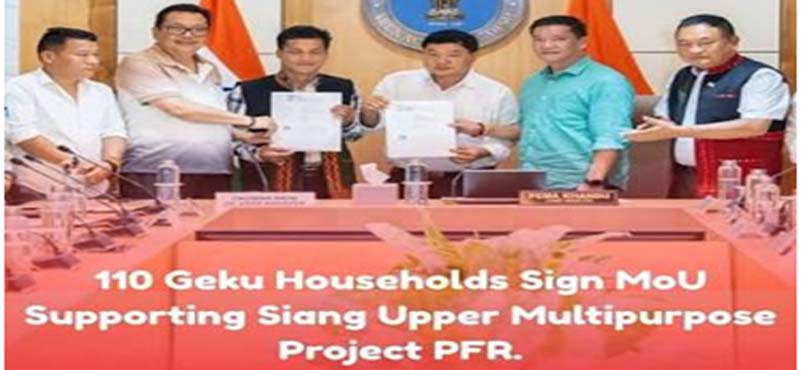
The controversy surrounding the Siang Upper Multipurpose Project (SUMP), precipitating with violent protests at Pasighat, headquarters of East Siang district, reflects a dissonance between strategic and economic necessity and tribal and ecological concerns. On one side is India’s long felt need to exploit its hydropower potential besides resilience against possible upstream water weaponization by China, and on the other, the ecological and geological sensitivities of the Eastern Himalayas and the socio-cultural concerns of the Adi community, whose ancestral traditions, identity and livelihoods are closely associated with the Siang River.
Major infrastructure projects in India have seldom progressed without controversies and agonising delays over land acquisition, environmental clearances, compensation, rehabilitation and bureaucratic passivity. What distinguishes SUMP is its location in a sensitive border state, its strategic implications for the Brahmaputra basin and the deep-rooted relationship between the river and the local tribal community. Having been associated with a frontline Army formation in the North East and three years as Security Advisor to Government of Arunachal Pradesh, this author feels that the issue must be examined in a much wider perspective rather than being held hostage to skewed narratives.
Background
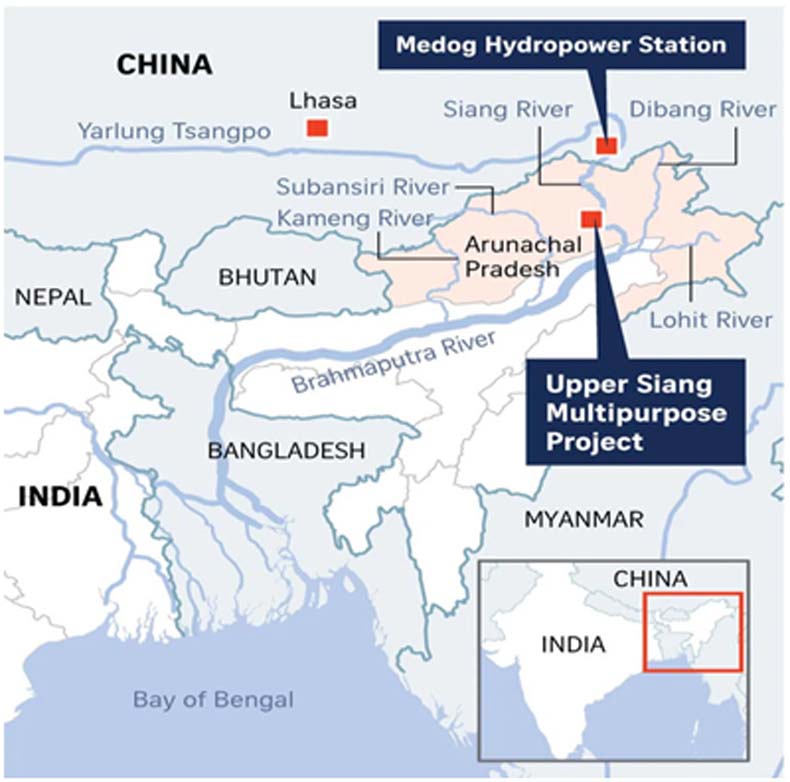
The idea of harnessing the hydropower potential of the Siang basin has evolved over several decades. The Brahmaputra Board, established under the Brahmaputra Board Act, 1980, was mandated to prepare integrated plans for flood control, bank erosion and development of the Brahmaputra Valley. Arunachal Pradesh, with its major river systems of Siang, Subansiri, Kameng, Dibang and Lohit, emerged as the principal repository of the Northeast’s hydropower potential. An earlier proposal of 2011 envisaged a 9,750 MW Siang Upper Hydropower Project. In April 2022, the Ministry of Jal Shakti entrusted NHPC with preparation of a revised Pre-Feasibility Report (PFR) for the Upper Siang Multipurpose Storage Project prompted by changed strategic and hydrological landscape following developments in the upper reaches of Yarlung Tsangpo in Tibet. It took into account the Niti Ayog proposal of 2017 for a single multipurpose project. Submitted in December 2022, the report examined three alternative sites: Uggeng (11,600 MW), Dite Dime (11,200 MW) and Parong (11,200 MW), as recorded in NHPC’s Annual Report 2023–24. The Chinese project at the Great Bend of the Yarlung Tsangpo, approved in December 2024 and construction having commenced in July 2025, is widely reported to have a capacity of approximately 60,000 MW and projected annual generation of around 300 billion units, substantially larger than the Three Gorges project. Its scale, location and limited transparency have heightened India’s concerns. SUMP has not received final environmental or construction approval. The immediate exercise is to determine the most suitable site and assess technical, geological, environmental and rehabilitation parameters.
Competing Standpoints
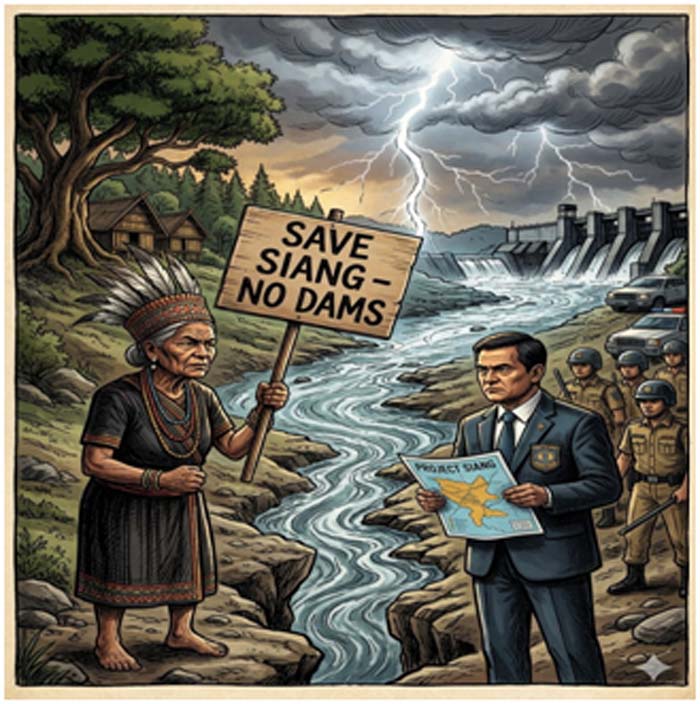
The objections raised by sections of the Adi community ( The Adi Bane Kebang-United(ABKU)), extend beyond compensation or displacement. They include loss of customary community property, ecological degradation, seismic vulnerability, disruption of fisheries and livelihoods, and the emotional and cultural association of Siang river with ancestral traditions. Neither can these concerns be dismissed as mere resistance to development nor can this be overplayed to assuage tribal sentiments. The government’s position is that the present exercise is a technical assessment and that the project cannot be evaluated conclusively without establishing its feasibility. This is a legitimate distinction. However, communities may fear that preliminary investigations are the first step towards a predetermined outcome; necessitating addressing the underlying grievances through meaningful engagement.
Economic and Strategic Imperatives
Arunachal Pradesh possesses one of India’s largest untapped hydropower resources. According to the Central Electricity Authority’s (CEA) assessment placed before Parliament in February 2019, further amplified by its region wise report in October 2026, the State has an identified hydropower potential of 50,394 MW. Out of which a capacity of 2365 MW, or approximately 4.69 percent, is in operation. The CEA’s basin assessment also identified substantial potential in the Siang system. An installed capacity of 11,200 MW would make SUMP one of India’s largest hydropower projects. Its significance extends beyond electricity generation. A multipurpose storage facility could regulate seasonal flows, support peak power requirements, contribute to flood moderation and strengthen the State’s economic and infrastructure base.
The State’s financial position offers a compelling economic rationale. According to the 2026–27 Budget Estimates analysed by PRS Legislative Research, Arunachal Pradesh’s revenue receipts are projected at ₹30,733 crore. Of this, ₹25,525 crore, or 83 per cent, is expected through central transfers. The State’s own revenue is estimated at a mere ₹5,208 crore. Such dependence restricts fiscal autonomy and the capacity to finance development from its own resources. Hydropower can provide a durable revenue stream. Under the State’s hydropower framework, it is entitled to 12 per cent free power from eligible projects. In addition, the Local Area Development Fund (LADF) framework provides for a contribution equivalent to 2 per cent of sale proceeds for projects above 25 MW. Each project affected family is entitled to 100 units of electricity per month for a period of 10 years on operationalisation. For a back of the envelope illustration, a 11,000 MW project would annually generate approximately 47,000 million units of electricity. At an assumed sale value of ₹6 per unit, the State’s 12 percent free-power entitlement of 5,640 million units would have a gross value of approximately ₹3,384 crore annually. A 2 percent LADF contribution calculated on the same generation value would be approximately ₹564 crore. Though the actual realisation would depend on generation, tariff, transmission charges, allocation and sale arrangements. The economic dividends are significant.
The State Chief Minister stated in October 2026 that nearly 19,000 MW of hydropower projects were at various stages of development and that the State could secure equity participation worth approximately ₹15,000 crore, with the Centre facilitating a 26 per cent State equity share in relevant joint ventures. The benefits would extend beyond the State exchequer. Construction and operation can generate employment, improve roads and communications, encourage tourism, support local enterprises and stimulate industries supplying construction materials and services. Properly designed benefit-sharing arrangements can make affected communities participants in the economic outcomes rather than merely recipients of compensation.
The strategic dimension is equally important. The Yarlung Tsangpo enters India as the Siang and subsequently becomes the Brahmaputra. China’s massive upstream project, combined with the absence of a comprehensive and transparent real-time hydrological information-sharing mechanism, raises legitimate concerns about sudden releases, altered flows and inadequate warning during emergencies. Indian storage could provide a measure of resilience by regulating flows and creating additional operational options.
The Brahmaputra is not dependent exclusively on water entering from Tibet. A 2011 parliamentary reply placed the Siang’s contribution from the Tibetan Autonomous Region at approximately 78.1 billion cubic metres, while the average annual contribution from the Indian catchment was estimated at 537.24 billion cubic metres. Tributaries such as the Dibang, Lohit and Subansiri add substantial flows within India. The concern is therefore not simply the loss of the river’s entire water supply, but India’s capacity to manage sudden changes in upstream flows and their consequences downstream. Storage can also contribute to flood moderation. SUMP must also be viewed as part of a wider national effort to strengthen infrastructure, connectivity, economic opportunity and assertion of India’s sovereignty over territory claimed by China. The project is a component of Comprehensive Brahmaputra Basin Strategy, alongside development on the Subansiri, Dibang, Kameng and Lohit systems.
Environmental, Geological and Social Costs
The economic and strategic arguments notwithstanding, the environmental, geological and socio-cultural costs merits careful deliberation. The project could submerge forest areas, agricultural land, villages and traditional community property. In March 2026, the State Panchayati Raj Minister referred to 21 project-affected habitations. The Centre of Excellence for Himalayan Studies has estimated 27 villages facing submergence and another 43 potentially affected directly or indirectly. The population likely to be affected requires detailed enumeration as the 1.5 lakh figure given by Siang Indigenous Farmers Forum and quoted by some news platforms appear exaggerated.
The geological dimension is particularly acute. Arunachal Pradesh lies in one of the world’s most seismically active regions. A large reservoir and dam structure, complex geological formations and unstable slopes demand rigorous assessment. Reservoir-induced seismicity, landslides and the possibility of landslide-generated waves cannot be dismissed. The proposed storage capacity of around 9.2 BCM has been discussed in connection with SUMP, but the final storage, dam height and reservoir configuration remain subject to further technical assessment. Environmental consequences extend downstream. Changes in sediment transport, river temperature, fish migration and seasonal flows could affect river ecology, agriculture and fisheries in Arunachal Pradesh and Assam.
The socio-cultural dimension has emotional and sentimental overtones. The State is home to 26 major tribes and over 100 sub tribes with an estimated 68.8 percent of 16.08 lakh population being Scheduled Tribe. The state has numerous ethnic and student organisations which influence political decision making, often overriding economic pragmatism. The Adi are the second major tribe after Nyishi, with a population of approximately 2.78 lakh (extrapolated figures from 2011 census and falling birth rates). Their attachment to the Siang is rooted in history, customary practices, land, livelihood and identity. The Arunachal Pradesh (Land Settlement and Records) Act, 2000, as amended in 2018, recognises customary land rights and community land. The Kebang (village council) institution and organisations such as the Adi Bane Kebang play influential roles in shaping community opinion. Thus ambition must be taken forward with amity. However, community opinion is not necessarily uniform. Traditional land-based identity and the aspirations of younger generations seeking education, employment and economic mobility may not always converge. Nor should any single organisation be presumed to represent every landholder, household or affected village.
The Way Forward
People in Arunachal Pradesh have consistently demonstrated fierce patriotism and commitment to national security. That sentiment should be recognised and matched by a development process that gives local communities confidence that their interests will not be sacrificed. However, respect for tribal identity and customary land rights does not mean that every development decision of national importance must be determined exclusively by community sentiment. A tribe’s historical association with a valley deserves consideration, but cannot automatically translate into an absolute veto over every project of wider public and strategic significance. The way ahead must rest on the following tenets:
- Transparent Communication: Explain the economic, strategic and long-term benefits to the State and the local population. Publish technical findings and counter misinformation with transparency and credible facts.
- Independent Scientific Scrutiny: Institute a Commission including intellectuals from the community for credible geological, seismic, hydrological and environmental assessment. Findings must be made public.
- Accurate Enumeration: Conduct physical household and land surveys to identify affected residents, migrants retaining customary land rights, seasonal users and households dependent on the river. Legitimate claims must be honoured.
- Meaningful Community Participation: Provide an enforceable development package covering livelihood restoration, employment, education, healthcare, roads, local enterprise and recurring benefits through LADF. Explore annuity-based benefits and opportunities for community participation in project-related economic activity.
- Design Flexibility: Calibrate live storage and Full Reservoir Level (FRL) against seismic vulnerability, flood-management requirements, possible upstream contingencies and submergence. Examine alternatives involving changes in dam location and height, or reductions in FRL and live storage.
- Guaranteed Rehabilitation: Ensure adequate compensation and rehabilitation before displacement. Involve customary institutions while ensuring that consultations are broad-based and representative.
Conclusion
There is no justification for allowing the a project of national significance to drift indefinitely, particularly when China’s project at the Great Bend has already entered the construction phase. The very thought of scuttling the project is unsettling. Urgency is to establish the facts and determine the most viable design, not to bypass scientific and statutory requirements. The project cannot be abandoned or compromised purely on the basis of tribal sentiment; equally, it cannot be imposed without addressing genuine social, environmental and geological concerns. Strategic and economic necessity must drive the project; scientific feasibility must determine the design; environmental sustainability and meaningful local participation must determine the methodology under which it proceeds. Pragmatism must ride over hysteria. SUMP must ultimately be treated not as an isolated hydropower installation, but as an integral component of a comprehensive Brahmaputra basin strategy for India’s energy security, water resilience, flood management, border development and long-term national interests. While tradition preserves our identity, pragmatism powers our future.
ABOUT THE AUTHOR
 Major General SC Mohanty, AVSM (Retd), was commissioned in June 1983. The officer commanded a Mechanised Infantry Battalion, a Mechanised Brigade and an Infantry Division (RAPID Strike) in the Western Sector. As a Brigade Major, he took active part in the Kargil Operations while located at Drass. As part of Military Operations Directorate, he headed the Information Warfare, Cyber and Electronic Warfare branches. Post retirement, he was the Security Advisor to Government of Arunachal Pradesh from July 2020 to May 2023.