
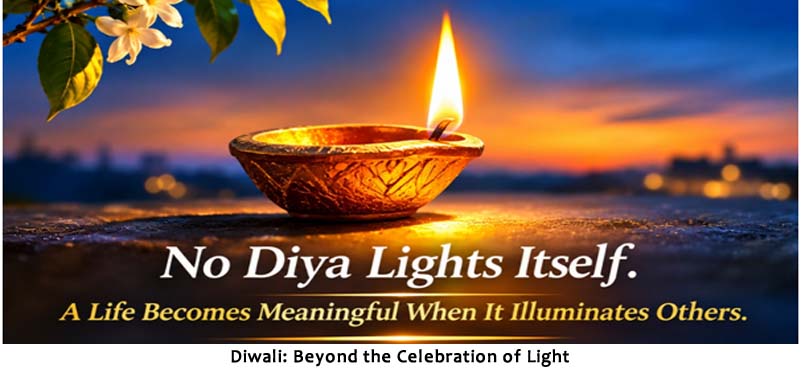
The Little Lamp and the Great Philosophy
Every Diwali, millions of little lamps illuminate India. Earthen diyas line doorsteps, balconies, temples and riverbanks. Homes sparkle, streets glow and the night sky comes alive with celebration. Yet, amidst this magnificent spectacle, perhaps we overlook the most profound lesson hidden in the simplest object of the festival: the diya.
A diya does not light itself. It needs an earthen vessel shaped by a potter, oil made possible by a farmer, a wick prepared by human hands and someone willing to light the flame. Its existence is the outcome of countless contributions, most of which remain invisible. And once lit, it does not illuminate itself; it spreads light around it.
Perhaps this is the most beautiful philosophy of Diwali. Human life, too, is sustained by the contributions of others. We inherit love from our parents, knowledge from teachers, nourishment from farmers, security from soldiers, opportunities from society and wisdom from generations before us. We are beneficiaries of an extraordinary collective effort. Yet how frequently do we pause to acknowledge it?
Nobody Lights Themselves
We often celebrate individual success as though it were a solitary achievement. We admire the successful entrepreneur, the decorated soldier, the accomplished professional and the celebrated artist. But behind every achievement stands an invisible network of people who made it possible.
A mother’s sacrifices, a teacher’s patience, a colleague’s cooperation, a worker’s craftsmanship and a friend’s encouragement may never appear in the story of success, but they are often integral to it. Nobody arrives at the summit entirely alone.
The diya reminds us to recognise these unseen contributions. Consider the potter who moulds thousands of lamps, the artisan who decorates them, the farmer who produces the oilseed, the shopkeeper who sells them and the countless workers who transport the festive essentials. We celebrate the illumination but rarely acknowledge the hands behind it.
Diwali should also be a celebration of the dignity of labour. Every little diya carries a story of human effort. Every festive purchase can become an opportunity to support a small artisan, a local entrepreneur or a family whose livelihood depends on our choices.
The Darkness We Choose Not to See
There is, however, another darkness that no number of decorative lights can dispel. It is the darkness of loneliness, deprivation, inequality and indifference.
While families celebrate together, someone may be spending the evening alone. While expensive gifts are exchanged, a daily-wage worker may be wondering how to provide a festive meal for the family. While children burst crackers, there may be a child watching from a distance, unable to participate. An elderly parent may be waiting for a telephone call that never comes.
The real test of a festival is not how magnificently we celebrate it, but how sensitively we include those who might otherwise remain outside its warmth. We do not need grand gestures. A visit to an elderly neighbour, a meal shared with a struggling family, a thoughtful gift to a worker or a simple conversation with someone lonely can make the festival meaningful.
A thousand diyas cannot make a society bright if compassion remains extinguished.
Ravana We Must Burn Within
Diwali also carries the powerful memory of the victory of good over evil and, in the Ramayana tradition, the return of Lord Rama to Ayodhya. Yet, while we celebrate the defeat of Ravana, perhaps we should examine the Ravana within ourselves.
Ego, greed, jealousy, arrogance, dishonesty, intolerance and the inability to forgive are not merely abstract moral weaknesses. They influence our relationships, institutions and public life. We may illuminate our homes while allowing bitterness to occupy our hearts. We may perform rituals of purification while refusing to acknowledge our own shortcomings.
Burning an effigy of Ravana is a public spectacle. Confronting our own failings is a private responsibility. Perhaps Diwali offers an annual opportunity for a personal moral audit. What have we done well? Whom have we hurt? Which prejudices have we carried? Which relationships have we neglected? What must we change?
The most meaningful victory over darkness is the one achieved within us.
When Celebration Becomes Consumption
Modern Diwali has also acquired a distinctly commercial character. Shopping, expensive gifts, elaborate decorations, extravagant parties and conspicuous displays of prosperity increasingly compete with the festival’s deeper meaning.
There is nothing inherently wrong with prosperity or celebration. Markets create livelihoods, commerce sustains businesses and gifts express affection. But when the value of Diwali becomes measured by the price of what we purchase, we risk confusing abundance with happiness.
The festival should not become a competition in consumption. Nor should our desire for celebration come at the cost of environmental responsibility. Excessive noise, air pollution, waste and the suffering of animals remind us that celebration must be accompanied by consideration. A more thoughtful Diwali would support traditional artisans, encourage local enterprise, minimise waste and respect the environment. Prosperity becomes meaningful when it is shared, not merely displayed.
We have become increasingly successful at decorating our homes. The question is whether we have been equally successful at enriching our lives.
The Art of Returning Home
There is another beautiful dimension to Diwali: the emotional significance of homecoming. The return of Rama to Ayodhya symbolises much more than the arrival of a victorious prince. It represents reunion, belonging, restoration and the triumph of hope after a long separation.
This emotion resonates across humanity. A soldier returning from the battlefield, a sailor returning after months at sea, a migrant worker reaching his village or a child returning to the embrace of parents all experience a version of the same happiness.
Home is not merely a physical address. It is where we are accepted without qualifications, where our absence is felt and where our return matters.
In an increasingly mobile and fragmented world, Diwali reminds us to reconnect. Call someone you have not spoken to for years. Revisit an old friendship. Forgive an estrangement. Spend time with parents and grandparents. Make room at the table for someone who needs companionship.
The greatest journey is not always the one that takes us farthest. Sometimes, it is the one that brings us home.
From Receiving Light to Becoming Light
Perhaps the deepest message of Diwali lies in the transition from being recipients of light to becoming its sources.
We receive so much throughout our lives. The real question is what we give back. Can our experience guide a younger generation? Can our knowledge create opportunities? Can our influence make institutions more honest? Can our resources improve somebody else’s circumstances? Can our presence make another person feel valued?
This is where the philosophy of the diya becomes a philosophy of leadership and citizenship. A good leader creates opportunities for others to shine. A good teacher makes knowledge available. A good parent prepares children to become better than themselves. A good citizen contributes to the collective well-being of society.
The diya does not ask who deserves its light. It simply illuminates. Perhaps humanity would be considerably better if we learned to do the same.
The Final Illumination
Diwali is much more than an annual celebration of lamps, sweets, gifts and festivities. It is a reminder of our interconnectedness, our obligations towards one another and our capacity to overcome darkness, both within and around us.
It asks us to acknowledge the hands that sustain our prosperity, remember those who remain outside our celebrations, conquer the darkness within, celebrate responsibly, return to our relationships and contribute something meaningful to the world.
When the festivities end, the decorations come down and the last diya is extinguished, what remains should be more than photographs and memories of a wonderful evening. There should be a little more kindness in our conduct, a little more gratitude in our hearts and a little more responsibility in our actions.
After all, the purpose of lighting a diya is not to admire the flame, but to illuminate what surrounds it.
No diya lights itself. And no life becomes meaningful by shining for itself alone.
ABOUT THE AUTHOR

Lt Gen Rajeev Chaudhry (Retd) is a social observer and writes on contemporary national and international issues, strategic implications of infrastructure development towards national power, geo-moral dimension of international relations and leadership nuances in changing social construct.