
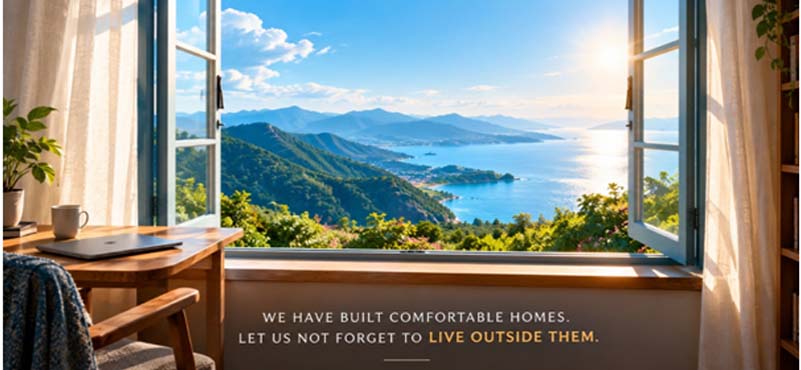
We have built extraordinarily comfortable prisons for ourselves. Our homes are temperature-controlled, our offices are centrally air-conditioned, our cars are insulated from the weather, our entertainment comes through screens and even our social relationships increasingly travel through digital networks. We have conquered heat, cold, distance and inconvenience, yet something rather fundamental seems to have escaped us in the process: the simple pleasure of being outdoors. We spend much of our lives enclosed within four walls and then wonder why our minds feel crowded, our routines monotonous and our spirits occasionally exhausted. Perhaps the time has come to acknowledge that human beings need more than comfortable surroundings. They need horizons.
Holidays, therefore, are not merely rewards for working hard or opportunities to escape professional responsibilities. They are essential interruptions in the mechanical rhythm of existence. Routine gives our lives discipline, structure and direction, but an uninterrupted routine can gradually turn existence into repetition. We wake up to the same alarm, follow familiar roads, occupy familiar chairs, attend familiar meetings and return to familiar surroundings. Days begin to resemble one another until the calendar changes more noticeably than our experiences. A holiday breaks this pattern. It gives the mind permission to wander, the imagination an opportunity to breathe and relationships the attention they often lose to everyday obligations. We discover that time can be enjoyed without being accounted for, and that an afternoon need not necessarily produce anything tangible to be worthwhile. A holiday should restore our appetite for living, not become another assignment from which we need recovery.
Indian civilisation understood this relationship between human beings and their surroundings long before the modern world invented wellness retreats. Our ancestors did not regard nature as a recreational facility to be visited occasionally. It was an essential part of their intellectual, spiritual and physical existence. The ancient gurukuls and ashrams were frequently located amidst forests, where learning happened beneath trees and contemplation unfolded beside rivers. The forest was not a place to escape civilisation but a place to understand it better. The concept of Vanaprastha, traditionally associated with the later stages of life, represented a gradual withdrawal from material preoccupations towards reflection and a deeper understanding of existence. It was an acknowledgement that life required different experiences at different stages. Our sages sought wisdom under open skies, not beneath artificial lighting. Perhaps we have become so sophisticated in organising our lives that we have forgotten some of the simplest arrangements that made those lives meaningful.
There is also a profound philosophical dimension to our relationship with nature. Indian thought describes the universe through the Panchamahabhuta: earth, water, fire, air and space. These are not merely elements in an ancient cosmological framework; they remind us of the fundamental interconnectedness of existence. We walk upon the earth, depend upon water, draw energy from the sun, breathe the air and inhabit space, yet increasingly experience these elements through windows, photographs and carefully curated holiday packages. A mountain does not need to deliver a motivational speech to teach humility. The ocean does not require a lecture to demonstrate the power of persistence. A river quietly explains continuity, while a forest reveals the extraordinary possibilities of coexistence. Nature teaches without appointments, certificates or examinations. We only need to make ourselves available for the lesson.
Stepping outdoors also restores something that modern technology cannot adequately reproduce – direct human experience. Watching a sunset on a screen is not the same as standing beside the sea as the horizon changes colour. Listening to recorded rain is not equivalent to experiencing the fragrance of wet earth after the first monsoon shower. No photograph can fully communicate the silence of a Himalayan valley or the exhilaration of reaching a hilltop after a demanding climb. Our senses were designed to engage with the world, not merely receive its digital representations. Technology has made information accessible, entertainment immediate and communication effortless, but it cannot substitute for the physical experience of being somewhere. We have become excellent at documenting moments and occasionally rather poor at experiencing them. The camera captures the sunset, the mobile phone captures our attention, and the sunset quietly disappears while we are checking whether the photograph has received sufficient appreciation.
Travel adds another dimension to this rediscovery. It takes us beyond geographical boundaries and, more importantly, beyond the boundaries of our assumptions. India, with its extraordinary civilisational and geographical diversity, offers an education that no classroom can completely provide. A journey from Ladakh to Kerala, from Rajasthan to Nagaland, reveals not merely different landscapes but different ways of understanding life. Languages, cuisines, traditions, architecture, faiths and customs become living experiences rather than paragraphs in a textbook. A conversation with a village elder, a meal in an unfamiliar household or a chance encounter on a mountain road can leave a deeper impression than an organised sightseeing itinerary. The Indian philosophy of Atithi Devo Bhava and the civilisational idea of Vasudhaiva Kutumbakam acquire a different meaning when we encounter hospitality and humanity beyond our familiar surroundings. Travel replaces distant perceptions with personal understanding. Geography may divide territories, but journeys often dissolve prejudices.
Unfortunately, we have also managed to turn holidays into highly organised exercises in productivity. There are destinations to be covered, attractions to be ticked off, photographs to be uploaded and experiences to be displayed. Even leisure has acquired performance indicators. Some people return from holidays requiring another holiday to recover from the exhaustion of having enjoyed themselves so efficiently. We must rediscover the pleasure of travelling without rushing, walking without a destination, sitting beside a river without consulting the time and allowing an afternoon to pass without feeling guilty about its apparent lack of achievement. The most memorable moments are often unplanned. A wrong turn may lead to a beautiful village, a delayed journey may produce an unexpected friendship, and an unplanned halt may become the highlight of the entire trip. Life occasionally rewards those who leave some space in their itineraries.
Nor must stepping outside become an expensive privilege. One does not need an international holiday, a luxury resort or an elaborate travel plan to reconnect with the world. A morning walk, a visit to a nearby beach, a bicycle ride, an afternoon in a garden, a weekend in the countryside or simply watching the changing sky from an open terrace can restore a sense of proportion. Children need open spaces to explore, older people need opportunities to remain physically and mentally engaged, families need experiences beyond shared television screens and working professionals need distance from their everyday pressures. We should not postpone living until retirement, until the next promotion, until the workload reduces or until circumstances become perfect. Life has an inconvenient habit of refusing to wait for convenient circumstances.
Perhaps the greatest purpose of a holiday is not to take us somewhere else but to bring us back to ourselves. It reminds us that we are more than our professional identities, responsibilities, possessions and daily schedules. There is a world beyond our offices, a universe beyond our devices and an existence considerably larger than the boundaries of our homes. We spend years constructing comfortable lives, but comfort should never become confinement. We must occasionally step outside, feel the wind, walk unfamiliar roads, meet unfamiliar people and allow nature to remind us of our place in the larger scheme of things.
After all, we were born into an open world, not a closed room. At the end of life, we are unlikely to remember the number of hours spent inside an office, but we will remember the mountains we climbed, the roads we travelled, the people we met and the sunsets that made us forget to look at our watches.
The world has not become smaller; our windows have merely become more interesting. It is time we stepped outside.
ABOUT THE AUTHOR

Lt Gen Rajeev Chaudhry (Retd) is a social observer and writes on contemporary national and international issues, strategic implications of infrastructure development towards national power, geo-moral dimension of international relations and leadership nuances in changing social construct.