
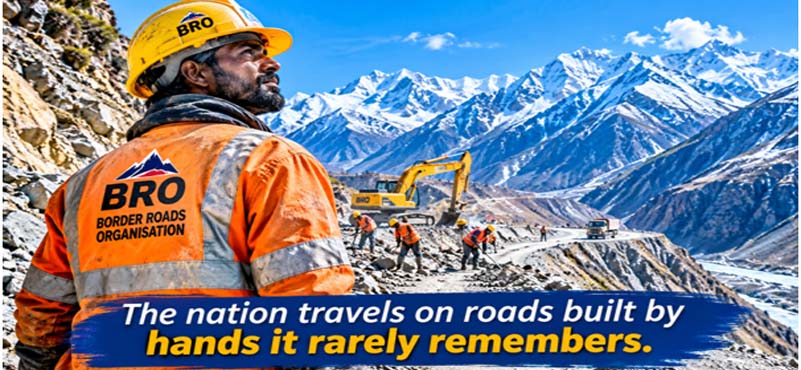
The Road Has a Human Face
When a strategic road cuts through a Himalayan mountain, the nation sees an engineering achievement. When a bridge spans a turbulent river or a tunnel pierces a formidable mountain range, the headlines celebrate technology, engineering and strategic connectivity. Yet, behind these achievements is a workforce whose contribution rarely receives comparable attention. At freezing altitudes, in remote valleys and along treacherous mountain slopes, thousands of men and women work under conditions that test the limits of human endurance. They drill rocks, clear landslides, operate machinery, transport material and rebuild roads destroyed by nature. Their names seldom appear in inauguration ceremonies, but their labour is embedded in every kilometre of strategic infrastructure.
The Border Roads Organisation (BRO) is not merely a road construction agency. It is an instrument of national security, strategic mobility and frontier development. Its achievements, however, cannot be measured exclusively in kilometres constructed, bridges completed or tunnels commissioned. They must also be measured by the dignity, security and welfare of the people who make them possible.
India’s strategic roads have names. The hands that built them rarely do.
The Other Frontline of National Security
BRO operates in an environment where geography is often an adversary. From the high-altitude deserts of Ladakh to the mountains of Arunachal Pradesh, from the Himalayan passes of Uttarakhand to the remote stretches of Sikkim, its personnel confront extreme weather, unstable terrain, avalanches, landslides and prolonged isolation. Construction seasons are short, operational demands are unforgiving and project deadlines are frequently dictated by strategic imperatives rather than engineering convenience.
The importance of this work extends well beyond civilian connectivity. Roads, bridges and tunnels determine the speed of military mobilisation, the resilience of logistics chains and the ability to sustain troops along sensitive frontiers. The workforce that constructs and maintains these assets is therefore contributing directly to India’s defence preparedness. When a landslide blocks a critical road, restoration is not simply a construction activity; it can become an operational necessity. When a bridge is completed ahead of schedule, its value may be measured in the mobility and logistical flexibility it provides to the Armed Forces.
The worker operating a machine or clearing debris may not wear a uniform, but his contribution has strategic consequences.
For the soldier, a road is an operational lifeline. For the worker, building that lifeline is itself a battle.
The Workforce That Moves Mountains
BRO’s human ecosystem is diverse. It includes Army and General Reserve Engineer Force (GREF) personnel, Casual Paid Labourers (CPLs), contractual workers, skilled tradesmen, equipment operators, mechanics, drivers, masons and specialists. Many civilian workers travel considerable distances from their homes to serve at remote project locations, often remaining separated from their families for extended periods.
Their contribution is frequently understated in an era increasingly fascinated by mechanisation and technology. Modern construction equipment, advanced surveying, digital project management and innovative engineering solutions have transformed the way BRO executes projects. Yet, technology has not eliminated the human element. Machines require operators, equipment requires maintenance, and difficult terrain demands experience, judgement and adaptability. Even the most sophisticated machinery cannot independently negotiate every challenge posed by a Himalayan construction site.
There is also an important distinction between permanent personnel and civilian labour engaged under different employment arrangements. Their service conditions, entitlements and vulnerabilities are not identical. A meaningful welfare framework must recognise these differences while ensuring that no category of worker falls through institutional gaps.
Technology may have changed the tools of construction; it has not diminished the importance of the human hand.
The Unseen Price of Nation Building
The human challenges are substantial, and acknowledging them must not be confused with questioning BRO’s commitment to its workforce. Over the years, several welfare measures have been introduced, including medical facilities, accommodation, transportation, warming arrangements and financial assistance. The introduction of group term insurance for Casual Paid Labourers, with an insured value of ₹10 lakh, was an important step. In February 2024, the Government also waived the 179-working-day eligibility condition for ex-gratia compensation, recognising that families should not be deprived of assistance merely because a worker had not completed a prescribed period of engagement.
These initiatives deserve recognition, but the nature of the operating environment demands continuous improvement. Occupational accidents, exposure to extreme temperatures, altitude-related illnesses, inadequate emergency evacuation and prolonged separation from families remain areas requiring sustained attention. Healthcare access in remote locations cannot depend entirely on the availability of facilities at the nearest town. Similarly, the quality of accommodation, sanitation, protective equipment and nutritional support must be assessed against the actual conditions of deployment.
The vulnerability of civilian labour is particularly important because employment arrangements and social security entitlements vary. A worker injured during a hazardous operation and a family that loses its sole earning member cannot be treated as routine administrative cases. Their circumstances demand timely intervention, transparent compensation and sustained institutional support.
The measure of a strategic organisation is not merely how efficiently it completes a project, but how responsibly it protects those who execute it.
From Welfare to Strategic Capability
Worker welfare must move from the margins of administrative consideration to the centre of operational planning. It is not charity, an avoidable overhead or merely a statutory obligation. It is an investment in productivity, morale, institutional loyalty and project continuity. A healthy, trained and secure workforce is more capable of meeting demanding construction schedules and responding to operational emergencies.
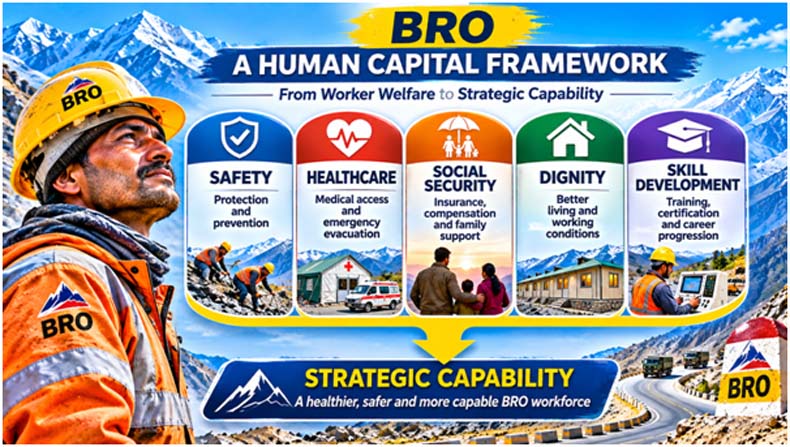
During my tenure as Director General BRO, I placed considerable emphasis on this principle and pursued a focused agenda covering five critical areas:
- Social security through comprehensive accident and life insurance, transparent compensation and dependable family assistance.
- Occupational safety through modern protective equipment, mechanisation of hazardous tasks, regular safety inspections and strict enforcement of worksite protocols.
- Healthcare through well-equipped medical facilities, preventive health screening, emergency evacuation arrangements and access to specialist treatment.
- Living conditions improvement through dignified accommodation, clean water, sanitation, adequate nutrition and communication facilities.
- Skill development through certification, technical training and opportunities for professional advancement.
These measures were tailored to employment categories, with clearly defined entitlements and accountability. Local communities were also given greater opportunities for recruitment and skill development wherever feasible. The strategic dividend is considerable: lower workforce attrition, fewer accidents, better construction quality and greater organisational resilience. The challenge now is to institutionalise these initiatives, strengthen their implementation and progressively raise the standards of welfare across every project and task force.
The welfare of the workforce is not separate from the mission; it is one of the foundations of mission success.
New Social Contract for Strategic Infrastructure
BRO now needs a comprehensive Human Capital and Welfare Charter, backed by measurable standards rather than broad declarations of intent. Every project and task force should maintain an updated digital record of its workforce, employment category, skills, insurance coverage, medical history relevant to occupational safety and welfare entitlements. A centralised monitoring mechanism should track compliance and identify gaps before they become crises.
Independent periodic audits of labour camps and construction sites should examine accommodation, sanitation, safety equipment, medical preparedness and payment systems. Accident reporting must be transparent, with time-bound investigation, compensation and corrective action. Special attention should be given to women workers, migrant labour and the welfare and education of children accompanying families at remote camps.
The charter must also establish clear responsibility across project headquarters, task forces and executing agencies. Welfare indicators should become part of organisational performance assessment, just as project completion, quality and financial expenditure are monitored. Recognition of exemplary workers, skill certification and opportunities for progression would reinforce a culture of dignity.
BRO has demonstrated that difficult terrain need not defeat engineering ambition. It must now demonstrate that difficult working conditions need not compromise human dignity.
India needs a new social contract with those who build its strategic frontiers.
The Nation Must Remember Its Builders
The next time a military convoy moves along a newly completed mountain road, or a civilian traveller crosses a bridge in a remote frontier valley, the achievement deserves to be celebrated. But the story must not end with the infrastructure. Somewhere along that road, a worker has packed his belongings and moved to another site, another mountain and another demanding assignment. His contribution may never be recorded in a history book, but it remains permanently etched into the nation’s strategic landscape.
As India pursues its ambition of becoming a developed nation and strengthens its border infrastructure, BRO’s transformation must include a decisive shift towards human capital development. Modern equipment, technology, faster execution and engineering innovation are essential. Equally essential is an institution that protects, respects and values its workforce.
India’s borders may be secured by its soldiers, but its strategic frontiers are also built by the sweat, skill and sacrifice of its workers. The nation must remember both.
ABOUT THE AUTHOR
Lt Gen Rajeev Chaudhry (Retd) is a social observer and writes on contemporary national and international issues, strategic implications of infrastructure development towards national power, geo-moral dimension of international relations and leadership nuances in changing social construct.