
A River Crosses More Than a Border
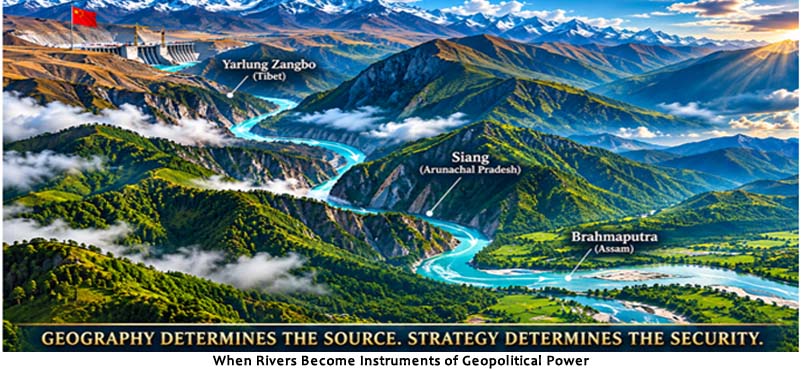
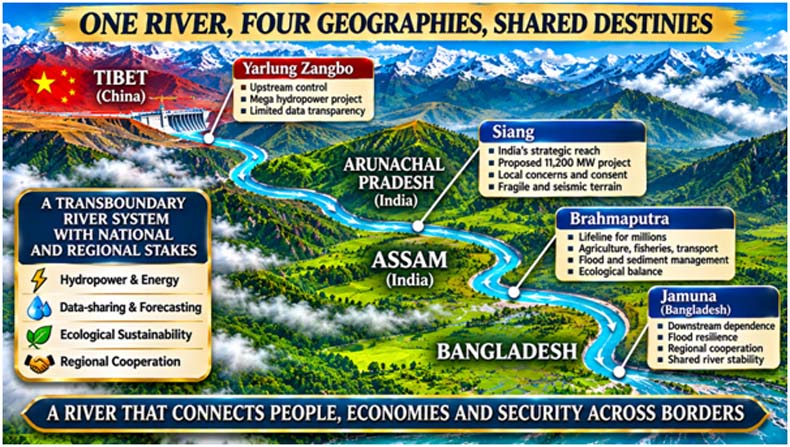
The Brahmaputra begins as the Yarlung Zangbo on the Tibetan plateau, enters India as the Siang and flows through Assam into Bangladesh. Its journey is geographical, ecological and increasingly strategic. Decisions upstream can affect communities thousands of kilometres downstream, yet the countries sharing its waters lack a comprehensive basin-wide agreement. The river is no longer merely a resource to be harnessed; it is a source of interdependence and potential leverage.
China’s proposed mega hydropower project with planned capacity of 60,000 MW on the lower Yarlung Zangbo, announced in December 2024, has sharpened India’s concerns. Its scale and operating design warrant scrutiny because technical information remains limited. Yet a dam does not automatically enable a country to divert an entire river or manufacture a flood. The concern is upstream control combined with inadequate transparency. For a downstream nation, uncertainty itself becomes a security liability.
China’s Upstream Advantage
China occupies the Brahmaputra’s upper reaches and has the capacity to develop major infrastructure there. Beijing presents hydropower as clean energy and regional development. India need not dismiss that rationale, but must assess the consequences of major infrastructure on a trans-boundary river without transparent operating arrangements.
The Yarlung Zangbo’s dramatic bend around the eastern Himalayas gives the project geographical significance. Its implications depend on design, reservoir capacity, diversion arrangements, seasonal operating rules, seismic conditions and emergency procedures. Without these details, India cannot assess effects on lean-season flows, sediment, flood peaks or ecosystems. Equally, every fluctuation in the Brahmaputra must not be labelled deliberate manipulation.
The diplomatic deficit is visible. The India-China MoU on Brahmaputra flood-season data expired in June 2023; the Sutlej arrangement expired in November 2020. India has sought renewed data-sharing and technical information through bilateral mechanisms. Such exchanges are not bureaucratic formalities: upstream data supports flood forecasting, disaster response, agriculture and public safety. India’s preparedness cannot depend on information another state may withhold.
Siang Agitation: Strategy Meets Society
India’s proposed 11,200 MW Siang Upper Multipurpose Project has acquired strategic importance partly in response to China. But it has become the centre of a serious local confrontation. Sections of the Adi community fear submergence of ancestral villages, loss of farmland and livelihoods, and damage to sacred landscapes and cultural continuity. As the project remains at pre-feasibility stage, its eventual footprint must be established through independent assessment, not assertion.
Opposition has moved beyond village meetings. Demonstrations, shutdown calls, arrests and clashes mark an escalating agitation. On 23 October 2026, protests in Pasighat turned violent, with reported injuries, property damage and police use of tear gas. A shutdown was called across three districts for 2 November, amid demands over arrests and security-force deployment. Violence cannot be justified, but the underlying concerns cannot be reduced to law and order. The movement reflects a dispute over consent, land, identity and trust.
This is India’s strategic paradox. A project intended partly to protect national interests cannot alienate border communities whose cooperation is itself a national asset. In frontier regions, legitimacy is a component of resilience. Consultation must precede irreversible decisions. The state must explain the strategic case, disclose uncertainties, hear objections without coercion and accept that an unviable or socially unacceptable project may need redesign or abandonment. National security cannot rest on the assumption that local people must comply.
Wider Geopolitical Canvas
The Brahmaputra sustains communities across Arunachal Pradesh and Assam before entering Bangladesh. Its flows shape farming, fisheries, livelihoods and floodplain ecology. Changes in sediment, seasonal discharge or flood behaviour can reach far beyond a dam site. India must view the Siang within a wider river-basin framework that recognises downstream communities and regional stability.
The Northeast occupies sensitive strategic geography. Connectivity, public services, economic opportunity and institutional confidence strengthen border security. Unresolved grievances can deepen alienation. The answer is neither to securitise every protest nor ignore security concerns, but to maintain public order proportionately while protecting lawful dissent, customary institutions and independent scrutiny.
Bangladesh must be part of India’s thinking. As a downstream riparian, it has legitimate interests in predictable flows, flood warnings and ecological health. Transparent engagement and information-sharing with Dhaka would strengthen India’s regional credibility. A trans-boundary basin requires cooperation even when upstream strategic trust is limited.
Himalayan Water Security Doctrine
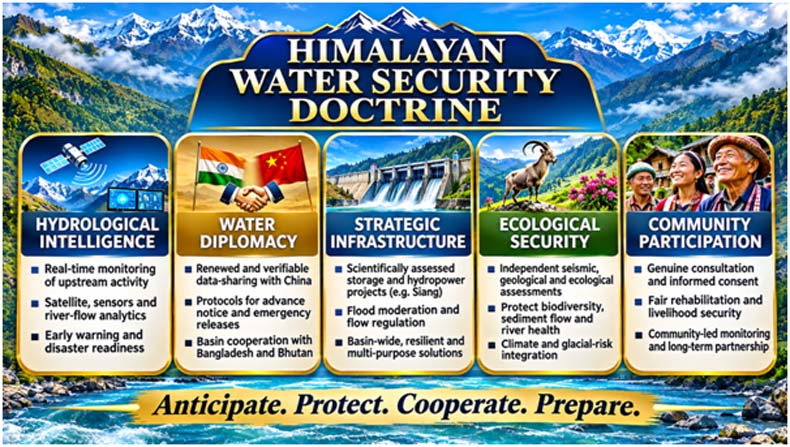
India needs a Himalayan Water Security Doctrine: a standing framework treating trans-boundary rivers as strategic systems while protecting ecological integrity and community rights. It should rest on five pillars.
- Hydrological intelligence and early warning. India should build year-round monitoring using satellite imagery, radar, ground sensors, river gauges, weather data and scientific modelling. It should track observable reservoir levels, construction, glacial lakes, landslides, sediment and river discharge. The Central Water Commission, space agencies, disaster authorities, research institutions and states must feed a common operating picture. Forecasts must become district alerts, evacuation plans and tested protocols. Intelligence must be continuous, not monsoon-bound.
- Water diplomacy and enforceable transparency. New Delhi should press to restore and modernise hydrological data-sharing with Beijing, seeking timely, verifiable information, advance notice of exceptional releases, project details and emergency channels. The Expert Level Mechanism should meet regularly, with protocols surviving wider political deterioration. Engagement with Bangladesh and Bhutan can strengthen flood forecasting and basin cooperation. Diplomacy must be persistent, technically informed and evidence-based.
- Strategic infrastructure, not a dam race. India must assess storage, hydropower and flood moderation on basin-wide evidence. The Siang project requires transparent feasibility studies, independent seismic and geological evaluation, cumulative environmental assessment and credible cost-benefit analysis. Alternatives such as smaller storage, distributed generation, better forecasting, resilient embankments and floodplain management must be compared. A mega-project cannot become viable merely by acquiring a national-security label. Every project must demonstrate public benefit and operational safety.
- Ecological security and community consent. A Himalayan doctrine must recognise that fragile mountains are not ordinary construction sites. Seismicity, slope instability, glacial dynamics, biodiversity and sediment require independent study. Social assessments must cover sacred sites, customary rights, forests, grazing routes and cultural landscapes, not merely houses and fields. Communities need accessible information, independent advice, fair compensation and rehabilitation plans before irreversible decisions. Their institutions should help monitor projects. Consent cannot be manufactured through hurried consultations or security deployment.
- National coordination and regional resilience. A permanent mechanism should unite Jal Shakti, External Affairs, Defence, Power, Environment and Home Affairs with Northeast states and scientific institutions. It should maintain classified assessments and a public risk framework, conduct annual exercises and publish progress reports. Dedicated funding must support river science, local preparedness and resilient infrastructure. National security must connect with livelihoods, public trust and regional cooperation.
The doctrine should also define thresholds for action. A sudden and unexplained change in discharge, an upstream impoundment, a glacial-lake outburst warning or a reported emergency release should trigger verification, inter-agency alerts and contact with the upstream authority. Independent teams must distinguish natural events from infrastructure-related changes before public conclusions are drawn. This separation between classified assessment and public warning will reduce panic, counter misinformation and help administrations act on evidence rather than rumour.
Reactive Management to Strategic Preparedness
The doctrine must change institutional behaviour. India should designate a nodal authority for trans-boundary river risk, assign responsibility for data fusion and ensure warnings reach the last village. Districts need trained teams, communications, evacuation routes and community-led drills. Infrastructure agencies must share project data with independent regulators, while universities should scrutinise assumptions rather than merely validate official positions.
India also needs a credible compact with the people of the Siang valley. Government must engage village councils and customary bodies, publish pre-feasibility findings, explain uncertainties and answer concerns. Allegations of excessive force require impartial examination; peaceful protest must not be conflated with violence. The state must enforce law fairly, protect safety and preserve democratic disagreement. A frontier community that trusts the Republic is a strategic strength no reservoir can replace.
The framework should be reviewed annually by Parliament, with the affected states presenting their preparedness and unresolved concerns. It should also fund local universities, civil-society institutions and community volunteers to participate in river observation, disaster education and ecological monitoring. Such participation will improve the quality of information while building confidence that national policy is not being imposed from distant capitals. Resilience begins where people understand the risks and trust the institutions asking them to prepare.
Securing the River, Securing the Future
India cannot determine what China builds upstream, but it can reduce exposure through intelligence, diplomacy, resilient infrastructure and sound governance. It should not imitate opacity or treat every river as an arena for competition. Its approach must defend national interests while upholding science, ecology and citizens’ dignity.
The Siang agitation is not a distraction from national security; it warns that strategic projects require social legitimacy. India must protect downstream interests without sacrificing the trust of those living beside the river.
The Himalayan water question demands foresight, cooperation without naivety and development without dispossession. The Himalayas may divide nations geographically, but their rivers bind their destinies strategically.
ABOUT THE AUTHOR

Lt Gen Rajeev Chaudhry (Retd) is a social observer and writes on contemporary national and international issues, strategic implications of infrastructure development towards national power, geo-moral dimension of international relations and leadership nuances in changing social construct.