
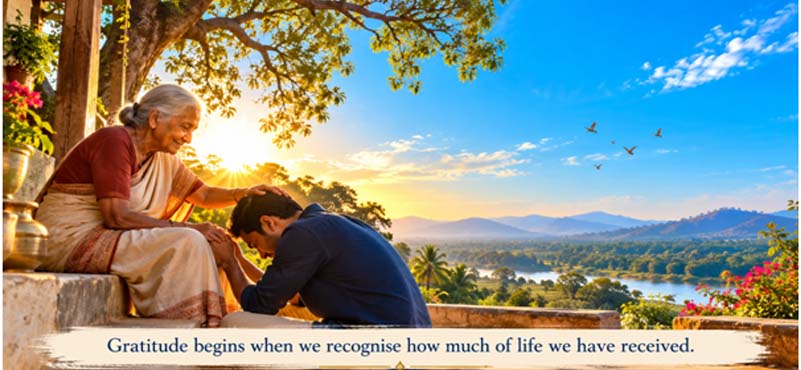
There are some emotions that do not announce themselves. They arrive quietly, sit beside us, and alter the way we see the world. Gratitude is one of them. It does not demand applause or recognition. Yet a grateful heart can transform an ordinary life because gratitude changes not what we possess, but how we perceive what we have been given. It turns abundance into awareness, memory into humility and existence itself into something worthy of reverence.
Perhaps that is why gratitude has always had a deeper place in the Indian imagination than the simple courtesy of saying thank you. The Indian civilisational mind has long understood life as an inheritance of countless gifts. We arrive in this world already indebted—to our parents who give us life, to teachers who give us knowledge, to ancestors who leave us a civilisation, to society that sustains us, to nature that nourishes us and to the unseen forces that make existence possible. The ancient idea of rin, or ऋण, captures this beautifully. To live is, in a sense, to receive; and to recognise what we have received is the beginning of gratitude.
This understanding quietly shaped everyday Indian life. We touched the ground before beginning our day, as if acknowledging the earth beneath our feet. Food was not merely consumed; it was respected, often preceded by a prayer of thanks. The teacher was not simply a professional who delivered lessons, but an acharya worthy of reverence. The words Matru Devo Bhava, Pitru Devo Bhava and Acharya Devo Bhava placed mother, father and teacher within a sacred moral universe. Even the farmer, the river, the cow, the tree and the mountain found a place in rituals and stories. Behind these practices was a simple recognition: human beings do not live independently; we live through an intricate web of relationships, gifts and sacrifices.
Modern life, however, constantly whispers another story. It tells us to count what is missing, compare what we possess with what someone else displays and measure our worth through acquisition. We begin with one desire, satisfy it, and immediately discover another. Gratitude offers a different direction. It does not ask us to abandon ambition or accept injustice. It simply reminds us that ambition without appreciation can make even abundance feel like poverty.
There is something profoundly humbling about looking honestly at any achievement and asking how many people stand behind it. A degree carries the sacrifices of parents and teachers. A career carries the support of colleagues, mentors and family. A successful mission carries the labour of people whose names may never appear in the final account. Even the strength with which we face adversity is often inherited from someone who taught us courage long before we understood its meaning. The more carefully we examine our lives, the harder it becomes to call anything entirely our own.
Gratitude therefore becomes more than an emotion; it becomes a way of seeing. It makes invisible contributions visible. It teaches us to acknowledge the hand behind the opportunity, the sacrifice behind the privilege and the kindness behind the journey. A grateful leader shares credit. A grateful student remembers the teacher. A grateful child recognises the years hidden behind a parent’s tired smile. A grateful citizen understands that ordinary comforts rest upon the labour of millions whom we may never meet. Gratitude expands the circle of those we see.
Yet genuine gratitude must not be confused with forced positivity. It does not require us to deny pain, injustice, loss or disappointment. A person can mourn and still be grateful. One can experience failure and still recognise the lessons it brought. One can stand amid uncertainty and still cherish the people who remain. That distinction gives gratitude its spiritual depth.
Perhaps its greatest gift is that it gently moves the human heart from possession towards participation. When we recognise that life has given us much, the natural question changes. Instead of asking only, “What more can I get?” we begin to ask, “What can I give?” The debt of gratitude is not repaid by words alone. It is repaid through conduct. We honour our parents by the lives we lead, our teachers by the values we carry forward, our nation by the responsibilities we accept and humanity by the kindness we extend beyond the boundaries of familiarity.
This is where gratitude becomes a moral force. It can soften arrogance without weakening confidence, create humility without diminishing ambition and encourage generosity without demanding reward. A grateful person does not necessarily have an easier life, but often has a deeper relationship with life. Such a person notices the morning differently, receives friendship differently, eats differently, remembers differently. Even a difficult day can contain a small gift—a conversation, a memory, a helping hand, a lesson, a moment of silence—and gratitude teaches the mind not to walk past it unnoticed.
Imagine, then, what would happen if gratitude became a habit rather than an occasional expression. Children would grow up recognising the invisible labour behind their comfort. Institutions would remember the people who built them. Leaders would acknowledge those who served before them. Society would become less obsessed with comparison and more attentive to contribution. The transformation would begin quietly, heart by heart.
Perhaps that is the quiet power of gratitude. It does not change the past, increase the possessions in our hands or guarantee an easier tomorrow. It changes the quality of the heart with which we receive the present. It reminds us that life is not a possession to be claimed but a gift to be honoured, a trust to be carried and, ultimately, something to be passed forward.
At the end of the day, perhaps the deepest prayer is not for more, but for clearer eyes—to see the blessings hidden inside ordinary moments, the people hidden behind our achievements and the grace hidden inside the journey. Gratitude is that quiet awakening.
It teaches us that we did not arrive here alone, and that the most meaningful way to say thank you is to become, for someone else, part of the gift.
ABOUT THE AUTHOR
Lt Gen Rajeev Chaudhry (Retd) is a social observer and writes on contemporary national and international issues, strategic implications of infrastructure development towards national power, geo-moral dimension of international relations and leadership nuances in changing social construct.