
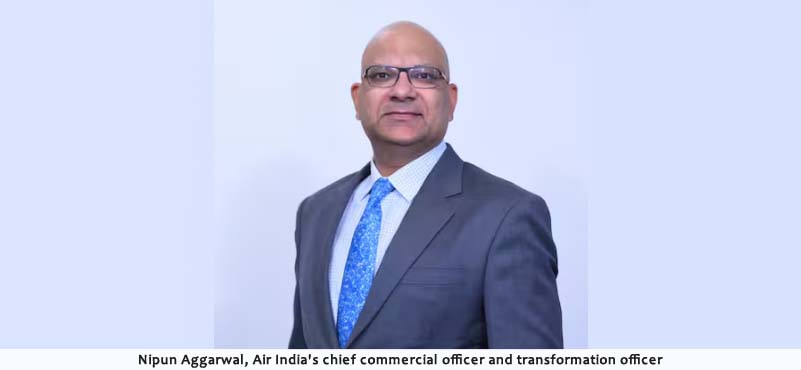
Air India CCTO Nipun Aggarwal says 120 of India’s 160 airports remain underutilised, calling for stronger regional connectivity, smaller aircraft and more affordable air travel.
Two-thirds of India’s 160 airports have very low utilisation, with only 40 operating at 70–80 per cent of capacity, Nipun Aggarwal, Air India’s Chief Commercial and Transformation Officer (CCTO), said on Monday. He attributed the situation to inadequate regional connectivity and suggested that regional jets and smaller aircraft could help connect Tier-II and Tier-III cities as airlines expand their networks.
Speaking at a panel discussion organised by GE Aerospace India, Aggarwal said India had made considerable progress in building airport infrastructure, but the focus now needed to shift towards ensuring that these facilities were used more effectively. Better air connectivity beyond major metropolitan centres would be essential to attract more passengers to smaller airports.
Improving Connectivity to Smaller Cities
Aggarwal said that the 120 airports located outside major metropolitan areas and large cities were experiencing particularly low utilisation. He stressed that airlines would need to expand beyond their existing networks to improve passenger traffic at these airports.
Air India’s current network is largely centred on major hubs, where passengers connect to other destinations. As the airline grows, regional jets and smaller aircraft could provide opportunities to serve Tier-II and Tier-III cities, especially on routes where passenger demand may not justify operating larger aircraft.
Making Air Travel More Affordable
Aggarwal said India’s aviation sector could experience significantly faster growth if flying became more affordable. He identified high taxation as an obstacle, arguing that aviation was still treated as a luxury despite the potential demand among people who currently rely on other modes of transport.
He said reducing the cost of flying and making air travel accessible to more Indians could generate substantial growth in passenger numbers. However, he did not specify which taxes should be reduced or how much airfares would need to decline.
Aggarwal noted that the aviation industry’s growth projections generally assume a nominal annual growth rate of 8–10 per cent. In his view, making flying more affordable could create an opportunity for growth beyond these conventional projections.
Rail Passengers Represent Potential Demand
To illustrate the potential size of the market, Aggarwal compared daily railway and air passenger numbers. According to the figures he cited, approximately 10 million people travel by train every day, compared with around 400,000–500,000 air passengers.
He suggested that more affordable air travel could encourage a larger number of people to consider flying. The extent of this potential demand would depend on ticket prices, route availability and the convenience of air travel compared with other transport options.
Indian Airlines Have Room to Expand Internationally
Aggarwal also highlighted the opportunity for Indian carriers to increase their presence in the long-haul international aviation market. He estimated that this segment carried approximately 25–30 million passengers annually and contributed more than half of the aviation industry’s revenue base.
He referred to India’s fleet of around 60 wide-body aircraft and highlighted the importance of expanding long-haul operations. Wide-body aircraft are generally used for longer international journeys and have the capacity to carry more passengers than smaller aircraft.
Despite the revenue potential of this market, Indian carriers account for less than 20 per cent of long-haul passenger traffic, according to Aggarwal. Many passengers travelling to international destinations continue to use foreign airlines and overseas connecting hubs.
He said this presented an opportunity for Indian airlines to strengthen their international networks and capture a larger share of the market.
Airspace Restrictions Affect Operations
Aggarwal acknowledged that airspace closures were affecting international airline operations, particularly on routes west of India. These routes are important to the long-haul market and can influence flight planning and connectivity.
However, he described the disruptions as temporary and maintained that they did not change the long-term growth prospects of India’s aviation industry.
Focus on Better Airport Utilisation
The comments highlight several challenges facing Indian aviation: underutilised airports, limited regional connectivity, the cost of air travel and the relatively small share of international long-haul traffic held by Indian airlines.
Improving links between major hubs and smaller cities, deploying aircraft suited to regional routes and making air travel more affordable could help airlines attract additional passengers. At the same time, expanding international operations could enable Indian carriers to compete for a greater share of long-haul traffic.
Aggarwal’s remarks underline the need to complement airport infrastructure development with stronger connectivity and more accessible air travel if India is to realise the full potential of its aviation market.