
Lt Gen PJS Pannu’s recently published book, ‘Taramandal Sangram: Space Constellations at War’ set me thinking beyond the subject of space warfare. I had occasion recently to speak about the book and, while preparing for it, found myself drawn towards something larger. Satellites today support communications, navigation, surveillance, weather forecasting, disaster warning, banking and much else that we take for granted. Military dependence on space is immense, but civilian dependence may be even wider.
Perhaps the expression “space wars” itself conditions our thinking. We immediately picture satellites being disabled, missiles being tracked and military communications being disrupted. Yet if satellite services suddenly became unavailable, millions of people far removed from any battlefield would discover how deeply space has entered their lives.
That started an inquiry for me. If that much critical infrastructure exists unseen above us, what else do we depend upon without giving it much thought?
I went looking, and what I discovered was fascinating. For someone professionally educated over decades to think about national security, it was also a reminder of how rapidly the meaning of security is changing. I felt it worth sharing, if only to encourage others to undertake their own discovery.

What We Rarely Notice
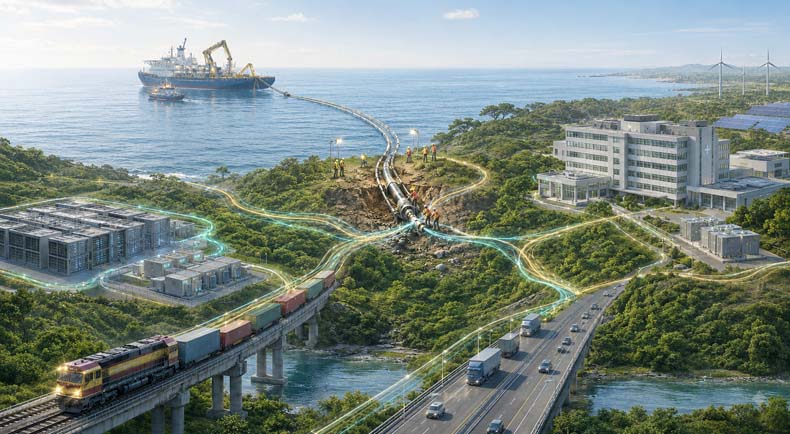
Take the internet. We speak casually of wireless connectivity and the cloud, creating an impression of information moving almost magically around the world. Much of it actually travels through fibre-optic cables laid across the ocean floor. Almost all international digital traffic passes through these submarine cables before coming ashore at landing stations.
That immediately made me look at the Indian Ocean differently. I have traditionally viewed it in terms of sea lanes, naval presence, ports, islands, energy flows and maritime chokepoints. Add submarine cables and another strategic layer appears on the same map. The Red Sea, Malacca and the approaches to the Persian Gulf are important for ships and energy; they are also crucial corridors for data.
Then there are data centres. The “cloud” ultimately has to live somewhere. Government records, financial systems, commercial information and an increasing share of our everyday digital activity reside in very physical facilities requiring communications, cooling and enormous quantities of electricity.
Electricity brings us to perhaps the most fundamental dependency. Lose power for a short period and inconvenience follows. Lose it extensively and for long enough and the consequences begin travelling elsewhere: communications, banking, hospitals, water supply, transport and administration.
The list keeps expanding. Ports and airports depend heavily upon digital systems. Railways rely upon networked signalling and communications. Logistics networks use software to move goods across enormous distances. Banking and payments have become deeply digital. Telecommunications hold much of it together. We have created remarkable capability. We have also created dependence.
When Systems Meet
It was at this point that my experience with disaster management began influencing the way I looked at the subject.
In disaster management, the initial event tells only part of the story. What follows can sometimes prove more difficult. A major flood can take out electricity. Communications then suffer. Roads become unusable. Supply chains are interrupted. Hospitals face pressure. Administration itself has to function with degraded systems. Each problem begins affecting another. The same logic can apply to technological infrastructure.
Imagine a serious power disruption affecting a large area. Telecommunications have backup arrangements, as do data centres and hospitals, but these too have endurance limits. Banking and digital payments could begin experiencing difficulty. Fuel distribution may be affected. Transport systems start operating under constraints. Government agencies are simultaneously attempting to manage the disruption while depending upon some of the very systems under stress.
The interesting issue here is the cause. It could be extreme weather, an earthquake, technical failure, sabotage, cyberattack or conflict. Each would require a different response at the point of origin. Yet many of the secondary consequences could look surprisingly similar.
Cyber adds another dimension because virtually every major infrastructure system is becoming networked. Power grids, ports, telecommunications, banking, transportation and even satellite systems rely increasingly upon software and digital control. Connectivity gives them extraordinary efficiency and reach. It also allows disruption to travel in ways that were difficult to imagine when these systems operated largely in isolation.
This is where the subject begins to enter the wider realm of national security.
A Soldier Looks at Another Map
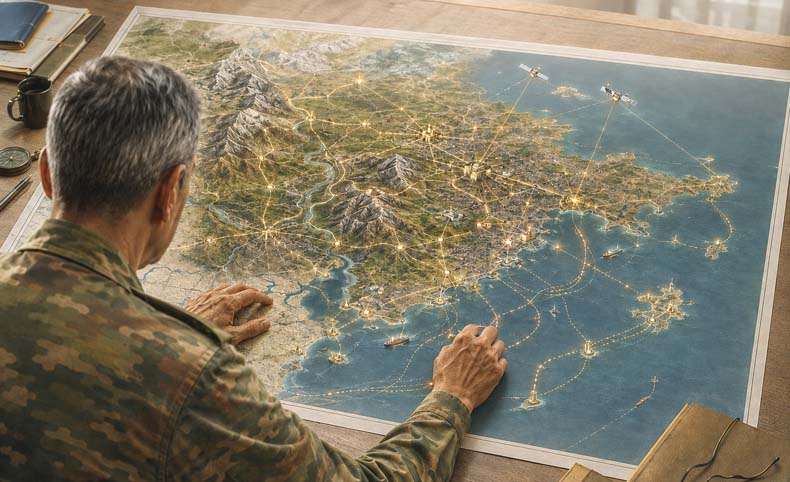
As a soldier, I was trained to read maps differently. Terrain was never simply mountains, rivers and roads. We looked for approaches, obstacles, communication arteries, bridges, passes, dominating ground and places whose loss could disproportionately affect an operation. Perhaps we now need to read another kind of map alongside the traditional one.
Where do the major submarine cables come ashore? Where is data concentrated? Which nodes are especially important to the electricity grid? Where do telecommunications networks converge? Which ports, railway junctions, fuel terminals and logistics hubs carry responsibilities far greater than their physical size would suggest?
I am not suggesting that every such location becomes a military objective or that we should begin viewing ordinary infrastructure through an alarmist security lens. The point is simpler. A highly networked country develops concentrations whose functioning becomes important to the larger system.
It also raises questions that security practitioners instinctively ask. How much redundancy exists? What happens when two systems fail together? How rapidly can damaged infrastructure be repaired? Are essential spares and technical expertise available within the country? Have agencies practised functioning for prolonged periods with communications or electricity severely degraded? Do we sufficiently understand the dependencies between systems?
These are uncomfortable questions, but asking them is part of preparedness.
Resilience Is the Key
Absolute protection is impossible. Vast networks of cables, power lines, pipelines, communications and transportation cannot be secured against every natural, technological or deliberate disruption. Resilience therefore demands alternatives and the capacity for rapid recovery.
A damaged cable needs another route for traffic; critical data must remain accessible if a centre fails; logistics require alternative arteries; and backup power must last long enough to matter. Equally important are trained manpower, spares and repair capacity available at short notice. Redundancy may appear an expensive luxury in normal times. Military logistics and disaster response repeatedly demonstrate its value when primary systems fail.
Ukraine has provided a contemporary reminder. Repeated attacks on energy, communications and logistics have made restoration almost as important as protection. The capacity to absorb damage, improvise and rapidly restore essential services has contributed directly to national endurance. That principle applies equally to major disasters and technological failures in peacetime.
Towards Comprehensive Security
My enquiry began with space and General Pannu’s book. It led beneath the oceans, into data centres and power grids, through communications and logistics networks, and eventually to resilience—a concept equally familiar to soldiers and disaster managers.
It also widened my understanding of national security. Territorial integrity and defence remain fundamental, but modern societies also depend upon the continuity of electricity, communications, banking, transportation, healthcare and essential supplies. Serious disruption of these can test the state and society without a conventional conflict ever occurring.
Comprehensive security must therefore embrace preparedness for war, cyber threats, technological failure and major natural disasters. We have long developed confidence in restoring damaged roads, railway lines, bridges and airfields. Engineers know what has to be done, resources can be mobilised and procedures have been practised. Can we claim the same confidence about disrupted submarine cables, data centres, satellite links, digital networks or interconnected power and communication systems? Do we possess the redundancy, repair capability, trained manpower and institutional coordination to restore them at comparable speed?
That perhaps is the question this journey of discovery ultimately leaves us with. The twenty-first century has created an unseen architecture supporting national life. If part of it suddenly stops working, how confident are we that we can restore it before disruption begins travelling through the rest of the system?
ABOUT THE AUTHOR
 The writer is the Governor of Bihar and the former Commander of the Srinagar-based Chinar Corps. Views expressed in the above piece are personal and solely those of the author. This article first appeared in Firstpost. Reproduced here with permission of the author