
“Made in India” has become an important marker of India’s growing defence-industrial capability. The transformation is real. India now manufactures major weapon systems, builds increasingly sophisticated supply chains and has moved from being predominantly a buyer to becoming a manufacturer, integrator and, increasingly, a technology partner.
Yet a more difficult question is emerging: what should “Made in India” actually signify in defence?
A system assembled in India, one substantially manufactured in India, and one whose critical technologies are designed and reside in India may all carry the same label. Yet they represent very different levels of self-reliance.
The issue is not whether foreign technology is involved. In a globally interconnected defence industry, it inevitably will be. The more important question is what capability India acquires through that relationship.
“Self-reliant defence is feasible only if the nation anticipates the threat well in time and is prepared to meet it in terms of personnel, their training and equipment.”
— K. Subrahmanyam
Beyond the Percentage
Indigenous content remains a useful measure of industrial participation. It encourages local manufacturing, creates supply chains and generates employment. But a percentage alone cannot reveal where the most consequential technologies reside.
A platform may be largely manufactured in India while its engine, seeker, processor, radar, electronic warfare system or software remains dependent on an overseas source. Conversely, a system incorporating foreign-origin technology can create considerable Indian capability if local industry participates deeply in engineering, integration, adaptation, manufacture and sustainment.
The more meaningful questions are therefore: Who designed the critical technology? Who understands it? Who can modify it? Who can sustain it during a prolonged conflict? And who can develop the next generation?
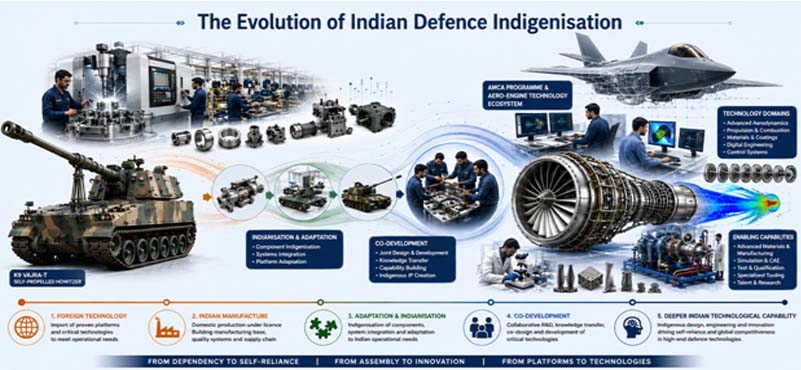
Indigenisation is therefore better viewed not as a binary condition, but as a progression:
Assembly → Manufacture → Adaptation → Co-development → Indigenous evolution.
The objective is not complete self-sufficiency. No major military power produces every component of every system domestically. The objective is strategic autonomy in technologies critical to military effectiveness and freedom of action.
From Production to Capability
Technological capability is acquired through design, experimentation and repeated iteration. Licensed production can build valuable manufacturing competence, establish tooling and quality systems, strengthen supply chains and develop maintenance skills. But deeper capability emerges when Indian engineers participate in systems engineering, testing, modification and development.
This is increasingly important as warfare becomes more technology-intensive. Sensors, processors, software, communications, propulsion, seekers, electronic warfare and advanced materials increasingly determine the performance of military platforms.
Indigenisation must therefore move progressively up the technology ladder—from making components to understanding and creating the technologies that make the system effective.
“Technology consists of stages like research and development, technology transfer, technology absorption and production of products or systems with the desired performance, quality, and cost-effectiveness.”
Dr.A.P.J. Abdul Kalam
K9 VAJRA-T: A Partnership That Has Evolved
The K9 VAJRA-T Gun System provides a useful example of how foreign technology can become a platform for building Indian industrial capability. Based on South Korea’s K9 Thunder, the Indian variant was produced through the L&T–Hanwha partnership and adapted to Indian requirements, including operations across deserts, plains and high-altitude regions. The original programme envisaged 100 guns; a further 100 were contracted by the Ministry of Defence in December 2024 under the Buy (Indian) category.
The programme’s significance goes beyond the number of guns manufactured in India. It has built capability in manufacturing, systems integration, maintenance, supply-chain development and adaptation to Indian operational requirements.
The lesson is not that the K9 became indigenous overnight. It is that a foreign-origin platform can progressively become an instrument for building Indian capability.
Co-Development: The Next Step
The more ambitious opportunity is co-development.
On 14 August 2026, Reliance Industries and Rolls-Royce announced their strategic intent to partner on the design, development, manufacture and delivery of an indigenous combat engine for the AMCA programme. They also proposed exploring an Aerospace Gas Turbine Complex in India covering capabilities across design, development, manufacturing, testing, production and through-life support.
This is significant because an aero-engine represents one of the most demanding areas of aerospace technology, drawing upon advanced metallurgy, materials science, thermodynamics, precision manufacturing, controls and systems engineering.
The proposal should not, however, be mistaken for an already concluded engine contract or as proof that India will automatically acquire complete ownership of every underlying technology. Those outcomes will depend on the eventual programme structure and agreements.
Its significance lies elsewhere: it points towards a model in which foreign expertise can be used to create deeper Indian technological capability rather than simply Indian manufacturing capacity.
That is the direction in which co-development should take Indian indigenisation.
The Digital and Technological Core
The distinction becomes even sharper in software-defined warfare.
A modern fighter, missile, air-defence system, unmanned platform or artillery system is increasingly a network of sensors, processors, communications and software wrapped around a physical platform.
Dependence on proprietary foreign architectures can affect India’s ability to modify, integrate or upgrade a system. The answer is not to insist that every line of code or every component must be indigenous. Rather, India should identify the technologies that are operationally critical and ensure that it possesses sufficient knowledge, access and control over them.
This is where intellectual property matters. But IP ownership should not become the sole measure of self-reliance. The ultimate question is much broader:
Can India understand, sustain, modify and evolve the capability?
The Wartime Test
The real test of indigenisation comes when a system is subjected to prolonged operational pressure. A military capability must not only be available for induction, it must be repairable, replenishable, upgradeable and scalable.
Can critical spares be produced? Can ammunition output be expanded? Can damaged components be repaired locally in an acceptable timeframe? Can software and electronics be modified? Can production be accelerated when demand suddenly rises? These are questions of industrial resilience.
Tejas offers a useful reminder of the distinction. The LCA Mk1A is an indigenously designed and developed fighter, with indigenous content of over 64 per cent specified for the 97-aircraft programme. Yet its GE F404 engine remains externally sourced. This does not diminish the achievement represented by Tejas. Rather, it illustrates how a highly indigenous system can still retain dependence on a technologically critical component. The strategic question is therefore not simply the percentage of indigenous content, but the criticality of what remains externally dependent.
Self-Reliance Is Not Self-Sufficiency
India should not seek technological isolation. BrahMos illustrates why. The India–Russia joint venture was established to jointly design, develop, produce and market the missile system. Russian expertise contributed critical propulsion technology, while Indian organisations developed and integrated capabilities across guidance, navigation, electronics, software and other systems. Over time, the programme evolved beyond the traditional buyer-seller model towards joint development and production.
The lesson is not that foreign technology compromises self-reliance. Properly structured, international collaboration can accelerate it by allowing India to absorb technology, develop engineering competence and build an industrial ecosystem around it. The objective should therefore be to make collaboration a pathway to capability.
Licensed production can establish manufacturing competence. Co-production can deepen supply chains. Adaptation can develop Indian engineering knowledge. Co-development can create joint design and development capability. Indigenous evolution is the point at which that accumulated knowledge begins generating technologies of India’s own.
The measure of a partnership should therefore not be simply how many systems are produced in India, but what capability remains in India when the partnership matures.
The Next Meaning of “Made in India”
India has already travelled a considerable distance in defence indigenisation. The next stage is not about withdrawing from global technology networks or manufacturing every component at home. It is about ensuring that foreign collaboration, wherever necessary, progressively builds Indian technological depth.
From assembly to design.
From local content to critical technology.
From production to technology absorption.
From platform ownership to freedom to evolve.
The real measure of “Made in India” should therefore be more demanding than the location of manufacture. It should reflect the knowledge, engineering capability and industrial resilience that remain within the country—and India’s ability to sustain, modify and improve the system when circumstances demand it. Ultimately, self-reliance is not the absence of foreign technology. It is the absence of strategic helplessness. That should be the next meaning of “Made in India.”
ABOUT THE AUTHOR
 Lt Gen Tarun Chawla, was commissioned into the Regiment of Artillery in Jun 1984. He has served with the United Nations Mission in Liberia and has been an instructor at the College of Defence Management at Secunderabad. The officer has commanded an Artillery Brigade in the LC Sector in J&K, and an Artillery Division as part of Army’s Western Command. He was the Director General Financial Planning, prior to assuming the role of Director General of Artillery.