
The Ribbon and the Ruins
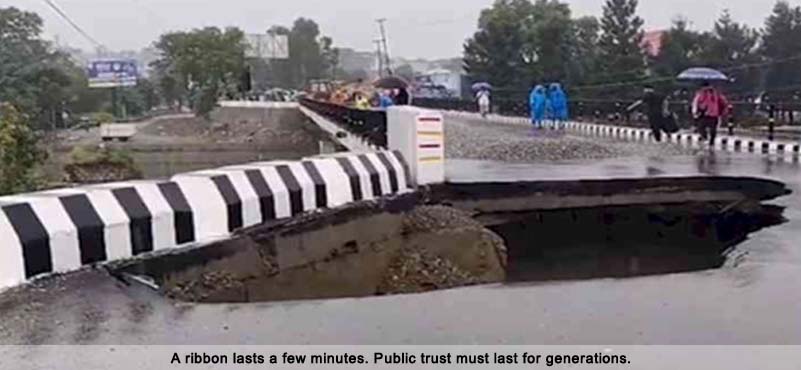
Barely sixteen days after its inauguration, a newly constructed bridge in Dehradun reportedly suffered a massive structural failure making it out of use for months till the repair work gets completed. Whether subsequent investigations attribute it to design flaws, construction deficiencies, supervision lapses or any other specific cause, the incident should serve as far more than another passing news headline. It should compel us to ask a far more uncomfortable question: Are we building infrastructure for inauguration or for generations?
India has every reason to take pride in the scale and speed of its infrastructure transformation. Highways, bridges, tunnels, airports and rail corridors are reshaping the country’s economic landscape. Yet every time a newly inaugurated road develops potholes within weeks, a flyover requires major repairs soon after commissioning, or a bridge fails immediately within days of cutting inaugural ribbon, the celebration of construction gives way to the burden of reconstruction.
The tragedy is not merely that failures occur. The greater tragedy is that such failures no longer surprise us.
The Hidden Cost of Premature Failure
A failed bridge is never just an engineering failure. It is an economic failure, an administrative failure and, ultimately, a failure of public trust.
The taxpayer pays for the same asset repeatedly. First, through the original construction cost. Then through emergency repairs or reconstruction. Thereafter through arbitration, litigation and contractual disputes. Reports indicate that claims running into over ₹1.2 lakh crore are under arbitration involving NHAI projects alone, illustrating how infrastructure disputes can lock up enormous public resources. Beyond these visible costs lies a much larger invisible bill paid every day by ordinary citizens.
Every pothole increases fuel consumption. Every diversion wastes productive hours. Every traffic jam raises logistics costs. Every damaged road accelerates wear and tear of private vehicles. Every delayed journey adds stress, pollution, road rage and lost economic output. Businesses pay more to transport goods, commuters leave home earlier than necessary, ambulances lose precious minutes, and the nation’s productivity quietly bleeds away.
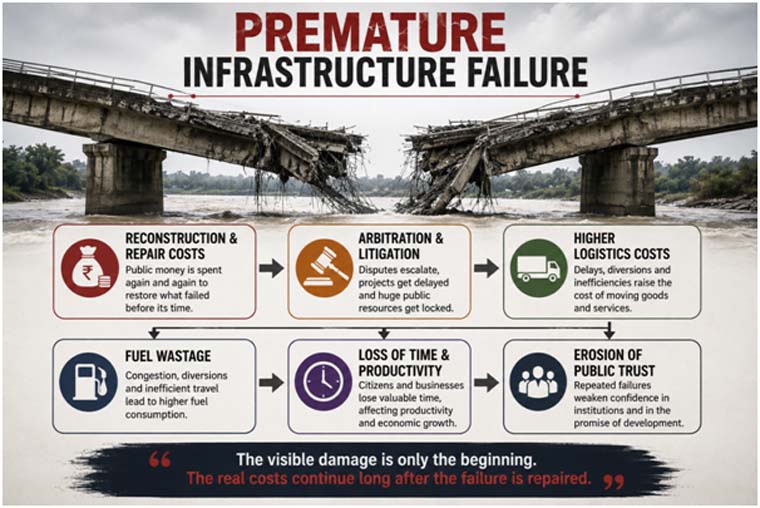
This is a hidden tax that no Parliament has approved and no citizen has willingly accepted. It is collected every day through delays, inefficiencies and avoidable infrastructure failures.
From Deficit to Durability
Every era presents a different infrastructure challenge. The true measure of national progress lies not merely in recognising these changing challenges but in adapting policies to meet them. India’s infrastructure journey can be understood in three distinct phases.
- 1999–2013: Bridging the Infrastructure Deficit. Inadequate highways, congested ports, limited airports, poor logistics and weak connectivity impose a heavy cost on economic growth. The national priority during this period was understandably to build more roads, bridges, power plants and transport networks. The challenge was one of quantity. Beginning with projects like Golden Quadrilateral and PMGSY (Pradhan Mantri Gram Sadak Yojana) in 1999 and 2000 respectively, every new project narrowed the infrastructure gap and expanded economic opportunities.
- 2014–2026: Building at Unprecedented Scale. The last decade witnessed an unprecedented acceleration in infrastructure creation. Highways, expressways, tunnels, railway corridors, airports and strategic border roads have expanded at a pace rarely seen before. India demonstrated that it possesses the financial capacity, engineering capability and administrative resolve to execute projects on a national scale. The emphasis rightly shifted from planning to execution and from incremental progress to transformational expansion. The country can legitimately take pride in this achievement.
- 2027–2047: The Era of Durability. As India marches towards the centenary of Independence, the national challenge must evolve once again. The question is no longer whether India can build faster; it has already demonstrated that capability. The defining challenge of the next two decades is whether India can build infrastructure that consistently delivers its full design life with minimal maintenance, maximum safety and optimum lifecycle cost.
This is the era of durability. The success of India’s next infrastructure revolution will be measured not merely in kilometres constructed but in decades of dependable service.
Rebuilding Trust: The Durability Dividend
If premature failure has become the problem, durability must become the national mission.
India’s next infrastructure revolution cannot be measured merely in kilometres constructed or projects inaugurated. It must be measured by the reliability, safety and longevity of public assets. Every additional year that a road, bridge or tunnel serves beyond its expected life generates a Durability Dividend—lower maintenance costs, higher productivity, greater public confidence and better returns on taxpayers’ money.
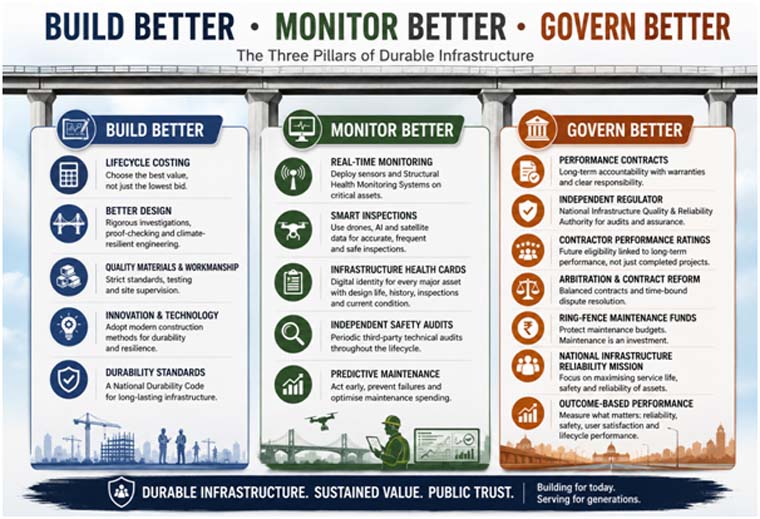
Achieving this transformation requires reforms in three critical domains.
- Build Better. Durability begins long before construction starts. It begins with sound planning, uncompromising engineering standards and selecting quality over short-term savings. The following reforms deserve priority:
- Adopt lifecycle costing instead of the lowest bid (L1) as the primary criterion for awarding major projects. The cheapest project often proves to be the costliest over its lifetime.
- Strengthen design quality through independent proof-checking, rigorous geotechnical investigations, climate-resilient engineering and realistic traffic projections before construction begins.
- Ensure uncompromising quality of materials and workmanship by enforcing strict testing protocols, modern construction practices and robust site supervision.
- Promote innovation and modern construction technologies that improve durability, reduce maintenance requirements and enhance resilience against extreme weather events.
- Develop a National Durability Code prescribing minimum lifecycle performance standards for roads, bridges and other critical public infrastructure across the country.
- Monitor Better. Infrastructure should never wait for visible deterioration before receiving attention. Modern technology now makes continuous monitoring both practical and economical. India should therefore:
- Deploy Structural Health Monitoring Systems on major bridges, tunnels and critical infrastructure to detect stress, vibration and deterioration in real time.
- Leverage drones, Artificial Intelligence, satellite imagery and Digital Twin technology for periodic inspection, predictive maintenance and early warning of structural distress.
- Introduce Infrastructure Health Cards for all major public assets containing information on design life, inspection history, maintenance records and current structural condition.
- Institutionalise periodic independent technical safety audits throughout the lifecycle of every major asset rather than limiting inspections to the construction phase.
- Shift from reactive maintenance to predictive maintenance, recognising that timely intervention costs only a fraction of reconstruction after failure.
- Govern Better. Engineering excellence alone cannot guarantee durable infrastructure. Sustainable outcomes require equally strong governance, accountability and institutional reforms. Key governance initiatives include:
- Introduce long-term performance-based contracts with meaningful warranties and clearly defined accountability for premature failures.
- Create an Independent National Infrastructure Quality and Reliability Authority to undertake third-party quality assurance, technical audits and post-construction performance evaluations.
- Develop a National Contractor Performance Rating System, where future eligibility depends not merely on projects completed but on how those projects perform over time.
- Reform arbitration and contract management through balanced contracts and time-bound dispute resolution to reduce the enormous financial burden of prolonged litigation.
- Ring-fence maintenance budgets, recognising maintenance as an investment that protects national assets rather than an expenditure that can be postponed.
- Launch a National Infrastructure Reliability Mission dedicated to maximising the service life, safety and performance of existing public assets through technology-driven asset management.
- Measure success through outcomes rather than outputs. Governments should evaluate infrastructure by travel time saved, logistics costs reduced, accident reduction, asset reliability, lifecycle performance and citizen satisfaction—not merely by kilometres constructed or projects inaugurated.
Infrastructure is far more than concrete, steel and asphalt. It is public trust cast into physical form. Every durable bridge strengthens that trust. Every premature failure weakens it.
The true success of infrastructure is not reflected in the applause on inauguration day, but in the quiet confidence of millions who continue to use it safely for decades thereafter.
Beyond the Ribbon
The Dehradun bridge should not become just another headline that fades from public memory after a few days of debate. It should become the catalyst for a national shift in thinking. India has already demonstrated that it can build infrastructure at remarkable speed. The next challenge is to ensure that every road, bridge, tunnel and public building endures through its full design life and continues to serve future generations with the same confidence with which it was inaugurated.
The ribbon lasts only a few minutes. The asset must serve for decades.
Governments are ultimately remembered not for the ceremonies they conduct but for the institutions they strengthen and the infrastructure they leave behind. As India advances towards Viksit Bharat 2047, the benchmark of success must evolve from kilometres built to decades served. That is the true Durability Dividend. It will reduce the hidden Tax borne by citizens, protect every rupee contributed by taxpayers and ensure that public infrastructure remains a lasting symbol of national capability rather than a recurring reminder of avoidable failure.
Only then will we truly build infrastructure for generations—not merely for inauguration.
ABOUT THE AUTHOR

Lt Gen Rajeev Chaudhry (Retd) is a social observer and writes on contemporary national and international issues, strategic implications of infrastructure development towards national power, geo-moral dimension of international relations and leadership nuances in changing social construct.