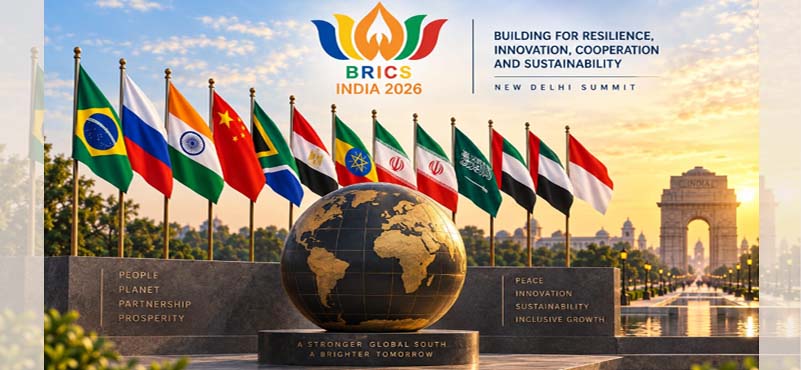
There was a time when BRICS was discussed largely as an idea, a grouping of large emerging economies − Brazil, Russia, India, China, and South Africa, seeking a greater voice in a world whose institutions were still overwhelmingly shaped by the industrialised West. The significance of the 2026 New Delhi Declaration lies precisely in its relative lack of drama: beneath the rhetoric surrounding the expanded eleven-member BRICS, it points towards a more pragmatic and operational approach to economic cooperation. It does not announce a new global currency, a new financial system or an alternative to the existing international order. Instead, it sets out an extensive agenda for making the economies of the Global South more resilient, better connected and less vulnerable to disruptions in trade, finance, technology and supply chains.
The theme of India’s 2026 BRICS Chairship: “Building for Resilience, Innovation, Cooperation and Sustainability”, captures this transition remarkably well. The central question, therefore, is not whether BRICS will replace the existing global economic order. It is whether it can build enough practical economic capacity to give its members, and other developing economies, greater room for manoeuvre within an increasingly uncertain global system.
A much larger economic platform
The expanded BRICS is already a major component of the world economy. Official BRICS data put the grouping’s share at around 48.5 per cent of world population, about 39 per cent of global GDP at purchasing-power parity and 24 per cent of global trade.
These numbers give BRICS considerable weight. But size by itself does not create economic power. The more difficult task is converting aggregate size into effective economic cooperation. That is where the New Delhi Declaration is potentially significant.
The Declaration covers an unusually broad range of economic issues: trade and global value chains, MSMEs, cross-border payments, development finance, energy, critical minerals, food security, digital public infrastructure, artificial intelligence, climate finance, transport and global economic governance. The BRICS Growth and Development Task Force created during India’s Chairship has also been designed to examine growth models suited to different national circumstances, with work spanning resilience, innovation, cooperation and sustainability.
This suggests that BRICS is gradually evolving from a political consultation mechanism into a more practical economic platform. The challenge will be implementation.
Trade: the biggest opportunity may be closer to home
Perhaps the clearest economic opportunity is trade. Intra-BRICS merchandise trade has expanded dramatically—from about US$84 billion in 2003 to US$1.17 trillion in 2024. Yet even this impressive increase represents only around 5 per cent of global trade. That combination tells an interesting story. BRICS trade has grown rapidly, but the potential for further integration remains considerable.
The New Delhi Declaration therefore places considerable emphasis on global value chains. It calls for resilient and inclusive GVCs and specifically seeks greater participation by emerging and developing economies in higher-value segments of manufacturing and production. It highlights trade facilitation, industrial capacity, connectivity, technology transfer and digitalisation of supply chains. It also endorses the further development of the BRICS GVC Action Plan 2026–2030. This is more important than it may initially appear.
The next phase of globalisation is unlikely to be simply about producing more goods at lower cost. It will be about controlling more of the value chain—from raw materials and processing to components, manufacturing, technology and design.
For India, this creates a particularly important opportunity. BRICS can become a platform for diversifying India’s export markets, attracting investment into manufacturing and connecting Indian enterprises with new production networks. But that will require competitive logistics, standards, technology, skills and reliable infrastructure.
The MSME test
The real test of whether BRICS trade cooperation becomes inclusive will be whether smaller enterprises benefit. The Declaration explicitly recognises that affordable finance remains a structural constraint on MSMEs’ participation in trade and global value chains. It supports a credit-assessment framework for export-oriented MSMEs, innovative digital financing mechanisms and an invoice-discounting mechanism intended to unlock working capital. This is an area where economic cooperation can become tangible.
A multinational corporation can generally find international finance. A small manufacturer trying to fulfil an export order may struggle to finance inventory, insure a shipment or obtain working capital against an invoice.
If BRICS can reduce these frictions through digital platforms, credit guarantees, interoperable systems and better access to trade finance, it will be doing something considerably more useful than simply announcing higher trade targets.
The currency debate needs to be reframed
Few BRICS issues have attracted as much attention as de-dollarisation. But the New Delhi Declaration points towards a much more pragmatic approach. The BRICS Payment Task Force is examining the interoperability of payment and messaging channels and the use of local currencies for trade settlements and investment. Crucially, the Declaration acknowledges that there is “no one-size-fits-all approach” and focuses on making cross-border payments faster, cheaper, more accessible, efficient, transparent and safe. This is a very different proposition from creating a common BRICS currency.
A common currency would require an extraordinary degree of monetary, fiscal and institutional integration among economies with very different inflation rates, exchange-rate regimes, financial systems and policy priorities. It is neither necessary nor realistic in the foreseeable future. Interoperability is much more achievable.
The objective is essentially to make it easier for an Indian exporter, for example, to receive payment from a BRICS trading partner without every transaction having to depend upon the same conventional financial pathways. Local-currency settlement, where commercially viable, can reduce transaction costs and some forms of external vulnerability. This is not the end of the dollar. Nor does it need to be. It is the construction of additional channels.
Development finance could be the real game-changer
If currency politics has attracted the headlines, development finance may prove to be more consequential. The New Development Bank already provides BRICS with an institution through which infrastructure and sustainable-development projects can be financed. The New Delhi Declaration also advances the idea of BRICS Multilateral Guarantees, which could improve project creditworthiness, reduce financing costs and mobilise private capital for projects in BRICS and the wider Global South. This is precisely where the distinction between money and finance becomes important.
Developing countries do not necessarily suffer from a shortage of investment ideas. They often suffer from a shortage of bankable projects. A transport corridor may be economically valuable but too risky for private capital. A climate-resilient urban project may generate substantial social benefits but insufficient conventional returns. A new manufacturing facility may be commercially viable but unable to obtain affordable long-term finance.
Guarantees can change that equation. The combination of NDB financing, risk-sharing instruments and the BRICS Contingent Reserve Arrangement could gradually create a more comprehensive economic resilience architecture—one dealing not only with long-term development but also with financial shocks. The Declaration explicitly seeks to make the CRA more flexible and responsive as a BRICS financial safety net. That may ultimately be more valuable than the politics of announcing a new currency.
Energy and critical minerals: where economics meets strategy
Energy security is another area where the interests of BRICS members converge. The Declaration recognises that fossil fuels will continue to play an important role, particularly for emerging and developing economies, while simultaneously supporting a just, orderly and equitable energy transition. It also calls for cooperation across renewable energy, nuclear power, hydrogen, storage and smart grids. This reflects economic reality.
The energy transition cannot be identical everywhere. Countries differ enormously in their energy mix, income levels, resource endowments and development priorities. A credible transition must therefore combine decarbonisation with energy security and affordability.
Critical minerals sit at the centre of this equation. Lithium, cobalt, nickel, rare earths and other minerals are becoming strategically important because they underpin batteries, electric vehicles, renewable-energy technologies and advanced manufacturing. The Declaration calls for diversified and resilient critical-mineral supply chains, with greater value addition and economic diversification in resource-rich countries. This offers BRICS an opportunity to connect resource endowments with processing, manufacturing and technology. The real prize is not simply trading minerals. It is building value chains around them.
Climate cannot remain separate from development
Climate policy is often presented as a choice between development and decarbonisation. For much of the Global South, that is a false choice. The greater challenge is to finance both. The New Delhi Declaration recognises that emerging and developing economies face disproportionate climate risks and substantial funding gaps, particularly for adaptation. It calls attention to making climate projects more bankable and to the role of financial institutions in expanding sustainable and green finance. This is an important shift in emphasis.
Adaptation is not an abstract environmental objective. It is investment in roads that can withstand extreme weather, cities that can cope with heat and flooding, agricultural systems that can manage water stress, and financial systems capable of absorbing climate-related shocks. BRICS cooperation can therefore be especially valuable if it helps turn climate needs into investible projects.
Technology may become BRICS’ most distinctive opportunity
The digital economy offers perhaps the most interesting area for India. The New Delhi Declaration places AI, Industry 4.0, digital transformation and digital public infrastructure within the broader BRICS economic agenda. The Growth and Development Task Force has also examined the macroeconomic and financial implications of digital transformation and AI.
India brings a particularly relevant experience through its digital public infrastructure ecosystem. The opportunity is not to export one country’s digital system wholesale. It is to share principles, architectures, standards and lessons that can be adapted to different national contexts. For developing countries, this could have profound implications. Digital systems can lower the cost of financial inclusion, public-service delivery, payments and entrepreneurship. AI can raise productivity, but it can also widen technological inequalities if access remains concentrated. A BRICS approach centred on affordable access, interoperability, skills and responsible innovation could therefore become a genuine Global South contribution to the next phase of digitalisation.
BRICS is not a replacement for the world order
Perhaps the most important message of the New Delhi Declaration is what it does not seek to do. BRICS continues to support the WTO and calls for reform of global economic governance. The Declaration also recognises the G20 as the premier forum for international economic cooperation. This matters because BRICS’ greatest strategic value may lie not in creating a parallel world economy, but in giving its members additional bargaining power within the existing one.
The world is not moving towards complete deglobalisation. Nor is it returning to the frictionless globalisation of the early 2000s. Instead, we are moving towards diversified interdependence. Countries want multiple suppliers, multiple markets, multiple payment channels, multiple sources of technology and multiple financial partners. BRICS fits naturally into this emerging architecture.
The India opportunity, and the China constraint
For India, BRICS offers a significant strategic and economic opportunity. It provides access to large markets, a platform for South-South cooperation, opportunities for technology and development-finance partnerships, and a stronger voice in debates over global economic governance.
But there is also an unavoidable constraint: China. China’s economic weight within BRICS is enormous. India and China are simultaneously economic partners, strategic competitors and neighbours with unresolved geopolitical tensions. The answer cannot be to pretend these differences do not exist. Nor should BRICS be reduced to an instrument of rivalry.
Its practical agenda should instead focus on areas where cooperation produces mutual economic benefit—trade facilitation, payments, infrastructure, climate, energy, technology, food security and development finance—while allowing members to maintain their independent strategic choices. That may be the only sustainable basis for BRICS.
From declarations to delivery
And this is where the real test begins. The New Delhi Declaration contains a formidable list of initiatives, but BRICS has never suffered from a shortage of communiqués. Its credibility will ultimately depend on whether these commitments translate into functioning systems, completed projects and measurable outcomes. Can intra-BRICS trade become easier? Can an Indian MSME obtain trade finance more cheaply? Can cross-border payments become faster? Can the New Development Bank mobilise significantly more private capital? Can critical-mineral cooperation move beyond extraction towards processing and manufacturing? Can BRICS help make climate-adaptation projects bankable? And can digital public infrastructure be successfully adapted across developing economies? These are the questions that will determine the relevance and influence of BRICS over the next decade.
The New Delhi Declaration therefore represents less a finished architecture than a blueprint. Its significance lies in recognising that resilience is itself an economic asset. In a world of tariffs, wars, sanctions, disrupted supply chains, technological competition, climate shocks and financial volatility, countries need not choose between globalisation and self-reliance.
They can build resilience through diversified interdependence. That may ultimately be the most realistic, and most consequential vision of BRICS at 20. The bloc does not need to replace the global economic order to change it. If it can build credible institutions, practical payment systems, deeper trade networks, development-finance mechanisms and technology partnerships, it can add a new layer to that order. For India, that is perhaps the most important opportunity of all: not to retreat from the world economy, but to help shape a more plural, resilient and representative one.
ABOUT THE AUTHOR
 Dr Debesh Roy is the Founder-Chairman of the Institute for Pioneering Insightful Research Pvt. Ltd. (InsPIRE), Greater Noida, an independent research and consulting firm (website: https://inspire-solutions.in/). He has over three-and-a-half decades of professional experience, including 32 years at NABARD. Dr Roy holds a PhD in economics, and has extensive experience in macroeconomic policy, international trade, agriculture & agri-business, rural infrastructure, financial inclusion, climate policy and sustainability. (Email ID: debeshroy_chairman@inspire-solutions.in )