
The Impossible Choice
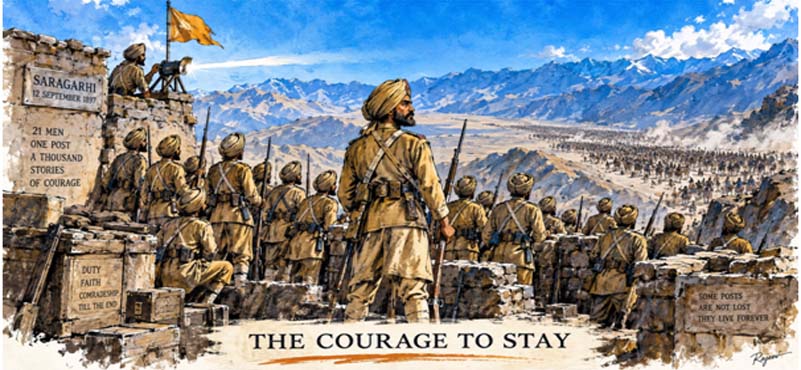
On 12 September 1897, twenty-one soldiers stood inside a small frontier post at Saragarhi and watched thousands of tribesmen gather on the surrounding hills. They knew what was coming. They also knew something more important: there would be no easy escape. Saragarhi was a communication post between Fort Lockhart and Fort Gulistan in the remote North-West Frontier, and its defenders were a small detachment of the 36th Sikh Regiment under Havildar Ishar Singh. Their orders were simple: hold the post and maintain communication. What followed would become one of the most extraordinary last stands in military history.
There was no illusion about the odds. The attackers vastly outnumbered them, and the isolated post could not realistically expect reinforcement in time. Yet the men did not abandon their position. They did not scatter into the hills. Instead, they prepared to defend it. As the battle began, Saragarhi became more than a military outpost. It became a test of what human beings are capable of doing when duty becomes stronger than fear.
When the Battle Began
The first attacks were met with disciplined fire. From Fort Lockhart, Lieutenant Colonel John Haughton received reports through the heliograph as the situation deteriorated. Saragarhi’s signaller, Sepoy Gurmukh Singh, continued transmitting messages, allowing the outside world to follow the battle almost as it happened. The attackers repeatedly attempted to overwhelm the small garrison, but the defenders held their ground.
The contest was brutally unequal, yet the twenty-one fought with remarkable determination. Their ammunition, numbers and options were steadily diminishing, while the pressure outside the walls increased. Eventually, the attackers succeeded in breaching the defensive perimeter. Even then, the defenders continued fighting from within the post.
The final phase became hand-to-hand combat. Havildar Ishar Singh and his men fought until the position was overrun and every defender was killed. Gurmukh Singh, who had been communicating the battle, is remembered as continuing to fight even after the post had been breached. By the end, Saragarhi had fallen, but the men defending it had accomplished something larger than survival. They had held long enough to give the nearby forts precious time to prepare themselves against the advancing force.
The defenders were posthumously awarded the Indian Order of Merit, then the highest gallantry award available to Indian soldiers. Their courage was recognised not because they had survived, but because they had refused to surrender when survival itself had become almost impossible.
Why Didn’t They Run?
That is the question Saragarhi leaves behind.
Military history can explain the terrain, the weapons, the numbers, the tactics and the communications. It can describe the sequence of attacks and calculate the tactical significance of the delay. But none of these fully explains the human decision at the heart of Saragarhi: why did twenty-one men stay when they knew they were likely to die?
The answer lies somewhere beyond orders. Soldiers obey orders every day, but there are moments when duty ceases to be something written on paper and becomes something carried within the character. At Saragarhi, each man understood that his decision affected the man beside him, the soldiers in the neighbouring forts and the mission entrusted to the entire unit. To leave was not merely to save oneself. It was to abandon others who were depending upon the post being held.
That is why Saragarhi is ultimately not a story about numbers. It is a story about relationships. Twenty-one men stood because each knew that twenty others were standing with him.
The Leadership of Ishar Singh
At the centre of that extraordinary resistance stood Havildar Ishar Singh. Leadership is often described in terms of rank, authority and decision-making, but battle strips leadership down to something much simpler: people watch what their leader does when fear arrives.
A commander can order courage, but he cannot manufacture it. He can only demonstrate it, share the danger and give his men a reason to believe that their sacrifice has meaning. Ishar Singh did not possess the luxury of promising victory. What he could offer was his presence. He would remain with them.
That is the essence of leadership. A leader does not necessarily make the danger disappear. Sometimes he simply ensures that nobody faces it alone.
The Man Behind the Heliograph
Then there was Sepoy Gurmukh Singh, the signaller whose messages carried the story of Saragarhi beyond the walls. His role gives the battle an extraordinary human dimension. While bullets were flying and the defensive position was shrinking, communication continued. Somewhere beyond the immediate violence, men knew that Saragarhi was still fighting.
There is something deeply moving about that image: a soldier transmitting the progress of a battle even while participating in it. His instrument was a heliograph, his message travelled across the frontier, and his words became a thread connecting twenty-one isolated men with the outside world.
The post was eventually silenced, but not before its story had been heard.
Courage Is a Moral Choice
We often speak of courage as though it were a personality trait, something possessed by extraordinary people and absent in ordinary ones. Saragarhi suggests something different. Courage is often a decision made in an ordinary human being at an extraordinary moment.
The twenty-one soldiers were not made of different flesh. They knew fear. They understood the odds. They knew what death meant. Their courage did not come from being unaware of danger; it came from deciding that something else mattered more.
That distinction matters. Fear says, save yourself. Duty says, stay. Fear calculates the cost. Character asks whether there are things worth paying for.
The men of Saragarhi paid the ultimate price, but their sacrifice was not empty. Their stand protected something larger than themselves: comrades, positions, a mission and the honour of the uniform they wore.
Saragarhi in 2026
One hundred and twenty-nine years later, the world has changed almost beyond recognition. Technology has transformed warfare, communication has become instantaneous and individual lives are increasingly shaped by comfort, convenience and personal calculation. Yet the fundamental human question remains unchanged.
What do we do when doing the right thing becomes difficult?
Most of us will never face a Saragarhi. We will never hear thousands of enemies approaching a wall or fight with a rifle until our ammunition runs out. But we encounter smaller versions of the same moral choice every day. A teacher can refuse to compromise standards. A public servant can refuse an improper favour. A professional can speak the truth when silence is easier. A friend can stand beside another when everyone else has walked away. A citizen can protect someone vulnerable even when there is nothing to gain.
These may not be battlefields, but they are tests of character. The scale is different. The principle is not.
The Courage to Stay
Saragarhi has survived for 129 years because the men who died there did something that time cannot easily erase. They demonstrated that a human being can stand firm even when the mathematics of survival says otherwise. They showed that duty can become stronger than instinct, comradeship stronger than fear and honour stronger than the desire to live.
Their story is therefore not really about death. It is about what makes a life meaningful.
The twenty-one defenders of Saragarhi could not choose whether they would survive. They could choose how they would meet the moment. They chose to stay, and in doing so they transformed a forgotten frontier post into a permanent monument to human courage.
We remember Saragarhi not because twenty-one men died. We remember it because, when everything told them to run, twenty-one men chose to stand. And perhaps that is the lesson we need most today: sometimes the measure of a life is not how long we live, but what we refuse to abandon while we are alive.
ABOUT THE AUTHOR
Lt Gen Rajeev Chaudhry (Retd) is a social observer and writes on contemporary national and international issues, strategic implications of infrastructure development towards national power, geo-moral dimension of international relations and leadership nuances in changing social construct.