Bitumen, Geopolitics and Green Infrastructure
When Oil Becomes a Geopolitical Weapon
Every Middle East crisis eventually reaches far beyond the battlefield. It travels through tanker routes, insurance premiums, shipping lanes and commodity exchanges. It appears at petrol pumps thousands of kilometres away and eventually finds its way into national budgets, inflation figures and strategic calculations.
Oil has never been merely a commodity. It is geography converted into power.
For decades, nations have therefore worried about securing petroleum supplies, protecting maritime routes and diversifying energy sources. But there is another, quieter dimension to our dependence on oil. Petroleum does not only move our vehicles. It is embedded in the infrastructure through which those vehicles move.
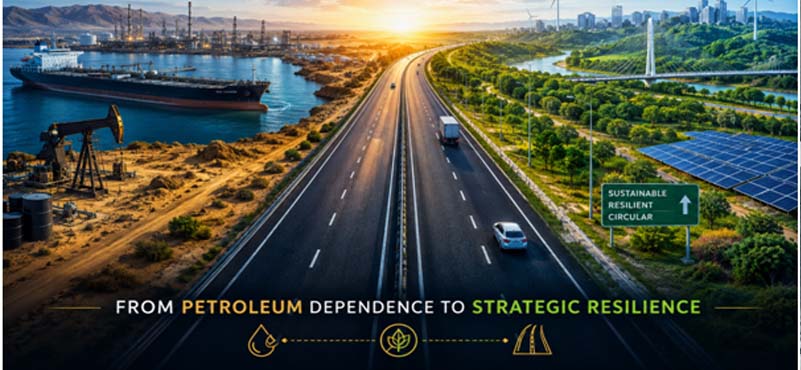
One of its most important products is bitumen. That black, viscous material binding together our roads rarely enters geopolitical conversations. Yet millions of tonnes are consumed every year in building and maintaining highways. As the world confronts energy insecurity, climate change and increasingly volatile supply chains, perhaps it is time to ask a deceptively simple question:
Can the world’s roads gradually move beyond black gold? The answer may lie in Green Bitumen.
The Black Gold Beneath Our Highways
Modern civilisation has been built, quite literally, on petroleum.
Bitumen has extraordinary qualities. It binds aggregates, provides waterproofing, withstands enormous traffic loads and can be engineered for different climatic and performance conditions. It is difficult to imagine contemporary road infrastructure without it. But conventional bitumen has a petroleum lineage. That creates two vulnerabilities.
- Environmental. Production, refining, heating, transportation and laying of conventional asphalt consume energy and generate emissions.
- Strategic. Whenever an essential infrastructure material is substantially dependent on a petroleum-based supply chain, fluctuations in crude prices, refining capacity, shipping costs and geopolitical disruptions can eventually affect infrastructure economics.
This does not mean petroleum will suddenly disappear from road construction. Nor is every alternative automatically greener. The more intelligent objective is progressive diversification.
If energy security means reducing excessive dependence on a single source of energy, infrastructure resilience should similarly mean reducing unnecessary dependence on a single virgin resource. Green Bitumen offers precisely such an opportunity.
What Exactly Is Green Bitumen?
Green Bitumen is not one magical new material waiting to replace conventional bitumen overnight. It is better understood as an ecosystem of technologies and materials that can reduce the petroleum intensity, energy consumption, carbon footprint and virgin-resource requirement of road construction.
This includes bio-based binders derived from renewable biological resources; reclaimed asphalt pavement, in which old roads become raw material for new roads; waste-derived modifiers; recycled plastics and rubber; rejuvenators that restore aged binders; and warm-mix technologies that allow asphalt to be produced and laid at substantially lower temperatures. The distinction is important.
Bio-bitumen is one pathway. Green Bitumen is the larger transition.
The objective is not simply to find a greener black liquid. It is to redesign the material ecosystem around the highway. That changes the question from “What can replace bitumen?” to a much more productive one:
“How can we need less virgin petroleum-derived material to build better roads?” That is a far more realistic—and potentially far more transformative—proposition.
From Waste to Road
Perhaps the most exciting dimension of Green Bitumen is that it turns the road into part of the circular economy.
The conventional economic model is linear: extract, manufacture, construct, use and discard. The emerging road model can be circular: recover, process, reuse, reconstruct and recover again.
An old pavement need not necessarily become waste. Reclaimed asphalt can be processed and incorporated into new pavement. Waste plastics and rubber can, under appropriate technologies and specifications, become useful modifiers. Biomass-derived materials can provide alternative sources for certain binder components. Rejuvenators can extend the useful life of aged asphalt.
The implications are much larger than carbon accounting.
A country that converts waste into infrastructure simultaneously addresses two problems: waste management and resource consumption.
For India, this is particularly significant. Our infrastructure ambitions are enormous. So are our waste streams. The ability to transform portions of those waste streams into certified, durable construction inputs could create an entirely new industrial ecosystem around recycling, processing, materials science and road construction.
The highway could become not merely a consumer of resources, but a large-scale recycler of resources. That is the essence of circular infrastructure.
The Temperature Revolution
There is another revolution taking place quietly inside asphalt plants: the battle against heat.
Conventional hot-mix asphalt requires substantial heating to manufacture, transport and lay the material. Every degree of unnecessary heat represents additional energy consumption. Warm-mix asphalt technologies seek to reduce these temperatures while maintaining the required workability and performance. The logic is beautifully simple:
Less heat → less energy → lower emissions.
But the strategic significance is larger. Reducing the energy intensity of road construction makes infrastructure less exposed to fuel-price volatility. It can reduce emissions without waiting for a completely new road material. And because the technology can potentially work alongside recycled and modified materials, it becomes part of a broader transition rather than a stand-alone solution.
This is where Green Bitumen becomes particularly interesting. The greenest road may not necessarily be the one made from an entirely new material. It may be the one that uses less material, less virgin petroleum, less heat, more recycled content and lasts longer. That is a much more sophisticated definition of sustainability.
India’s Strategic Opportunity
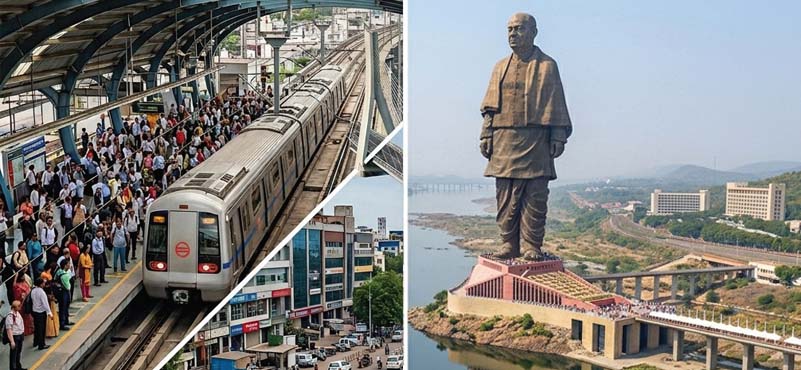
India has a unique opportunity because it is simultaneously building, expanding and modernising one of the world’s largest road networks.
This scale changes the equation. For a country constructing thousands of kilometres of highways, even a modest reduction in the material or energy intensity of each kilometre can produce enormous aggregate benefits. India also possesses another advantage: necessity.
We have vast quantities of municipal waste, plastic waste, construction and demolition waste and used materials searching for productive end uses. What appears to one sector as waste can become an input for another.
The convergence of highway construction, waste management, energy efficiency and materials innovation could therefore become a major strategic opportunity. But India should not approach this merely as a climate-compliance exercise. Green Bitumen can contribute to strategic autonomy.
Every tonne of recycled material replacing virgin material is a small reduction in resource dependence. Every reduction in production temperature is a small reduction in energy dependence. Every improvement in pavement life is a reduction in future material and maintenance demand.
Individually, these may appear incremental. At national scale, they become strategic.
Green Does Not Automatically Mean Better
There is, however, a danger in making sustainability fashionable: confusing intention with performance.
A material is not green merely because it contains recycled content. A road is not sustainable merely because it has a lower initial carbon footprint.
The real test is lifecycle performance. Does the pavement last longer? Does it withstand India’s extraordinary climatic diversity? Does it perform under heavy axle loads? Does the environmental benefit survive transportation and processing? Is the alternative material available at scale? Does it remain economical when supply chains mature? And, most importantly, does it perform consistently enough to justify widespread adoption?
These are not inconvenient questions. They are essential questions. India should resist both extremes: blindly defending conventional materials and blindly celebrating every alternative. The correct principle should be simple:
Green must be measured by performance, not advertised by colour.
Lifecycle carbon, durability, cost, resource efficiency, recyclability and resilience should become part of the same evaluation framework.
The future belongs not to the material that sounds the greenest, but to the material that performs the best across its entire lifecycle.
From Pilot Projects to a Green Highway Doctrine
The next step is to move beyond isolated demonstrations.
India needs a coherent framework for low-carbon road construction—one that brings together engineering standards, procurement, research, finance and environmental objectives.
Government procurement can become a powerful instrument. Performance-based specifications can encourage innovation without compromising road quality. Lifecycle carbon accounting can ensure that the environmental cost of materials is considered alongside their purchase price. Recycled-content targets, where technically appropriate, can create predictable demand. Research institutions and industry can work together on locally suitable materials rather than importing solutions designed for completely different conditions.
Most importantly, the objective should be performance-led innovation. The Green Highway of the future should be judged on five simultaneous parameters: Carbon. Circularity. Cost. Durability. Strategic resilience.
That could become India’s Green Highway Doctrine. It would recognise that road infrastructure is not merely a civil engineering activity. It is simultaneously an economic, environmental, industrial and strategic enterprise.
The transition would not happen overnight. Nor should it. But infrastructure has always been a long game. The decisions made today will determine the material and carbon intensity of the highways we will use for decades.
The Road Beyond Black Gold
The Middle East will continue to matter to the global economy. Oil will continue to matter to the world. Petroleum will not disappear simply because we have decided to become greener.
But strategic thinking has never been about waiting for one resource to disappear. It is about reducing vulnerability before vulnerability becomes a crisis. That is the larger promise of Green Bitumen.
It is not about declaring war on conventional bitumen. It is about gradually making our roads less dependent on virgin petroleum, less intensive in energy, more circular in material use and more resilient in their supply chains.
The road of tomorrow may contain yesterday’s road. It may contain recovered asphalt, recycled material, renewable feed-stocks and innovative binders. It may be produced at lower temperatures and designed around longer lifecycles. And, increasingly, its environmental performance may be measured with the same seriousness with which we measure its engineering performance.
The greatest transformation may therefore happen without most motorists ever noticing it. They will simply drive over it. And perhaps that is the most elegant definition of strategic infrastructure: technology that quietly reduces a nation’s vulnerabilities while making everyday life work better.
For two centuries, black gold helped build the modern world. The next century may belong to infrastructure that learns how to build beyond it.
The highway of the future will not merely carry the green transition. It will be built from it.
ABOUT THE AUTHOR

Lt Gen Rajeev Chaudhry (Retd) is a social observer and writes on contemporary national and international issues, strategic implications of infrastructure development towards national power, geo-moral dimension of international relations and leadership nuances in changing social construct.