Every year, lakhs of young Indians enter an examination that is far larger than an examination. UPSC represents a pathway from aspiration to public service and a mechanism for identifying citizens entrusted with responsibility. On 1 October 2026, the institution completes a century. The occasion is therefore not merely for recalling history; it is an opportunity to ask if the system designed for yesterday is adequately preparing the public servants required by India@2047.
A Century of Merit
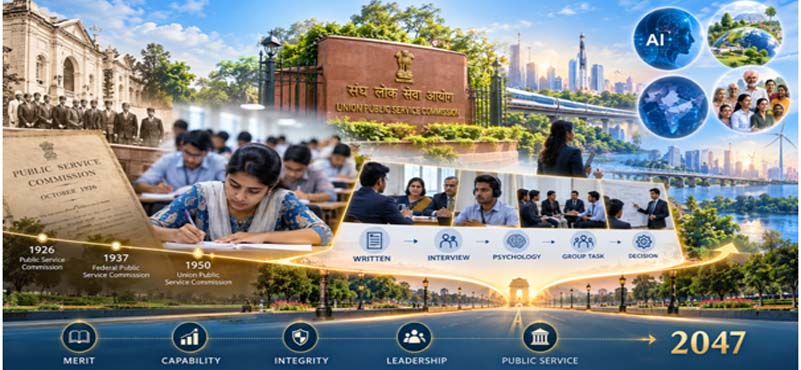
- Institutional Journey. The first Public Service Commission was established on 1 October 1926, following the Government of India Act, 1919 and the recommendations of the Lee Commission. It became the Federal Public Service Commission in 1937 and, with the adoption of the Constitution in 1950, became the Union Public Service Commission. Its constitutional safeguards gave it an institutional identity distinct from the executive.
- Nation-building Role. Independent India inherited an administrative system designed for colonial governance but transformed its purpose through democracy, development and constitutional accountability. UPSC became an important instrument in that transition. Over decades, recruitment widened opportunity across regions and social groups, while the Commission expanded its responsibilities across examinations and recruitment. Merit increasingly came to mean performance through a competitive process.
- The Enduring Compact. The greatest achievement of UPSC is institutional trust. Its credibility rests on impartiality, confidentiality, consistency and the perception that selection is governed by rules rather than influence. Yet institutions remain credible only when they evolve with society. India of 2047 will confront challenges scarcely imagined in 1926 or even 1950.
From Examination Reform to Selection Reform
- A Changing System. Since Independence, UPSC has steadily modernised its processes. The Civil Services Examination combines Preliminary screening, a substantial written Main examination and an Interview/Personality Test. The present framework makes written performance central, while the interview carries 275 marks. Digital applications, online systems, security measures and accessibility initiatives have changed the candidate experience.
- The Recent Phase. The last few years have accelerated the transition towards technology, security, transparency and candidate convenience. Under present Chairman Dr Ajay Kumar, the Commission has undertaken several visible initiatives. These include a revamped online application portal, expanded accessibility arrangements for candidates with benchmark disabilities, real-time face authentication during the 2026 Preliminary Examination, and, for the first time, publication of a provisional Preliminary answer key with a representation mechanism. The centenary year has also brought greater outreach, including the “My UPSC Interview” initiative.
- The Larger Question. These are important improvements to the examination process. But the next reform frontier is deeper. The question is whether the examination can adequately identify the qualities required of a public servant who may manage a district, lead a crisis response, resolve competing interests, protect constitutional values and take consequential decisions amid uncertainty.
2047 Imperative: Reimagining the Selection Process
- From Knowledge to Capability. A future civil servant will need knowledge, but knowledge alone will not suffice. Public administration increasingly demands judgement, ethical reasoning, empathy, communication, teamwork, resilience, technological literacy, strategic awareness and decisions under uncertainty. UPSC should therefore progressively move from asking only what a candidate knows towards assessing how a candidate thinks, behaves, decides and leads.
- Learn from SSB, without Copying it. The Armed Forces offer a useful institutional lesson. The Services Selection Board combines intelligence and screening tests with psychological assessment, group-testing tasks, personal interview and a conference, with different assessors observing the candidate from different perspectives. The lesson for UPSC is not to create a military-style selection system for civilians. It is to recognise the value of observing a person in multiple situations rather than judging capability predominantly through written performance.
- A Civil Services Assessment Centre. UPSC could pilot a multidimensional Civil Services Assessment Centre after the written stages. Candidates could continue to be tested for knowledge, but the final assessment could add structured exercises around public-service competencies. These could include a structured personal interview, validated psychometric assessment, situational-judgement tests, group problem-solving exercises, a leadership task and practical work samples.
- Mind, Word and Action. The assessment could examine three dimensions. “Mind” would test reasoning, adaptability and responses to psychological and ethical dilemmas. “Word” would examine communication, listening, persuasion and the ability to explain difficult decisions. “Action” would assess behaviour in group tasks, prioritisation, teamwork and leadership under pressure. Multiple trained assessors could observe these dimensions independently before reaching a collective assessment.
- Real Administrative Problems. Candidates should face realistic, unfamiliar situations rather than rehearsed questions. A simulated district flood, cyber-attack, communal tension, infrastructure failure or public-health emergency could require them to analyse information, identify priorities, allocate limited resources, communicate with stakeholders and defend a decision. Such exercises would test what an officer might actually do, not merely what an aspirant has learnt to write.
- Protecting Fairness. A multidimensional system must not become a personality contest. Standardised competencies, structured scoring rubrics, trained and calibrated assessors, multiple independent observations and periodic validation would be essential. No single interviewer should determine a candidate’s future. The system should also be audited for reliability, transparency and demographic effects.
- Breaking the Coaching Advantage. Coaching can improve knowledge and examination technique, but selection should not become a contest in reproducing model answers. Dynamic situational exercises, unfamiliar problems and adaptive assessments could reduce the value of rehearsed responses. The objective would be to ensure that coaching cannot manufacture integrity, judgement, teamwork or leadership.
- AI and the Future Candidate. Artificial intelligence should strengthen the system, not replace human accountability. It can assist in question generation, anomaly detection, scheduling, analytics and quality assurance. UPSC should also assess whether candidates can use AI critically, verify its outputs, recognise bias and retain responsibility for decisions. The future administrator must be AI-enabled but never AI-dependent.
- Pilot, Validate, Scale. Such reform should begin with a controlled pilot rather than wholesale disruption. For three years, a representative cohort could undergo the proposed assessment alongside the existing process. UPSC could examine predictive validity, reliability, candidate feedback and feasibility before deciding what becomes permanent. By 2030, the Commission could publish a Civil Services Competency Framework for 2047 and align selection with it.
- A new Philosophy of Selection. The shift would be simple but profound: first define the public servant India needs, then design the process capable of finding such people. The written examination would remain important, but become one component of evidence-based assessment.
From Testing Aspirants to Selecting Public-Service Leaders
UPSC’s first century established the credibility of merit-based public recruitment. Its next century must ensure that merit remains relevant to a changing India. The civil servant of 2047 will operate amid technological disruption, geopolitical competition, climate stress, social complexity and rising citizen expectations. Selection must therefore identify not merely knowledge, but judgement; not merely expression, but communication; not merely ambition, but integrity; and not merely individual excellence, but the ability to lead and serve.
The centenary should become a moment of institutional imagination. UPSC@100 should mark the beginning of a journey from examination to assessment, from knowledge to capability and from selecting candidates to discovering public-service leaders capable of helping build India@2047.
ABOUT THE AUTHOR
Lt Gen Rajeev Chaudhry (Retd) is a social observer and writes on contemporary national and international issues, military affairs, strategic infrastructure, leadership nuances, governance and the changing relationship between the soldier, the State and society.